Key takeaways
- Nonstick-coated aluminum: easiest for beginners and requires little oil, but avoid metal utensils and abrasive cleaning.
- Cast aluminum: better thermal mass and often more even recovery between tortillas, with greater weight.
- Uncoated cast iron: durable and naturally nonstick when seasoned, but uncommon in compact electric models and more demanding to maintain.
- Removable plates: easier to clean, although the hinge and electrical connections can make the appliance more expensive.
The best electric tortilla makers are the ones that match your preferred tortilla diameter and thickness while delivering even heat without demanding more counter space than you can spare. For most home cooks, a 10-inch press with nonstick plates, adjustable pressure, and roughly 1,000–1,500 watts is the most versatile choice.
Best electric tortilla makers at a glance
| Best for | Recommended spec or model type | Typical tortilla size | Typical power | Main advantage | Main limitation |
|---|---|---|---|---|---|
| Everyday family cooking | Adjustable 10-inch electric press | 8–10 inches | 1,000–1,500 W | Good balance of speed and versatility | Usually bulky to store |
| Small kitchens | Compact 8-inch electric press | 6–8 inches | 700–1,000 W | Lower storage and power demands | Less suitable for burrito-size tortillas |
| Occasional users | Basic nonstick electric tortilla maker | 6–8 inches | 750–1,200 W | Simple operation and usually lower cost | Less control over thickness |
| High-volume cooking | Heavy-duty commercial electric press | 10–14 inches | 1,500–2,000+ W | Faster recovery between tortillas | More expensive, heavier, and harder to store |
What to look for before buying
Tortilla diameter
Diameter determines what you can cook more than almost any other specification. A 6- or 8-inch plate is well suited to tacos, quesadillas, and small corn tortillas. A 10-inch plate is more flexible: it can make standard taco tortillas while also producing tortillas large enough for burritos and wraps. Models with 12-inch or larger plates are useful for commercial-style cooking, but they need more dough, more counter space, and a larger storage location.

8" Electric Tortilla Press Maker Tortilladora Gonzalez Made in Mexico
Included for 'Best Electric Tortilla Makers for Easy Cooking' as a relevant option in this category; details come from the product listing.
View on Amazon
VEVOR Electric Tortilla Maker, 5.5 Inch Diameter Automatic Corn Tortilla Making Machine with Non-Stick Coating, Electric Chapatti Machine Suitable for Produce Sopes Gorditas Roti Pita Tortilla Pizza
Included for 'Best Electric Tortilla Makers for Easy Cooking' as a relevant option in this category; details come from the product listing.
View on Amazon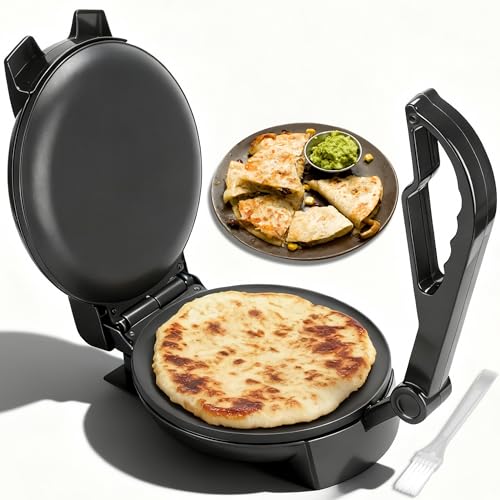
FineMade Compact Roti Maker, 8'' Electric Tortilla Maker Machine, Maquina Para Hacer Tortillas, Crepe Maker,Electric Tortilla Press, Prensa Para Tortillas, Recipe Included, Black
Included for 'Best Electric Tortilla Makers for Easy Cooking' because the listing specifies 8'' Electric Tortilla Maker Machine and Maquina Para Hacer Tortillas, details this guide uses to compare options.
View on Amazon
Westinghouse WKRM293 Tortilla and Roti Maker - Non Stick Coating & Adjustable Thermostat 120 Volt 60 Hz 1000 Watt
Included for 'Best Electric Tortilla Makers for Easy Cooking' as a relevant option in this category; details come from the product listing.
View on AmazonCheck whether the stated diameter refers to the plate or the finished tortilla. Dough can contract slightly during pressing, and the usable cooking area may be smaller than the outside measurement.
Plate material and coating
Most home electric tortilla makers use cast aluminum or stamped aluminum plates with a nonstick coating. Aluminum heats quickly and keeps the appliance relatively light. Cast plates are usually thicker and can hold heat better when several tortillas are cooked in succession, but they make the appliance heavier.
- Nonstick-coated aluminum: easiest for beginners and requires little oil, but avoid metal utensils and abrasive cleaning.
- Cast aluminum: better thermal mass and often more even recovery between tortillas, with greater weight.
- Uncoated cast iron: durable and naturally nonstick when seasoned, but uncommon in compact electric models and more demanding to maintain.
- Removable plates: easier to clean, although the hinge and electrical connections can make the appliance more expensive.
Look for a smooth plate surface without deep ridges. Ridges can leave attractive grill marks, but they may make thin tortillas cook unevenly and can complicate cleaning.
Heat consistency
Maximum wattage does not guarantee uniform cooking. A well-designed 1,000-watt appliance can produce more consistent tortillas than a poorly insulated 1,500-watt model. Useful features include a thermostat, a preheat indicator, thick plates, and insulation around the hinge.
For corn tortillas, a useful working surface is generally around 375–450°F, depending on dough hydration and desired browning. Flour tortillas often need a slightly shorter cooking time because their added fat and gluten structure can make them brown quickly. Adjustable temperature control is valuable if you make both types.
Pressing thickness and hinge control
Some electric tortilla makers are primarily griddles: they heat the dough but do not provide much mechanical pressure. Others combine a heated hinge with a pressing action. The second type is faster for beginners, but it can flatten tortillas too aggressively if the hinge closes to a fixed stop.
Choose a model with an adjustable thickness dial, spacer, or floating hinge if you want thicker tortillas, gorditas, or flatbreads. If the appliance has no thickness adjustment, control the result by using a smaller dough ball and stopping the lid before it reaches maximum closure. Do not force the hinge, because excessive pressure can squeeze moisture from the dough and produce stiff tortillas.
Cooking speed and recovery
A tortilla maker’s real speed depends on three intervals: preheating, cooking, and recovery after the lid opens. A typical home appliance may need 5–10 minutes to preheat and about 1–3 minutes per tortilla, although dough temperature, thickness, and browning preference change those figures.
For a family dinner, the difference between one tortilla every two minutes and one every three minutes is noticeable. Eight tortillas at two minutes each require about 16 minutes of cooking time; at three minutes each, the same batch requires about 24 minutes. That calculation does not include preheating, but it shows why plate recovery matters more than a very high advertised peak temperature.
Decision matrix: which type fits your kitchen?
| Your situation | Choose | Why | Avoid |
|---|---|---|---|
| You make tacos for two people | 8-inch, 700–1,000 W model | Compact plates are sufficient and preheat quickly | 12-inch commercial units |
| You make burritos or large wraps | 10–12-inch model with adjustable thickness | Provides enough surface area and better control | Fixed 6-inch presses |
| You cook several dozen tortillas | Thick cast-aluminum plates, 1,500 W or more | Better heat retention and recovery | Very lightweight compact appliances |
| You have limited cabinet space | Vertical-storage model with a locking latch | Can stand upright and keep the lid closed | Wide commercial presses with exposed handles |
| You make corn and flour tortillas | Adjustable thermostat and floating hinge | Different doughs need different heat and pressure | Single-temperature, fixed-pressure models |
Named home models and realistic alternatives
CucinaPro electric tortilla maker
CucinaPro’s electric tortilla maker line is aimed at home cooks who want a dedicated appliance rather than a stovetop press. The commonly sold 1443 model is associated with a roughly 10-inch format, making it more versatile than small taco-focused presses. It is a sensible choice when diameter matters, but check the current plate, thermostat, and storage details before purchase because product configurations can vary by market and production revision.
Brentwood TS-119S tortilla maker
The Brentwood TS-119S is a compact home tortilla maker designed for smaller tortillas and straightforward operation. It is better suited to tacos, snacks, and occasional batches than to large burrito tortillas. Its appeal is the smaller footprint and simpler controls; its trade-off is limited diameter and less flexibility for unusually thick dough.
Commercial electric tortilla presses
Commercial units from specialist food-service manufacturers can offer larger plates, sturdier hinges, and stronger heat recovery. They make sense for catering, a food stall, or a household that routinely cooks large batches. For occasional home use, their weight, price, and storage demands usually outweigh the speed benefit.
If a named model does not clearly state plate diameter, temperature control, thickness adjustment, and electrical requirements, a spec-based alternative is safer than choosing by appearance alone.
Storage and electrical requirements
Measure the appliance with its handle and power cord included. A 10-inch press may occupy approximately 12–16 inches of counter width once the hinge and handle are accounted for. Vertical storage is useful, but only if the appliance has a secure latch and a stable base. Let the plates cool completely before storing to protect coatings and prevent trapped moisture.
Power planning is simple but important. A 1,200-watt appliance running for 20 minutes consumes:
1,200 W × one-third of an hour = 400 watt-hours, or 0.4 kWh.
Actual consumption is often lower because the thermostat cycles the heating elements after preheating. However, avoid operating a high-wattage press on an overloaded extension cord or sharing a weak circuit with a kettle, toaster oven, or microwave. Use the manufacturer’s required voltage and a properly rated outlet.
How to get thinner, softer tortillas
- Preheat fully. Wait for the ready indicator, then give the plates another minute if the first tortilla cooks pale. A partially heated plate causes sticking and uneven thickness.
- Use consistent dough portions. Weighing dough balls is more reliable than estimating. For small tortillas, start around 25–35 grams; for 10-inch tortillas, try roughly 45–60 grams and adjust for the recipe.
- Line the plates if needed. Use a cut piece of food-safe plastic or parchment according to the appliance instructions. This helps prevent sticking, but keep the material away from exposed heating elements.
- Press briefly, then check. If the tortilla is too thin or dry, reduce pressure or use more dough. If it is thick in the center, press slightly longer rather than forcing the hinge.
- Cook until the surface changes, not until it becomes hard. Remove the tortilla when it is set and lightly browned, then keep it covered in a towel or tortilla warmer so steam preserves softness.
Final buying advice
For most households, the best electric tortilla makers are adjustable 10-inch models with nonstick or cast-aluminum plates, a thermostat, a floating hinge, and a locking mechanism for storage. Choose an 8-inch model when tacos and cabinet space are the priorities. Move to a heavy-duty 12-inch or larger press only when batch size justifies the extra cost, weight, and electrical demand. The most useful specifications are not the highest wattage or the boldest temperature claim; they are the plate size, heat recovery, pressure control, cleaning design, and whether the appliance fits your actual cooking routine.