Our Top Picks
A LiPo charger is not a place to improvise. Unlike a phone charger, it must read the voltage of each cell in a pack, balance them, and stop at the right moment, because a mismatch between charger settings and battery chemistry can damage the pack or start a fire. Choosing one therefore starts with two facts about your batteries: how many cells they have (the S count) and how much current they can accept, and only then with convenience features such as dual outputs or a built-in power supply.
This guide is for RC car, drone, and plane hobbyists comparing eight chargers, from a pocket-sized unit rated for 1S to 3S packs to dual-channel models with hundreds of watts of capacity. The notes below stick to what each listing states: supported chemistries, cell counts, charge current, power rating, and connectors. As you shop in 2026, treat every claim about speed as secondary to the question of whether the unit balances your specific pack and whether you have a safe place to charge it.
Quick Picks
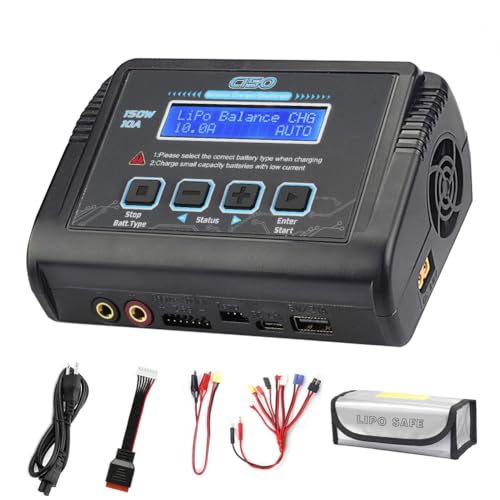
LiPo Battery Charger, 150W 10A Balance Fast Charger for RC Car Drone | RC Battery Charger Discharger for 1S-6S LiPo/Li-ion/Life/LiHV 1-15S NiMH/NiCD 2-20V PB Smart Batteries
One of the consumer electronics options compared in this guide.
View on Amazon
LiPo Battery Charger Dual 10A RC Fast Balance Battery Charger Discharger | RC Car Drone Chargers for 1S-6S LiPo Li-ion Life LiHV 1S-15S NiCd NiMH 2-20V PB Smart Batteries
One of the consumer electronics options compared in this guide.
View on Amazon
6A Lipo Battery Charger, 1S-6S Balanced Charger Discharger, 1-6S Lipo Li-ion NiMH NiCD Li-Fe Battery with Tamiya XT60 Deans Futaba Connector
One of the consumer electronics options compared in this guide.
View on Amazon
B6 Lipo Battery Charger Newly Upgraded 80W Mini Balance RC Battery Charger/Discharger with Power Supply for Lipo/Li-ion/Life(1-6s) NiMh/NiCd (1-15s) Pb RC Lipo Battery Charger with LCD Display
One of the consumer electronics options compared in this guide.
View on Amazon
Gens Ace Lipo Battery Charger IMARS D300 G-Tech Series Smart Dual Lipo Charger 16A AC 300W DC 700W Lipo Charge(White Upgrade)
One of the consumer electronics options compared in this guide.
View on Amazon
OVONIC D15 Dual LiPo Charger AC 15W 1.2A for 1S-3S (3.7V, 7.4V, 11.1V) LiPo RC Batteries
One of the consumer electronics options compared in this guide.
View on Amazon
OVONIC X1 Dual RC LiPo Battery Balance Charger for 1S-6S LiPo, LiHV, Life, NiMH, NiCd Batteries, AC 200W / DC 600W 15A Smart Fast Charger with Sync Charging Mode
One of the consumer electronics options compared in this guide.
View on Amazon| Product | Best for | Key spec from the title |
|---|---|---|
| 150W 10A LiPo balance charger | General RC use with mid-size packs | 150W, 10A, 1S-6S LiPo, discharge function |
| Dual 10A RC charger | Two packs at the same time | Dual 10A, 1S-6S LiPo, charger and discharger |
| 6A LiPo charger with connectors | Mixed plug types | 6A, 1S-6S, Tamiya, XT60, Deans, Futaba |
| B6 80W mini charger | Simple, portable hobby charging | 80W, 1S-6S LiPo, power supply included |
| Gens Ace IMARS D300 | High-power dual charging | 16A, AC 300W, DC 700W |
| OVONIC D15 | Small packs from 1S to 3S | AC 15W, 1.2A, 1S-3S dual |
| B6 80W balance charger | Entry-level multi-chemistry charging | 80W, discharger, NiMH/NiCd 1-15S |
| OVONIC X1 | Fast dual charging up to 6S | 15A, AC 200W, DC 600W, sync charge |
How to Choose
Match cell count and chemistry first
The S number is the count of cells in series, and every cell needs its own voltage monitoring. A 3S pack is 11.1V nominal and a 6S pack is 22.2V, so a charger limited to 1S-3S, like the OVONIC D15, cannot handle a 4S drone pack, while 1S-6S models cover most hobby packs. Confirm that your chemistry is listed: LiPo, Li-ion, LiFe, and LiHV all charge to different voltages, and selecting the wrong profile is the most common mistake. NiMH and NiCd support is a bonus for older RC gear.
Power and charge current
Charge current is the amps flowing into the pack, and wattage caps how fast you can go as cell count rises. A 6A unit charging a 6S pack may hit its watt limit before it reaches 6A, so read the fine print. A common safe rate is around 1C, meaning the pack capacity in amps, unless the battery maker allows more. Chargers with 10A, 15A, or 16A ratings help with large packs, but bigger numbers only matter if your batteries are large enough to use them.
Single or dual channel, and AC or DC input
A single-channel charger charges one pack at a time, which is fine for casual flying. A dual-channel unit like the Dual 10A, IMARS D300, or OVONIC X1 lets you charge two packs side by side and saves time at the field. Check the input: models listing AC and DC wattage, such as 300W AC and 700W DC, can run from the wall or a car or bench supply, but higher DC power needs a source that can deliver it. Units described as including a power supply are more convenient for beginners.
Connectors, discharge, and safety habits
Plug types vary between XT60, Tamiya, Deans, and others. A charger listing several connectors saves adapters, but you still need a correct balance lead for your pack. A discharge function helps you bring a pack to storage voltage when you will not fly for weeks. Whatever you buy, charge on a non-flammable surface, use a fire-safe bag, and never leave a charging pack unattended. Budget chargers sometimes skimp on documentation and protections, so read the manual before the first charge.
The 8 Best Options
150W 10A LiPo Balance Charger
This unit is rated at 150W and 10A as a balance fast charger and discharger for RC car and drone batteries, supporting 1S-6S LiPo, Li-ion, LiFe, and LiHV plus NiMH and NiCd. It covers most hobby needs in one box and suits flyers who own packs of different chemistries, such as a LiPo for the quad and an older NiMH pack for a crawler. The discharge function is also useful before storage, when packs should rest at a lower voltage rather than sit fully charged.
- Strength: wide chemistry support from LiPo to NiMH.
- Strength: charge and discharge functions in a single unit.
- Trade-off: single-channel, so packs charge one after another.
Skip it if you routinely charge two large packs between flights.
Dual 10A RC Fast Balance Charger
A dual-output charger and discharger rated at 10A, supporting 1S-6S LiPo, Li-ion, LiFe, and LiHV, and wider ranges for NiCd and NiMH. Two channels mean one pack can charge while another is being discharged or waiting its turn, which speeds up a flying day. Racers and bashers who swap batteries every few minutes will notice the difference most.
- Strength: dual channels cut waiting time.
- Strength: broad chemistry support for RC cars and drones.
- Trade-off: the listing gives no total wattage in the visible text, so check how power is shared.
Skip it if you only own a single small pack and want the simplest unit.
6A LiPo Charger with Connector Set
This is a 6A balanced charger and discharger for 1S-6S LiPo, Li-ion, NiMH, NiCd, and Li-Fe, advertised with Tamiya, XT60, Deans, and Futaba connectors. The connector variety is the highlight for hobbyists who own different brands of cars and planes, and it spares you from soldering adapters for every new battery. Beginners may also like that the current is modest, which is gentler on small and mid-size packs.
- Strength: multiple connector types reduce the need for adapters.
- Strength: balanced charging and discharging at 6A.
- Trade-off: 6A is lower than the 10A and 15A models.
Skip it if you have large packs and want the fastest charge.
B6 80W Mini Balance Charger
The upgraded B6 is an 80W mini charger and discharger that comes with a power supply, handling LiPo, Li-ion, and LiFe from 1-6S and NiMH or NiCd up to 15S. It is a popular style of hobby charger: small, inexpensive, and enough for beginner and mid-size packs. Anyone who flies a few times a week and charges one pack at a time will find the capability adequate, and the bundled supply avoids hunting for a compatible power source.
- Strength: power supply is included, so it works out of the box.
- Strength: compact and easy to carry to the field.
- Trade-off: 80W limits charge speed on larger packs.
Skip it if you need fast turnaround on big 6S packs.
Gens Ace IMARS D300 G-Tech
A smart dual LiPo charger rated at 16A, with 300W on AC and 700W on DC, in a white upgraded version. It is the high-power option for enthusiasts who own several large packs and want to charge two at once at speed, such as competitive racers or owners of large multirotors and big-scale cars. The DC rating suggests it can be powered from a bench supply or battery at the field, provided that source can deliver the current.
- Strength: the highest listed power in the group, particularly on DC.
- Strength: smart dual-channel design for two packs.
- Trade-off: it is likely overkill for small drones and cars.
Skip it if your packs are small or your budget is limited.
OVONIC D15 Dual LiPo Charger
A small dual charger rated at AC 15W and 1.2A for 1S-3S packs at 3.7V, 7.4V, and 11.1V. Its low power makes it a gentle, simple choice for small RC batteries, such as those used on compact models and small indoor flyers. For packs this small, a gentle charge current is arguably the right match, since pushing hard on a tiny battery can shorten its life.
- Strength: dual output for small 1S-3S packs.
- Strength: low current is appropriate for little batteries.
- Trade-off: it cannot charge 4S or larger packs.
Skip it if any of your batteries have more than three cells.
B6 Balance Charger 80W
Another 80W B6-style unit with a discharger for NiMH and NiCd from 1-15S and LiPo, Li-ion, and LiFe from 1-6S, aimed at RC hobby batteries. It is an entry-level generalist for people who own mixed packs, including older nickel batteries from a previous hobby. It is a sensible second charger to keep in a travel bag, though it does not try to compete with the dual-channel models.
- Strength: supports both lithium and nickel chemistries.
- Strength: familiar B6 form factor with discharge function.
- Trade-off: only 80W, so large packs charge slowly.
Skip it if you want dual outputs or high current.
OVONIC X1 Dual Charger
A dual-channel charger for 1S-6S LiPo, LiHV, LiFe, NiMH, and NiCd, rated at AC 200W and DC 600W with 15A and sync charging. It sits between the basic units and the highest-power chargers, and is aimed at hobbyists with larger packs who still want something more approachable than the top-end charger. The sync charge mention suggests it can treat two packs together, which helps when you run pairs of batteries in one vehicle.
- Strength: 15A with dual channels and a sync charge option.
- Strength: strong DC rating for field use.
- Trade-off: more complex than the basic B6 style.
Skip it if you only need a simple charger for small packs.
Which One Fits Your Situation
You fly a small whoop or micro drone
The OVONIC D15 handles 1S-3S packs gently with two outputs, so it is a better fit than a high-power unit.
You are just starting out in RC
The B6 80W mini with a power supply is a simple, low-cost starting point for common packs.
You race or fly with several large packs
The OVONIC X1 or Gens Ace IMARS D300 can charge two packs at once at high current, with the IMARS being the high-power top end.
You own cars, planes, and different plugs
The 6A charger with Tamiya, XT60, Deans, and Futaba connectors cuts down on adapters.
Common Mistakes
- Selecting the wrong chemistry or cell count on the charger screen.
- Skipping the balance lead and charging a multi-cell pack without balancing.
- Charging at a rate above what the battery maker allows.
- Leaving a pack charging unattended or on a flammable surface.
- Buying a high-wattage dual charger when a small pack would charge fine on a gentle unit.
Related guides
- Solar Chargers For Camping And Hiking
- Retro Game Storage Cases And Displays
- How To Clean Retro Game Cartridges Safely
Frequently Asked Questions
What does 1S-6S mean?
It is the number of cells in series the charger supports. Check your pack’s label and choose a charger that covers it.
Is a higher wattage always better?
No. Higher wattage helps with large packs and fast charging but does nothing for small batteries. Match the unit to the packs you own.
Do I need a balance charger?
Yes for multi-cell LiPo packs. Balancing keeps each cell at the same voltage, which improves safety and pack life.
Can I use these for other batteries?
Many list NiMH, NiCd, Li-ion, LiFe, and LiHV, but always select the right profile and confirm the cell count before starting.