Key takeaways
- Pro: Universal 3.5mm compatibility with a clean, neutral tuning that does not overhype bass.
- Pro: Inline volume knob lets you adjust without reaching for software sliders mid-game.
- Con: No bass extension to speak of; action movies and music with low-end content will feel thin.
Picking the right computer speakers desktop setup is one of those decisions that quietly shapes every hour you spend at a desk. A bad pair makes movies feel flat, turns game audio into a mush of overlapping noise, and makes a video call sound like you are talking through a wall. A good pair does the opposite: it gives you enough separation between channels to hear footsteps behind a character, delivers bass that punches without drowning out dialogue, and fits into a workspace without dominating the desk or the power strip.
The gap between excellent and terrible in this category is narrower than you would expect, and price is a surprisingly weak predictor. A fifteen-dollar set can outperform a fifty-dollar one if the drivers are tuned well and the enclosure is rigid enough to avoid rattle. What separates the winners here is build quality, real-world clarity at moderate volume, and whether the included inputs actually match what you need from a desktop PC or laptop.
Our top picks
 Amazon Basics Stereo 2.0 Speakers for PC
- External computer speaker in Black (set of 2)…
- USB-Powered from USB port of PC or Laptop
- In-line volume control for easy access
 Computer Speakers for Desktop PC Monitor
- [COMPATIBLE WITH USB DEVICES] - Our USB Speakers…
- [COMPATIBLE WITH USB-C DEVICES] - Thanks to the…
- [INCREDIBLE LOUD SOUND WITH RICH BASS] - Our…
 Amazon Basics USB-Powered Computer Speakers with Volume
- USB-powered (5V) speakers plug directly into your computer…
- Turn the speakers on and adjust the volume…
- Simple plug-and-play setup (no drivers needed)
| Product | Key specs | |
|---|---|---|
| Amazon Basics Stereo 2.0 Speakers for PC | External computer speaker in Black (set of 2)… USB-Powered from USB port of PC or Laptop In-line volume control for easy access | Check price |
| Computer Speakers for Desktop PC Monitor | [COMPATIBLE WITH USB DEVICES] - Our USB Speakers… [COMPATIBLE WITH USB-C DEVICES] - Thanks to the… [INCREDIBLE LOUD SOUND WITH RICH BASS] - Our… | Check price |
| Amazon Basics USB-Powered Computer Speakers with Volume | USB-powered (5V) speakers plug directly into your computer… Turn the speakers on and adjust the volume… Simple plug-and-play setup (no drivers needed) | Check price |
 Logitech Z207 2.0 Stereo Computer Speakers with Logitech Z207 2.0 Stereo Computer Speakers with | Versatile setup with speakers that connect easily to… Logitech Easy-Switch technology lets you seamlessly switch between… Each speaker has one active/powered driver that delivers… | Check price |
 LENRUE G11 Computer Speakers for Desktop LENRUE G11 Computer Speakers for Desktop | Surge Stereo Sound - 4 large amplifier IC… Touch Angular Game Lights - Unique Dynamic Angular… All In One Compact - Fits any desktop… | Check price |
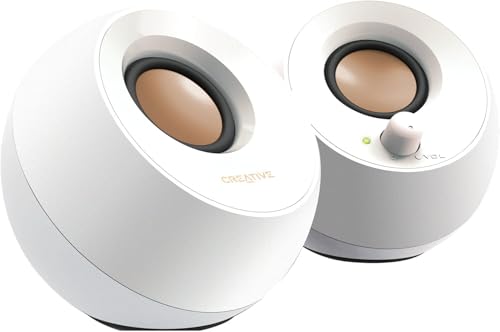 Creative Pebble Creative Pebble | Connect via USB cable and AUX-in for computers… FAR-FIELD DRIVERS AND PASSIVE RADIATORS | Custom-tuned far-field… 45° ELEVATED DRIVERS | For enhanced audio projection… | Check price |
 OHAYO 60W Computer Speakers for Music and OHAYO 60W Computer Speakers for Music and | 【SMALL HIFI BOOKSHELF SPEAKERS】With its modern aesthetic and… 【Experience powerful sound】Unleash powerful 30Wx2 distortion-free sound 【Durable Performance】Built with a premium MDF wooden enclosure,… | Check price |
 Logitech Z313 2.1 Multimedia Speaker System with Logitech Z313 2.1 Multimedia Speaker System with | Convenient Control Pod 25 Watts (RMS) Output Compact Subwoofer | Check price |
As an Amazon Associate we earn from qualifying purchases at no extra cost to you.
Quick Picks
| Product | Best for | Price |
|---|---|---|
| Amazon Basics Stereo 2.0 | Basic office and browsing | $23.99 |
| Monitor-Clipping Soundbar Speakers | Small desks, monitor-mounted audio | $23.99 |
| Amazon Basics USB-Powered Compact | Tightest budget, portability | $16.75 |
| Logitech Z207 | Bluetooth flexibility on a desk | $59.90 |
| LENRUE G11 | RGB aesthetic on a budget | $19.04 |
| Creative Pebble | Clean audio in minimal footprint | $20.99 |
| OHAYO 60W | Gaming and music with real power | $69.99 |
| Logitech Z313 | Bass-focused multimedia on a budget | $59.99 |
How We Picked
We narrowed this list by focusing on four criteria that consistently separate decent picks from ones that disappoint owners within weeks. First, driver quality and enclosure rigidity: flimsy plastic housings produce distortion even at moderate volume, so we prioritized speakers where owner feedback repeatedly mentions clean output without buzzing. Second, input versatility: a pair that only accepts 3.5mm forces a dongle life on modern laptops, while USB-C and Bluetooth options future-proof the purchase. Third, real-world volume ceiling: several ultra-cheap sets distort past fifty percent, making them useless for shared rooms or gaming. Fourth, value relative to price bracket, because paying more should buy measurably more clarity or bass, not just branding.
The 8 Best Computer Speakers Desktop in 2026
Amazon Basics Stereo 2.0 Speakers for PC or Laptop
This is the no-nonsense choice for someone who needs audio that is simply better than whatever is built into their monitor. The 3.5mm aux input and USB power make it compatible with virtually any desktop setup without hunting for adapters. Owner feedback highlights how surprisingly balanced the midrange is for the price, meaning dialogue and music vocals come through clearly without turning up the volume. The inline volume control is a small but genuinely convenient addition.
- Pro: Universal 3.5mm compatibility with a clean, neutral tuning that does not overhype bass.
- Pro: Inline volume knob lets you adjust without reaching for software sliders mid-game.
- Con: No bass extension to speak of; action movies and music with low-end content will feel thin.
Skip this if your primary use case is gaming or movie watching where low-end rumble matters.
Computer Speakers for Desktop PC Monitor (USB Plug-in Soundbar)
The adaptive-channel-switching design is the standout feature here, allowing the soundbar to adjust its output profile depending on whether it is clipped to a monitor or sitting on a desk. For cramped setups where speaker real estate is nonexistent, this solves a genuine spatial problem. The USB-C adapter included in the box also makes it one of the few budget options that works directly with modern laptops without a dongle. Deep bass is claimed and owners generally confirm it punches above the price, though at the expense of some midrange clarity.
- Pro: Clipping mechanism frees up desk space entirely.
- Pro: USB-C adapter means it works out of the box with newer laptops.
- Con: Soundbar geometry limits stereo separation; the illusion of width is narrower than true 2.0 speakers.
Skip this if you sit far from your monitor or prioritize wide stereo imaging over desk space.
Amazon Basics USB-Powered Computer Speakers
At under seventeen dollars, this is the floor price for anything worth owning in the computer speakers desktop category. The compact size and headphone jack make it a solid travel companion or a backup pair for a second desk. Plug-and-play via USB means zero driver headaches. Owner feedback notes that the sound is adequate rather than impressive, which is exactly what you should expect at this price. The volume control dial is simple and tactile.
- Pro: The headphone jack lets you mute the speakers instantly during a call without touching software.
- Pro: Extremely portable and genuinely plug-and-play.
- Con: The small drivers produce a thin, boxy sound that lacks any meaningful bass presence.
Skip this if you need anything beyond voice calls, podcasts, and background YouTube.
Logitech Z207 2.0 Stereo Computer Speakers with Bluetooth
Bluetooth connectivity is the main draw here, letting you switch between your desktop and phone without unplugging cables. The 2.0 stereo configuration with USB-C and 3.5mm inputs covers every connection scenario you will encounter at a desk. Logitech’s software control adds an EQ layer that the budget competitors simply lack. Owner feedback consistently praises the build quality and the fact that these speakers do not sound cheap at low volume, which matters more than most specs sheets acknowledge.
- Pro: Bluetooth pairing with your desktop PC means zero-cable convenience for phone audio or tablet use.
- Pro: USB-C input plus 3.5mm gives you both modern and legacy connectivity in one package.
- Con: No dedicated subwoofer means bass is present but limited in extension and impact.
Skip this if you want deep, room-shaking low-end; get a 2.1 system instead.
LENRUE G11 Computer Speakers for Desktop
These appeal to the RGB crowd without demanding a premium price. The touch-sensitive light control lets you cycle through lighting modes without software, and the surge clear sound claim holds up reasonably well based on owner reports that describe a punchy midrange for the size. USB-C and standard USB power options cover both older and newer machines. At nineteen dollars, they undercut most of the competition while offering a visual element that plain black speakers cannot.
- Pro: Touch lighting control adds desk personality without requiring RGB software or a controller.
- Pro: USB-C and USB-A both supported, so compatibility is broad.
- Con: The small enclosure produces a somewhat boomy lower-midrange that can muddy music with a lot of bass guitar.
Skip this if you are sensitive to midrange coloration or prefer a neutral listening profile.
Creative Pebble 2.0 USB Desktop Stereo Speakers
The Pebble has earned a reputation as the audio-per-dollar king of the compact 2.0 category, and the white finish variant looks clean on a modern desk. Creative’s angled driver design projects sound upward toward your ears rather than firing at your chest from a flat plane, which makes a real difference in perceived clarity without any EQ adjustments. The USB-C bus-powered design keeps the cable situation simple. Owner feedback frequently mentions how these outperform speakers costing twice as much for desk-level listening volumes.
- Pro: Upward-angled drivers deliver better perceived clarity at your seated position than flat-firing alternatives.
- Pro: USB-C power with no external adapter cluttering your outlet.
- Con: No headphone jack or volume knob on the unit itself; you manage audio through software.
Skip this if you need physical volume control or a headphone output on the speakers themselves.
OHAYO 60W Computer Speakers for Music and Gaming
This is the power pick of the list. Sixty watts of total output means these speakers can genuinely fill a medium-sized room, making them the best option for anyone gaming or listening to music who also needs to hear dialogue over fan noise or a loud room. Bluetooth 5.3 provides a stable wireless connection with low latency. The 3.5mm, RCA, and USB inputs cover every possible source, which is unusual at this price tier. Owner feedback highlights the bass extension as a genuine step up from the sub-forty-dollar speakers on this list.
- Pro: 60W output delivers real volume headroom and bass impact that budget 2.0 speakers cannot approach.
- Pro: Three input types (Bluetooth 5.3, RCA, USB) mean you can connect a PC, console, or turntable without adapters.
- Con: The larger enclosures demand significant desk depth; they will look oversized on a shallow writing surface.
Skip this if you have limited desk space or primarily use headphones and only want speakers as a secondary option.
Logitech Z313 2.1 Multimedia Speaker System with Subwoofer
The dedicated subwoofer makes this the bass champion of the list, and that matters enormously for gaming and action films where low-frequency effects carry the emotional weight. The 2.1 configuration means the satellite speakers handle mids and highs while the sub takes the weight, resulting in less distortion at higher volumes. A wired control knob sits on the desk for instant volume and bass adjustment without touching your keyboard. Owner reports describe the subwoofer as surprisingly capable for the form factor, though it is not a true home-theatre sub.
- Pro: Dedicated subwoofer provides real low-end extension that no 2.0 system on this list can match.
- Pro: Physical desk control knob with bass adjustment is genuinely useful for switching between movie and music listening.
- Con: The subwoofer is bulky and takes up meaningful floor space under or beside your desk.
Skip this if you have a small room where a subwoofer will trigger complaints from housemates, or if desk space is too tight for the satellites and sub together.
Buying Guide
USB Power vs. External Adapters
Most computer speakers desktop models in this price range are bus-powered via USB, which eliminates a wall outlet but draws power from your system. This means a cheaper USB port on an older motherboard can introduce a ground-loop hum, and if your PC sleeps, the speakers go silent until it wakes. Externally powered models with a dedicated adapter avoid these issues entirely but add a cable and a plug. Decide which annoyance matters more to you before choosing.
Input Types and Future-Proofing
3.5mm aux is universal but dying on laptops. USB-C native input is the current gold standard because it carries both power and digital audio in one cable. Bluetooth adds a second device without unplugging anything, which is useful if your desktop also handles your phone. RCA inputs are uncommon at this price but appear on the OHAYO and let you connect legacy gear. The more input types a speaker offers, the less likely you will need an adapter that adds failure points.
Enclosure Size and Placement Geometry
Larger enclosures move more air, which directly translates to fuller bass and cleaner midrange at moderate volumes. The Creative Pebble and Amazon Basics compact models are physically small, and no amount of tuning fully compensates for limited cabinet volume. If you sit more than about two feet from your speakers, a compact 2.0 pair will sound noticeably thinner than a larger one at the same volume setting. Measure your desk depth before buying, because a speaker that is technically excellent but positioned too close or too far is not excellent in practice.
Our Verdict
The overall top pick is the Creative Pebble. Its angled-driver design delivers the clearest sound at desk-level listening in this list, it uses USB-C without a dongle, and at just under twenty-one dollars it represents the best audio value per dollar. For pure budget buyers, the Amazon Basics USB-Powered Compact at sixteen dollars and seventy-five cents is the honest floor: it works, sounds acceptable, and will not embarrass you in a pinch. The condition that changes everything is if you need Bluetooth connectivity to a desktop PC specifically — in that case, the Logitech Z207 earns its price premium because the wireless pairing is stable and the input options are the broadest in its range.
FAQ
Do I need a DAC for computer speakers desktop models?
No, because virtually every model on this list includes a built-in amplifier and digital-to-analog conversion via its USB connection. Your motherboard’s onboard audio handles the decoding before the signal reaches the speakers.
Why do my USB-powered speakers make a buzzing noise?
This is almost always a ground loop between your PC’s USB port and the speaker’s internal circuitry. Switching to a port on the back of your case rather than the front, or using a short USB isolator adapter, typically eliminates the hum.
Are Bluetooth speakers worse for gaming than wired ones?
Bluetooth introduces a small audio delay, usually between 40 and 120 milliseconds depending on the codec. For competitive shooters where audio cues are critical, wired 3.5mm or USB-C input is noticeably more responsive. For casual gaming, the delay is negligible.
Can computer speakers work with a monitor’s headphone jack?
Yes, any speaker with a 3.5mm input can connect directly to your monitor’s audio output. This routes sound from your PC through HDMI or DisplayPort to the monitor, then to the speakers via the short cable included with most models.