Key takeaways
- Assuming Higher mAh Means Longer Battery Life: A 5,000 mAh battery running an Android OS with high-brightness screens and 3D emulation can drain faster than a simple 3,000 mAh open-source Linux handheld running lightweight 8-bit ROMs. Match the capacity to the processor and display technology, not just the raw numbers.
- Ignoring Joystick Clearance in Measurements: Outer dimensions provided by manufacturers often list the shell body size only, ignoring protruding analog thumbsticks. Dual 3D joysticks can add 0.25 to 0.4 inches (0.6 to 1.0 cm) to total thickness, causing tight travel sleeves to pinch or turn the unit on accidentally.
- Overlooking Charging Port Location: Bottom-mounted USB-C ports prevent the device from standing upright on a desk or nightstand dock while charging unless you use a right-angle USB-C adapter. Measure table clearance if you like playing while plugged in.
- Using Oversized Fast Chargers: Many low-to-mid range retro consoles lack modern Power Delivery (PD) handshake chips. Attempting to charge a 3,000 mAh budget console with a high-wattage 65W laptop charger can lead to charging failures. Stick to standard 5V/2A (10W) wall bricks unless the manufacturer specifies PD support.
What's inside
The Short Answer
When deciding how much battery capacity do you need retro handheld devices to carry, the ideal sweet spot for most players sits between 3,000 mAh and 5,000 mAh. A 3,000 mAh to 3,500 mAh battery delivers approximately 4 to 6 hours of continuous playtime for classic 8-bit, 16-bit, and 32-bit systems (such as NES, Game Boy, and PlayStation 1). If you plan to emulate demanding 3D consoles, run brighter OLED screens, or use Android-based operating systems, you will want a 5,000 mAh cell, which yields roughly 6 to 8 hours of unplugged gameplay under realistic screen brightness settings.
For ultra-compact budget units or children’s mini arcade toys, smaller internal cells ranging from 800 mAh to 1,500 mAh provide 2 to 4 hours of lightweight play. Choosing the right capacity isn’t just about battery chemistry; it directly impacts physical device dimensions, overall weight in your hand, and nightstand drawer storage options in your home setup.
As an Amazon Associate we earn from qualifying purchases at no extra cost to you. Product prices and availability are accurate as of the date shown and are subject to change.

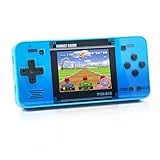


Standard Sizes
In the modern 2026 retro gaming landscape, physical handheld dimensions scale directly with battery capacity, screen panel footprint, and thermal cooling needs. Below is a breakdown of standard size tiers, physical measurements, and battery capacities found across common portable retro consoles.
| Device Class | Battery Capacity (mAh) | Screen Size & Type | Dimensions (Inches) | Dimensions (cm) | Weight (oz / g) | Typical Price Range |
|---|---|---|---|---|---|---|
How to Measure Your Space
Finding the right balance between battery runtime and physical handheld size requires measuring both your personal ergonomics and carry storage before buying. Follow these four practical steps:
- Measure Pocket and Travel Bag Pockets: Measure the interior dimensions (Length x Width x Depth) of the pocket, EDC pouch, or bag compartment where you plan to store the unit. Add 0.5 inches (1.3 cm) of buffer space around the height to prevent joysticks from catching on zippers.
- Determine Hand Span and Grip Clearance: Measure your open hand from the tip of your thumb to the tip of your pinky finger. If your hand span is under 7.5 inches (19 cm), vertical devices under 5.0 inches (12.7 cm) long or lightweight 3.0-inch to 3.5-inch horizontal shells feel most comfortable for extended play.
- Check Shell Thickness for Storage Drops: Measure nightstand organizer slots, desk charging docks, or hard travel cases. Standard devices range from 0.7 inches (1.8 cm) to 0.9 inches (2.3 cm) thick. Ensure your cable plug adds another 1.0 inch (2.5 cm) of clearance when plugged into bottom USB-C ports.
- Account for Cable and Power Adapter Storage: Larger 5,000 mAh batteries require standard 5V/2A or 15W USB power bricks for efficient charging. Measure an extra 2 x 2 x 1 inch (5 x 5 x 2.5 cm) tray footprint inside your travel bag for the charging gear.
By Room or Use Case
Daily Commutes & Pocket Carry
For short trips, bus rides, or quick coffee breaks, compact devices with 3,000 mAh to 3,500 mAh batteries provide the best balance of size and endurance. Units featuring a 3.5-inch or 4.0-inch screen weigh between 6.7 oz (190 g) and 7.4 oz (210 g), allowing them to slip easily into front jacket pockets or small shoulder bags without sagging. Expect 4 to 5 hours of runtime, which is more than enough for several days of casual transit play without needing a recharge nightstand setup.
Long-Haul Travel & Flight Storage
If your gaming happens on extended cross-country flights or hotel stays, prioritize a 5,000 mAh battery pairing with an energy-efficient OLED or crisp IPS screen. Operating on higher-end Android architectures with 6GB RAM, these handhelds effortlessly handle longer sessions of upscaled systems. While slightly heavier at 8.1 oz (230 g), their sleek profiles (around 6.1 x 3.1 x 0.7 inches / 15.5 x 7.9 x 1.8 cm) slide easily into custom travel storage cases alongside power banks and noise-canceling headphones.
Bedside Nightstand & Casual Home Lounging
When playing in bed or on the living room sofa, weight becomes less critical than visual comfort and screen real estate. Mid-size devices carrying 3,500 mAh to 5,000 mAh cells offer excellent brightness headroom. A 4.0-inch square screen (720×720 resolution) or 3.9-inch display paired with dual analog joysticks allows cozy navigation through deep retro RPGs. Resting the device on a lap cushion eliminates hand fatigue, making the extra battery mass a non-issue.
Kids’ Playrooms & Youth Gifting
For younger players, durability, low weight, and simplicity trump high battery capacities. Entry-level mini handhelds priced between $15 and $40 often utilize lightweight 800 mAh to 1,200 mAh rechargeable batteries inside compact 3.0-inch screen frames. Weighing under 4.0 oz (113 g) and measuring roughly 4.9 x 2.8 inches (12.4 x 7.1 cm), these units fit comfortable in small hands, offer 2 to 3 hours of safe playtime, and easily store inside toy baskets or desk drawers.
Common Sizing Mistakes
Buyers often focus strictly on battery mAh numbers without evaluating how hardware design alters real-world energy draw. Here are four common mistakes to avoid:
- Assuming Higher mAh Means Longer Battery Life: A 5,000 mAh battery running an Android OS with high-brightness screens and 3D emulation can drain faster than a simple 3,000 mAh open-source Linux handheld running lightweight 8-bit ROMs. Match the capacity to the processor and display technology, not just the raw numbers.
- Ignoring Joystick Clearance in Measurements: Outer dimensions provided by manufacturers often list the shell body size only, ignoring protruding analog thumbsticks. Dual 3D joysticks can add 0.25 to 0.4 inches (0.6 to 1.0 cm) to total thickness, causing tight travel sleeves to pinch or turn the unit on accidentally.
- Overlooking Charging Port Location: Bottom-mounted USB-C ports prevent the device from standing upright on a desk or nightstand dock while charging unless you use a right-angle USB-C adapter. Measure table clearance if you like playing while plugged in.
- Using Oversized Fast Chargers: Many low-to-mid range retro consoles lack modern Power Delivery (PD) handshake chips. Attempting to charge a 3,000 mAh budget console with a high-wattage 65W laptop charger can lead to charging failures. Stick to standard 5V/2A (10W) wall bricks unless the manufacturer specifies PD support.
FAQ
How long does a 3,000 mAh battery last on a retro handheld?
A 3,000 mAh battery typically lasts between 4 and 6 hours when playing 8-bit and 16-bit games at 50% screen brightness. Power consumption increases when running 3D systems like PS1 or N64, reducing runtime closer to 3.5 to 4.5 hours.
Does screen type affect battery life as much as mAh capacity?
Yes. OLED panels are much more energy-efficient when displaying dark pixels, extending battery life significantly compared to traditional IPS LCD screens at full brightness. A 3.9-inch OLED display paired with a 5,000 mAh battery can outlast larger IPS screens by up to 20% under similar workloads.
How heavy is too heavy for a comfortable portable handheld?
For comfortable handheld gaming without wrist support, keep total device weight under 8.5 oz (240 g). Pocket-sized units weighing between 6.5 oz and 7.5 oz (184 g to 212 g) represent the optimal comfort threshold for long sessions.
How much battery capacity do you need retro handheld models for road trips?
For long road trips without constant access to wall outlets, target a capacity of 3,500 mAh to 5,000 mAh. This guarantees 5 to 8 hours of uninterrupted playtime, which can be easily replenished using a standard 10,000 mAh external power bank.