
Our Top Picks
For 4K gaming or anyone who wants the most VRAM headroom AMD’s RDNA 3 lineup offers, the RX 7900 XTX is the better buy; for high-refresh 1440p on a tighter budget, the RX 7900 XT delivers most of the XTX’s speed for less money and less power. The two cards share the same chip family, the same features and the same launch date, so the decision comes down to how much a 10-20% performance gap and 4 GB of extra memory are worth to you at today’s prices.
Both cards launched on 3 November 2022 as AMD’s top RDNA 3 models, the XT at $899 and the XTX at $999. They are previous-generation cards now that the Radeon RX 9000 series is on shelves, but they remain the fastest Radeon cards ever made in pure rasterization, which keeps them relevant for buyers shopping new old stock or the used market.
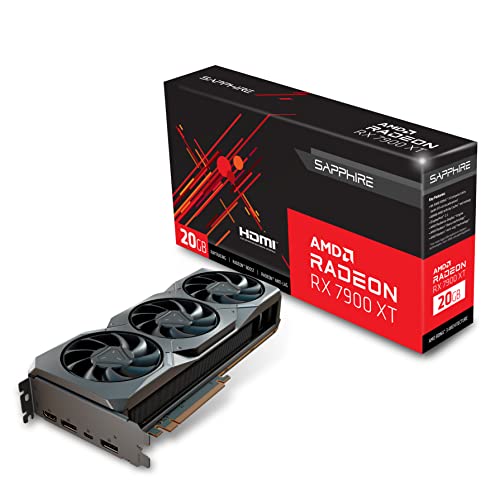
Sapphire 21323-01-20G AMD Radeon RX 7900 XT Gaming Graphics Card with 20GB GDDR6, AMD RDNA 3, Black
Chosen because it specifies AMD RDNA 3 and Black.
View on Amazon
Sapphire 11323-02-20G Pulse AMD Radeon RX 7900 XT Gaming Graphics Card with 20GB GDDR6, AMD RDNA 3
Chosen because it specifies AMD RDNA 3.
View on Amazon
ASRock Radeon RX 7900 XTX Phantom Gaming 24GB OC Graphics Card, 2615 MHz Boost Clock, 24GB GDDR6, DisplayPort 2.1, HDMI 2.1, Triple Fan Cooling
Chosen because it specifies 2615 MHz Boost Clock and 24GB GDDR6.
View on AmazonSpecifications Side by Side
| Specification | RX 7900 XT | RX 7900 XTX |
|---|---|---|
| Architecture | RDNA 3.0 | RDNA 3.0 |
| Release date | 3 November 2022 | 3 November 2022 |
| Launch MSRP | $899 | $999 |
| Stream processors | 5376 | 6144 |
| Boost clock | 2394 MHz | 2498 MHz |
| Process | 5 nm | 5 nm |
| TDP | 300 W | 355 W |
| Memory | 20 GB GDDR6 | 24 GB GDDR6 |
| Memory bus | 320-bit | 384-bit |
| Bandwidth | 800.0 GB/s | 960.0 GB/s |
| L2 / Infinity Cache (L3) | 6 MB / 80 MB | 6 MB / 96 MB |
| Interface | PCIe 4.0 x16 | PCIe 4.0 x16 |
| Power connectors | 2x 8-pin | 2x 8-pin |
| Length / width (reference) | 276 mm, 2-slot | 287 mm, 2-slot |
| Display outputs | 1x HDMI 2.1a, 2x DP 2.1, 1x USB-C | 1x HDMI 2.1a, 2x DP 2.1, 1x USB-C |
The XTX has about 14% more stream processors (6144 vs 5376), a slightly higher boost clock, 20% more memory bandwidth and 16 MB more Infinity Cache. The XT is the same design with one memory chiplet disabled, which is why its bus drops from 384-bit to 320-bit and its VRAM from 24 GB to 20 GB. Those cuts matter most at 4K, where bandwidth and cache hit rates become the bottleneck.
How Far Apart Are They in Games?
According to TechPowerUp’s launch review data, the RX 7900 XTX was about 11% faster than the RX 7900 XT at 1440p and about 16% faster at 4K. TechSpot (Hardware Unboxed’s written outlet) measured the XT running roughly 12-20% behind the XTX in individual games at 4K. Aggregated comparison sites using newer game suites land in a similar band, with some 2026 titles stretching the 4K gap past 20%. A fair summary is:
- 1080p: the gap is small, often under 10%, because both cards are frequently limited by the CPU.
- 1440p: the XTX leads by roughly 7-15%.
- 4K: the XTX leads by roughly 12-20%, and the gap tends to widen in newer, heavier games.
In practical terms, both cards handle demanding 1440p games at high refresh rates on high or ultra settings, typically somewhere in the 100-160 fps range in many modern titles, with the exact number varying heavily by game, settings, CPU and patch version. At 4K with native rendering, the XTX is more likely to hold 60 fps or better in heavy games where the XT dips into the high 40s or 50s.
Ray tracing
Ray tracing is where RDNA 3 is weakest, and that applies to both cards equally. The XTX keeps roughly the same percentage lead with ray tracing on as without it, so neither card changes the picture: in heavy path-traced or RT-heavy titles, both fall well behind NVIDIA’s comparable cards and AMD’s own RDNA 4 Radeon RX 9070 XT. If ray tracing is a priority, neither of these is the ideal pick; if you play mostly raster games, both are excellent.
Upscaling and frame generation
Both cards support FSR 3.1 upscaling and frame generation in supported games, plus AMD Fluid Motion Frames at the driver level. AMD’s machine-learning based FSR 4 upscaler launched as an RDNA 4 feature, so neither RDNA 3 card gets its official image-quality improvements in the same way the RX 9070 series does. Because the feature sets are identical, upscaling does not separate these two cards; it simply lets the XT close part of the 4K gap by running at a higher upscaling quality preset than the XTX would need.
VRAM: Is 20 GB Enough, or Do You Need 24 GB?
Both cards have more memory than nearly any current game needs. A rough guide for 2026 titles:
- 1080p high/ultra: 8-10 GB is typically used.
- 1440p ultra with ray tracing: 10-14 GB in the heaviest games.
- 4K ultra with ray tracing and high-resolution textures: 14-18 GB in the worst cases.
Against those figures, 20 GB on the XT already leaves headroom, and 24 GB on the XTX adds more for heavy mods, very large texture packs, or non-gaming work like local AI models and 3D rendering, where the extra 4 GB and 160 GB/s of bandwidth can matter more than they do in games. For pure gaming, VRAM is not a reason to pick the XTX; performance at 4K is.
Value Math: Cost per Unit of Performance
Using launch MSRPs and the TechPowerUp relative performance figures above, with the XT set to 100:
| Resolution | RX 7900 XT ($899) | RX 7900 XTX ($999) | Cost per point |
|---|---|---|---|
| 1440p | 100 | ~111 | XT $8.99 vs XTX ~$9.00 |
| 4K | 100 | ~116 | XT $8.99 vs XTX ~$8.61 |
At launch prices the XTX offered equal value at 1440p and slightly better value at 4K, which is why reviewers at the time considered the XT overpriced. AMD later cut the XT’s street price substantially, and on today’s new and used market the XT usually sells for noticeably less than an XTX. If the XT costs 20% or more below the XTX, it becomes the better value at 1440p; if the gap is only around 10%, the XTX is the smarter purchase at any resolution above 1080p.
Power, PSU and Case Fit
The XT is rated at 300 W and the XTX at 355 W. A simple PSU sizing approach is GPU TDP plus CPU power plus about 150 W of headroom for the rest of the system and transient spikes:
- RX 7900 XT with a 125 W CPU: 300 + 125 + 150 = 575 W, so a quality 650-750 W unit is comfortable.
- RX 7900 XTX with a 125 W CPU: 355 + 125 + 150 = 630 W, so a quality 750 W unit is the sensible floor, and 850 W gives margin for factory-overclocked models.
Both reference designs use two standard 8-pin PCIe connectors, so there is no adapter or 12V-2×6 cable to worry about, although some partner XTX models add a third 8-pin connector. Use separate cables for each connector rather than a single daisy-chained cable. Reference cards measure 276 mm (XT) and 287 mm (XTX) and occupy two slots, but many partner cards are 300-340 mm long and closer to three slots thick, so check your case’s GPU clearance against the specific model rather than the reference dimensions.
The XTX also runs warmer and louder under load on equivalent coolers, simply because it dissipates about 55 W more. In small cases with limited airflow, the XT is the easier card to keep quiet.
Buying Used in 2026
Since both cards are a generation old, many buyers will find them on the used market. Typical used pricing tends to fall in broad ranges, with the XT commonly well below the XTX. When buying used, check that the card has not been heavily used for mining or compute, ask for a stress-test screenshot or video, and confirm the cooler is intact. Some early reference XTX cards had a vapor-chamber issue that caused high hotspot temperatures; AMD replaced affected units, but it is worth asking a seller whether the card is a reference design and whether it shows unusually high hotspot readings.
It is also worth comparing against the current Radeon RX 9070 XT: it trades blows with the 7900 XT in raster, beats both 7900 cards in ray tracing, and supports FSR 4. A used 7900 XT or XTX makes sense mostly when it is clearly cheaper than a new RX 9070 XT, or when you need the extra VRAM.
Which One Should You Pick?
| Your situation | Better pick | Why |
|---|---|---|
| 1440p high refresh, budget-focused | RX 7900 XT | Gap is only ~7-15%, lower power and cost |
| 4K native, max settings | RX 7900 XTX | 12-20% lead where it matters most |
| Price gap under ~10% | RX 7900 XTX | Better or equal cost per frame |
| Price gap over ~20% | RX 7900 XT | Clearly better value |
| Small case or 650 W PSU | RX 7900 XT | 55 W less heat and power draw |
| AI, rendering, heavy mods | RX 7900 XTX | 24 GB VRAM and more bandwidth |
| Ray tracing is a priority | Neither, consider RX 9070 XT or RTX 50 | RDNA 3 RT is the weak point |
The short version: the RX 7900 XT is the sensible 1440p card when priced well below the XTX, while the RX 7900 XTX is the card to buy for 4K or when the two are close in price.
Frequently Asked Questions
Is the RX 7900 XTX worth $100 more than the RX 7900 XT?
At launch MSRPs, yes, especially at 4K, where the roughly 16% performance lead outpaced the 11% price increase. At 1440p the value was about equal. Today the answer depends on the actual price gap, since the XT is often discounted more heavily.
Can the RX 7900 XT run games at 4K?
Yes, the RX 7900 XT can play most games at 4K with high settings, often around 60 fps in demanding titles, varying by game and settings. In the heaviest games, enabling FSR upscaling helps keep frame rates up. The XTX simply provides more margin at native 4K.
What power supply do I need for an RX 7900 XTX?
A quality 750 W power supply is a sensible minimum for an RX 7900 XTX paired with a typical gaming CPU. For overclocked partner models or high-power CPUs, 850 W adds comfortable headroom. Make sure the PSU has enough separate PCIe 8-pin cables for the card you choose.
Do the RX 7900 XT and XTX support FSR 4?
FSR 4 was launched as an RDNA 4 feature for the RX 9000 series. Both RDNA 3 cards support FSR 3.1 upscaling and frame generation, as well as AMD Fluid Motion Frames. Check AMD’s current driver notes for any later changes to FSR 4 support on older cards.
Is 20 GB of VRAM enough for future games?
Yes, 20 GB is well above what current games use even at 4K with ray tracing. It should remain comfortable for years at 1440p and 4K. The extra 4 GB on the XTX mainly benefits professional workloads and extreme modding.
Should I buy an RX 7900 XT or an RX 9070 XT instead?
The RX 9070 XT is broadly similar to the RX 7900 XT in raster performance, much stronger in ray tracing, and supports FSR 4. The 7900 XT keeps the advantage in VRAM with 20 GB versus 16 GB. Unless the 7900 XT is clearly cheaper, the newer card is usually the more future-proof choice.




