Key takeaways
- Integer Pixel Scaling: Pixels are scaled up uniformly, preserving the crisp edges of 2D sprites.
- Proper Aspect Ratio Locking: Keeps original 4:3 games square instead of stretching characters out horizontally across widescreen monitors.
- Reduced Processing Load: Offloads analog video processing from your computer CPU onto dedicated internal hardware chips.
- Low-Latency Passthrough: Advanced gaming upscalers line-double video in under a single millisecond, preventing control delay while playing.
What's inside
The Short Answer
If you are asking yourself, “do i need an upscaler to capture retro consoles”, the short answer is: It depends on whether you care about input latency, pixel sharpness, and correct screen proportions.
You do not strictly need a dedicated hardware upscaler just to pass a video signal from an old console into a computer setup. A basic $15 analog capture dongle will accept composite RCA cables and display a picture inside your software. However, if you want a clean image that looks like crisp, authentic pixel art rather than a blurry smear—and if you want control responsiveness that allows you to actually play while recording—then yes, you need a hardware upscaler.
As an Amazon Associate we earn from qualifying purchases at no extra cost to you. Product prices and availability are accurate as of the date shown and are subject to change.


Modern video capture cards and HDMI monitors expect progressive high-definition feeds like 720p, 1080p, or 4K. Retro consoles from the 8-bit through 32-bit eras (such as the NES, Super Nintendo, Sega Genesis, and PlayStation) output non-standard analog 240p or 480i signals. Without a proper upscaler to double scan lines and translate signals, modern capture cards interpret 240p video as interlaced 480i video. This misinterpretation introduces ugly combing artifacts, heavy input lag, and stretched 16:9 distortion.
What You Actually Get
To understand why upscaling hardware matters, it helps to examine how analog video signals translate into digital screen pixels. When you plug a retro console directly into a standard display device or generic capture dongle via yellow composite video or S-video, the receiving hardware attempts to process incoming data as standard television content. Because old CRT broadcasts used interlacing (splitting frames into odd and even line fields), modern display processors apply deinterlacing filters to blend fields together.
When applied to 240p progressive retro game signals, soft deinterlacing creates motion blur, ghosting, and noticeable frame delays. A dedicated hardware upscaler sits between your retro console and your capture card. It takes analog video feeds, processes the 240p or 480i signals directly in hardware, and converts them into crisp digital 720p or 1080p HDMI outputs before sending them to your computer.
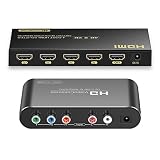
Entry-level upscaling devices, such as the ClearClick AV to HDMI Converter 3.0 ($39.95) or the SoundBeast AV to HDMI Converter & Recorder 2.0 ($49.95), provide standard hardware scaling in compact desktop form factors. These hardware boxes typically measure around 4.5 x 3.0 x 1.0 inches, weigh between 4 and 6 ounces, and draw less than 5 watts of power via a simple 5V USB connection. Units in this class allow you to select between 720p and 1080p HDMI output, toggle between forced 4:3 and 16:9 aspect ratios, and adjust color parameters via remote control or onboard buttons.
In 2026, streaming platforms and capture software rely heavily on stable digital HDMI inputs. By using a hardware upscaler, you provide your capture setup with concrete advantages:
- Integer Pixel Scaling: Pixels are scaled up uniformly, preserving the crisp edges of 2D sprites.
- Proper Aspect Ratio Locking: Keeps original 4:3 games square instead of stretching characters out horizontally across widescreen monitors.
- Reduced Processing Load: Offloads analog video processing from your computer CPU onto dedicated internal hardware chips.
- Low-Latency Passthrough: Advanced gaming upscalers line-double video in under a single millisecond, preventing control delay while playing.
Pros
- Immediate HDMI Compatibility: Converts standard composite RCA and S-Video outputs directly to modern HDMI capture cards and HD monitors.
- Correct Aspect Ratio Controls: Prevents original 4:3 retro console displays from being forced into stretched 16:9 widescreen formats.
- Reduced Control Lag: Bypasses slow software deinterlacing routines in video streaming programs, preserving responsive gameplay feel.
- Compact and Energy Efficient: Desktop units average 4 to 6 ounces in weight and draw minimal power (5V USB under 5 watts).
- Independent Video Capture: Select upscaler units include direct USB flash drive storage slots, enabling PC-free recording capabilities.
- Customizable Image Output: Integrated remote controls allow users to adjust brightness, contrast, sharpness, and tint settings on incoming analog signals.
Cons
- Added Financial Investment: Standalone upscalers add $40 to $300 to your streaming setup costs depending on video quality tiers.
- Cable and Desk Clutter: Requires extra cabling (HDMI, RCA, USB power cords) and dedicated surface space near your capture station.
- Sensitivity to Source Noise: Upscalers reflect the signal quality fed into them; dirty power supplies or low-grade video cables will still show visual noise.
- Budget Unit Processing Limits: Entry-level converters under $50 may still treat 240p signals as 480i interlaced video, causing minor smoothing on fast motion.
Who Should Buy It
You should invest in a dedicated upscaler if you want to stream or record authentic retro hardware like the NES, Super Nintendo, Sega Genesis, Nintendo 64, or PlayStation 1 onto modern computers. If you plan to play directly off your capture software preview screen or a secondary monitor while recording, an upscaler is vital to eliminate control lag. Content creators focused on visual fidelity, retro video game preservation, and twitch-reflex gameplay will find hardware upscaling essential for professional-looking broadcasts.
Who Should Skip It
You can safely skip buying a hardware upscaler if you record retro games using software emulators like RetroArch, official mini consoles (such as the NES or SNES Classic), or modern FPGA consoles like the Analogue Mega Sg. These modern systems emit native, progressive 720p or 1080p HDMI signals that plug directly into standard capture cards with zero conversion needed. Furthermore, if you are simply digitizing old home VHS movies where video delay and pixel sharpness are not factors, a basic capture dongle will suffice without a dedicated line doubler.
Cheaper Alternatives
If you are exploring capture setups on a tight budget, several paths exist for getting legacy console video onto your computer screen. The comparison table below highlights standard options, typical price ranges, and primary trade-offs:
| Option | Price Range | Trade-off |
|---|---|---|
| Direct Composite USB Capture Dongle | $12 – $25 | High input latency, treats 240p as 480i, forces soft deinterlacing, often stretches video to 16:9 widescreen. |
| Basic AV-to-HDMI Converter (e.g., ClearClick / SoundBeast) | $35 – $50 | Fixed 720p/1080p output, physical 4:3 aspect ratio toggle, minimal setup, mild motion blur on fast platformers. |
| Dedicated Gaming Line Doubler (e.g., RAD2X / RetroTINK 2X) | $75 – $150 | Zero input lag, precise 240p processing, sharp pixel retention, requires higher upfront investment. |
| Software Emulation / Official Mini Consoles | $0 – $100 | Outputs native HD digital signals with zero extra analog hardware needed, but loses physical media authenticity. |
FAQ
Will a cheap $15 AV to HDMI adapter work for capturing retro games?
A cheap $15 adapter will pass a video signal to your capture card, but it is not optimized for retro gaming. These generic converters treat 240p progressive signals from classic consoles as 480i interlaced TV signals. This results in heavy input lag, smudged pixel art, interlacing lines during fast movement, and forced 16:9 widescreen stretching that distorts original game proportions.
What is the difference between 240p and 480i retro console signals?
Classic consoles output 240p video, which sends 240 progressive scan lines every frame without alternating lines. Standard broadcast television used 480i video, which splits 480 lines into two alternating 240-line fields. Modern displays assume analog video is 480i and attempt to deinterlace it. A retro-capable upscaler recognizes 240p as progressive video and line-doubles it instantly without applying destructive deinterlacing filters.
Does an upscaler introduce input lag when recording to OBS?
Quality gaming upscalers add virtually zero input lag (typically under 1 millisecond or a fraction of a single frame) because they use hardware line doubling rather than frame buffering. Entry-level consumer converters may add 1 to 2 frames of delay (around 16 to 33 milliseconds), which is still far less lag than running unscaled analog video through soft computer deinterlacing filters in capture software.
Can I capture retro console gameplay directly without a computer?
Yes. Standalone converter-recorders—such as the SoundBeast AV to HDMI Converter 2.0—feature integrated USB host ports and SD card slots. These devices allow you to plug your composite or S-Video console cables directly into the unit, upscale the signal, and record MP4 video files straight to a thumb drive at the press of a button without turning on a PC.