Key takeaways
- Latency: A quality 2.4GHz link is now imperceptibly different from USB in blind testing; Bluetooth, offered as a secondary mode on mice like the AJAZZ AJ200, is noticeably slower and best reserved for laptop and productivity use.
- Weight: Wired mice avoid battery mass but drag a cable that adds perceived resistance. Modern wireless designs like the AJ200 and PRO X2 Superstrike hit 61g including the cell, so the weight argument has flipped in wireless’s favour at the high end.
- Power: Wired means never thinking about it. Wireless ranges from the G305’s roughly 250 hours on a single AA to rechargeable designs that need a nightly USB-C top-up or a charging dock.
- Price: At entry level, wired still wins on sensor and build quality per dollar. Above the mid-range, wireless dominates the feature set almost entirely.
- Features: The newest technology — magnetic analog switches, rapid trigger, adjustable click haptics — is arriving on premium wireless first, not on cables.
- Reliability: A cable can fray or snag; a dongle can be lost and a battery degrades. Neither failure mode is common, but they’re different kinds of risk.
What's inside
- Watch: Wired vs Wireless Gaming Mouse in 2026 — Video Review
- Quick Verdict
- Key Differences
- Wired Gaming Mice: The Case for Staying Plugged In
- Wireless Gaming Mice: Why Most Players Should Cut the Cord
- Which Should You Buy?
- Related Guides
- Frequently Asked Questions
- Final Verdict
- Related Articles
- Related Guides
For years the wired-versus-wireless question in gaming had a simple answer: if you cared about competitive performance, you plugged in. That answer expired somewhere around the last hardware generation, and by 2026 it’s genuinely obsolete. Modern 2.4GHz gaming receivers deliver latency that sits well inside the margin of error for human reaction time, and the high polling rates once exclusive to cables are now standard on flagship cordless mice. The gap that used to define the debate has effectively closed.
- Watch: Wired vs Wireless Gaming Mouse in 2026 — Video Review
- Quick Verdict
- Key Differences
- Wired Gaming Mice: The Case for Staying Plugged In
- Wireless Gaming Mice: Why Most Players Should Cut the Cord
- Which Should You Buy?
- Related Guides
- Frequently Asked Questions
- Final Verdict
- Related Articles
- Related Guides
That doesn’t make the decision trivial — it just moves it somewhere more interesting. The choice now hinges on weight distribution, battery logistics, switch technology, ecosystem lock-in and, bluntly, how much you want to spend. A budget wired mouse still buys you more raw sensor and build quality per dollar than a budget wireless one. A premium wireless mouse buys you a cleaner desk and freedom that’s hard to give up once you’ve had it. Below we break down where each option genuinely wins in 2026, and which specific mice are worth your attention.
As an Amazon Associate we earn from qualifying purchases at no extra cost to you. Product prices and availability are accurate as of the date shown and are subject to change.





⚡ Save on Your Next PC — Amazon Prime
Prime members get fast free shipping on the systems above, plus early access to Prime Day & Black Friday PC deals. New members get a 30-day free trial.
Watch: Wired vs Wireless Gaming Mouse in 2026 — Video Review
Quick Verdict
Wired mice remain the value play and the zero-maintenance option: no charging, no dongle to lose, and the best specs-per-dollar if you’re building on a tight budget or need a guaranteed-stable connection for LAN and tournament play. Wireless is the better all-round choice for almost everyone else in 2026 — particularly if you want a genuinely lightweight shape, a tidy desk, or access to the newest switch and haptics technology, which now debuts on cordless flagships like the Logitech G PRO X2 Superstrike first.
Key Differences
- Latency: A quality 2.4GHz link is now imperceptibly different from USB in blind testing; Bluetooth, offered as a secondary mode on mice like the AJAZZ AJ200, is noticeably slower and best reserved for laptop and productivity use.
- Weight: Wired mice avoid battery mass but drag a cable that adds perceived resistance. Modern wireless designs like the AJ200 and PRO X2 Superstrike hit 61g including the cell, so the weight argument has flipped in wireless’s favour at the high end.
- Power: Wired means never thinking about it. Wireless ranges from the G305’s roughly 250 hours on a single AA to rechargeable designs that need a nightly USB-C top-up or a charging dock.
- Price: At entry level, wired still wins on sensor and build quality per dollar. Above the mid-range, wireless dominates the feature set almost entirely.
- Features: The newest technology — magnetic analog switches, rapid trigger, adjustable click haptics — is arriving on premium wireless first, not on cables.
- Reliability: A cable can fray or snag; a dongle can be lost and a battery degrades. Neither failure mode is common, but they’re different kinds of risk.
Wired Gaming Mice: The Case for Staying Plugged In
The strongest argument for wired in 2026 is economic. Removing the radio, battery and charging circuitry frees up budget for a better sensor, better main switches and a more rigid shell at the same price point. If your ceiling is modest, a wired mouse will almost always feel like a more expensive product than a wireless one costing the same.
The second argument is operational simplicity. There’s no charge state to monitor mid-session, no receiver to pack for a LAN, and no firmware pairing to troubleshoot. For competitive players who value absolute predictability — and for anyone who shares a machine, runs long sessions, or simply resents another device to charge — a cable remains a completely defensible choice rather than a compromise. It’s also worth noting that most modern wireless mice, including the G703 Lightspeed and the USB-C-equipped AJ200, run perfectly well as wired mice while charging, so you’re rarely locked out of the option entirely.
Wireless Gaming Mice: Why Most Players Should Cut the Cord
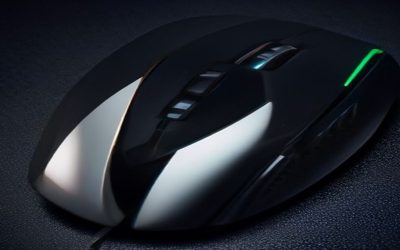
The practical case for wireless is the absence of cable drag. Even with a good bungee, a cable subtly resists fast flicks and low-sensitivity arm sweeps. Removing it produces a consistency that’s immediately noticeable in tracking-heavy shooters. At the value end, the Logitech G305 Lightspeed remains the reference point — HERO sensor, 12,000 DPI, six programmable buttons, on-board memory and that outstanding 250-hour AA runtime, with the Lilac colourway offering the same internals in a softer finish.
Move up and the feature gap widens sharply. The G703 Lightspeed pairs the HERO 25K sensor and 100–25,600 DPI range with Powerplay compatibility for continuous charging, LIGHTSYNC RGB, rubber side grips and an optional 10g weight for players who prefer more heft. The PRO X2 Superstrike pushes furthest with customisable rapid-trigger magnetic analog switches, adjustable click haptics and up to 8K polling at 61g. For a tri-mode option with a charging dock, the AJAZZ AJ200 covers Bluetooth 5.0, 2.4GHz and USB-C with a PAW3311 sensor and up to 24,000 DPI; the Redragon M810 Pro is the accessible pick for macro-heavy play with 10,000 DPI and extensive key remapping.
Which Should You Buy?
- For a tight budget: pick a solid wired mouse, or stretch slightly to the G305 Lightspeed — it’s the rare wireless mouse that doesn’t cut corners on the sensor.
- For competitive FPS: pick wireless at 61g — the PRO X2 Superstrike if you want rapid trigger and haptics, the AJAZZ AJ200 if you want tri-mode flexibility.
- For MMO and MOBA macro use: pick the Redragon M810 Pro for its remappable keys and rapid-fire macro binds.
- For larger hands or a palm grip: pick the G703 Lightspeed — the bigger shell, rubber side grips and 10g optional weight suit heavier, slower-sensitivity play.
- For zero maintenance: pick wired, or the G305 and its AA battery, which sidesteps recharging cycles entirely.
Frequently Asked Questions
Is wireless still slower than wired in 2026?
Not in any way you can feel. A modern 2.4GHz gaming receiver operates at latencies below the threshold of human perception. Bluetooth is a different story — it’s convenient for travel but not appropriate for competitive play.
How long do gaming mouse batteries actually last?
It varies enormously with RGB use and polling rate. The G305 quotes around 250 hours on a single AA with lighting off, while rechargeable models with RGB and high polling typically need charging every few days. A dock or Powerplay-style pad removes the issue almost entirely.
Does a heavier mouse ever make sense?
Yes. Ultralight designs suit fast, wrist-driven aiming, but many low-sensitivity players find extra mass improves micro-adjustment stability. That’s exactly why the G703 ships with an optional 10g weight.
Can I use a wireless mouse while it charges?
Generally yes. USB-C models like the AJ200 and PRO X2 Superstrike function as wired mice on the cable, so a flat battery mid-match is an inconvenience rather than a session-ending problem.
Final Verdict
In 2026, wireless is the default recommendation for most gamers: the latency argument is settled, the best shapes and newest switch technology arrive cordless first, and 61g flagships have erased the weight penalty. Wired remains genuinely smart at the budget end and