Key takeaways
- Switch type: Mechanical switches offer crisper actuation and far better longevity, but a well-made membrane board can still be responsive and is noticeably quieter and cheaper. Decide whether tactile feedback or a low price and low noise matters more to you.
- Size and layout: Full-size boards keep the numpad for productivity and MMO macros; 75% and 65% layouts free up desk space for wider mouse sweeps, which matters a lot in low-sensitivity FPS play. Check that the arrow keys and Delete are where you expect before committing to a compact layout.
- Anti-ghosting and rollover: Look for genuine N-key rollover or at least full anti-ghosting on the gaming cluster. Cheap boards often advertise “anti-ghosting” but only cover 6–19 keys, which is fine for most games but limiting for rhythm titles and complex keybinds.
- Build quality and spill resistance: A metal or metal-topped chassis resists flex during frantic input and adds welcome weight so the board stays put. If you eat or drink at your desk, an IP-rated or drain-channel design is worth prioritising over extra lighting zones.
- Connectivity and extras: Wired USB remains the simplest low-latency option, but modern 2.4GHz wireless is effectively lag-free and adds Bluetooth for multi-device use. Hot-swap sockets, volume knobs, dedicated media keys and a wrist rest are the extras that meaningfully improve daily use.
What's inside
Shopping for a gaming keyboard under $100 sounds easy until you actually start looking. The sub-$100 tier is the most crowded segment on the market, packed with boards that all promise RGB lighting, anti-ghosting and “mechanical feel” — a phrase that can mean anything from genuine mechanical switches to a rubber dome dressed up in gamer branding. Add in the choice between full-size, 75% and 65% layouts, wired versus wireless, and hot-swappable versus soldered, and it’s easy to overspend on features you’ll never use or underspend on a board that feels mushy within a month.
This guide cuts through that noise. We’ve focused on keyboards that genuinely deliver on the fundamentals — switch feel, build quality, key rollover and long-term durability — while staying comfortably inside a $100 budget. Below you’ll find our top picks for 2026, a short buying checklist to help you match a board to your setup, and answers to the questions we get asked most often. Every recommendation here is chosen for value, not spec-sheet padding.
As an Amazon Associate we earn from qualifying purchases at no extra cost to you. Product prices and availability are accurate as of the date shown and are subject to change.


⚡ Save on Your Next PC — Amazon Prime
Prime members get fast free shipping on the systems above, plus early access to Prime Day & Black Friday PC deals. New members get a 30-day free trial.
Watch: Best Gaming Keyboard Under $100 — Video Review
How to Choose Gaming Keyboard Under $100
- Switch type: Mechanical switches offer crisper actuation and far better longevity, but a well-made membrane board can still be responsive and is noticeably quieter and cheaper. Decide whether tactile feedback or a low price and low noise matters more to you.
- Size and layout: Full-size boards keep the numpad for productivity and MMO macros; 75% and 65% layouts free up desk space for wider mouse sweeps, which matters a lot in low-sensitivity FPS play. Check that the arrow keys and Delete are where you expect before committing to a compact layout.
- Anti-ghosting and rollover: Look for genuine N-key rollover or at least full anti-ghosting on the gaming cluster. Cheap boards often advertise “anti-ghosting” but only cover 6–19 keys, which is fine for most games but limiting for rhythm titles and complex keybinds.
- Build quality and spill resistance: A metal or metal-topped chassis resists flex during frantic input and adds welcome weight so the board stays put. If you eat or drink at your desk, an IP-rated or drain-channel design is worth prioritising over extra lighting zones.
- Connectivity and extras: Wired USB remains the simplest low-latency option, but modern 2.4GHz wireless is effectively lag-free and adds Bluetooth for multi-device use. Hot-swap sockets, volume knobs, dedicated media keys and a wrist rest are the extras that meaningfully improve daily use.
The Best Picks Reviewed
AULA F75 Pro Wireless Mechanical Keyboard
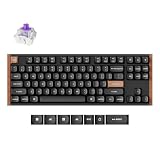
The F75 Pro is the most complete enthusiast package under $100, pairing a 75% hot-swappable layout with pre-lubed Reaper switches, side-printed PBT keycaps and a genuinely useful control knob. Triple connectivity (2.4GHz, Bluetooth 5.0 and USB-C) means it works equally well as a desktop gaming board and a travel keyboard, and the hot-swap sockets let you change switch feel later without buying a new board.
SteelSeries Apex 3 RGB
SteelSeries built the Apex 3 around durability rather than headline specs: IP32 water resistance, a soft-landing whisper-quiet switch and a premium magnetic wrist rest that’s better than most boards twice the price include. It’s the sensible pick for shared spaces, late-night sessions and anyone who has already lost one keyboard to a spilled drink.
Logitech G213 Prodigy
The G213 remains the safest full-size buy in this bracket thanks to Logitech’s build consistency, spill-resistant chassis, dedicated media controls and five-zone RGB with Lightsync support. Its Mech-Dome keys aren’t true mechanical switches, but they’re among the best-feeling membrane keys available and the anti-ghosting holds up under heavy simultaneous input.
Redragon K521 Upgrade
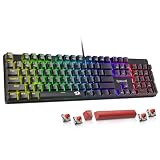
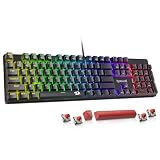
Redragon’s K521 delivers a full 104-key layout with rainbow LED lighting, one-touch backlight control and multimedia keys at an aggressively low price, plus broad compatibility across PC, Mac, PS4/PS5 and Xbox. The “mechanical feeling” keys are membrane, but the travel is firm and consistent, making this the best choice for console players and anyone building a second setup on a tight budget.
TECKNET Wired Gaming Keyboard
The TECKNET’s metal panel design gives it a rigidity and heft you rarely find at this price, so it stays planted through frantic movement inputs and resists the flex that plagues all-plastic budget boards. RGB backlighting and straightforward plug-and-play wired operation round out a no-nonsense board that spends its budget where it counts.
Frequently Asked Questions
Do I really need a mechanical keyboard for gaming?
No. Mechanical switches offer better feedback, faster resets and a lifespan measured in tens of millions of keystrokes, but a good membrane board like the G213 or Apex 3 is perfectly competitive for the vast majority of players. Buy mechanical for feel and longevity, not because you think it will improve your aim.
Is wireless fast enough for competitive play in 2026?
Yes, provided it’s 2.4GHz rather than Bluetooth. Modern low-latency wireless dongles are effectively indistinguishable from wired for input timing, which is why boards like the AULA F75 Pro can offer wireless without compromise. Save Bluetooth for laptops, tablets and productivity work.
What size keyboard should I buy?
Choose full-size if you use the numpad regularly for work, MMOs or sim titles. Choose 75% or 65% if you play low-sensitivity FPS games and want more room to swing your mouse — the tradeoff is losing dedicated keys and learning a few function-layer shortcuts.
Are hot-swappable keyboards worth it?
They are if you’re curious about switch feel. Hot-swap sockets let you try linear, tactile or clicky switches for a few dollars instead of replacing the whole board, which makes a keyboard like the F75 Pro a far better long-term investment than a soldered equivalent.
Final Thoughts
If you want the most capability for your money in 2026, the AULA F75 Pro is the clear winner — hot-swap sockets, pre-lubed switches, PBT keycaps and triple connectivity is a specification list that belonged to $150+ boards two years ago. Choose the SteelSeries Apex 3 instead if durability, water resistance and quiet operation matter more than customisation, or the Logitech G213 Prodigy if you want a dependable full-size board from a brand with proven support and build consistency. All three represent genuine value well under the $100 mark.