Key takeaways
- GPU tier matters most: The graphics card sets your performance ceiling more than anything else. At this budget, an RTX 5050 or RTX 5060 is the sweet spot for 1080p high settings, while an RTX 3050 will require you to dial back demanding titles.
- Insist on 16GB of RAM: Modern games routinely use more than 8GB of system memory alongside Windows and a browser. An 8GB configuration will stutter in open-world titles, and upgrading later costs time and money you could have saved upfront.
- Refresh rate over resolution: A 144Hz or faster 1080p/1200p panel delivers a noticeably smoother experience than a 60Hz higher-resolution screen. At this GPU class you won’t be pushing 1440p in AAA games anyway, so prioritise the fast panel.
- Storage fills up fast: A single modern AAA install can exceed 100GB. A 1TB Gen 4 SSD is worth paying for; if you settle for 512GB, confirm there’s a free M.2 slot for a second drive.
- Check cooling and chassis: Thin gaming laptops throttle. Dual-fan designs with generous exhaust vents sustain higher clocks over a long session, which translates directly into more consistent frame rates than a spec sheet alone suggests.
What's inside
Shopping for a gaming laptop under $1000 in 2026 means walking a tightrope. Spend too little and you end up with a machine that stutters through modern titles at native resolution; stretch too far and you’ve blown past the budget you set in the first place. The market is crowded with configurations that look similar on a spec sheet but perform very differently once you’re actually running a demanding game with ray tracing enabled, and manufacturers are not shy about pairing a capable GPU with 8GB of RAM or a slow panel to hit a headline price.
This guide cuts through that noise. We’ve focused on machines that deliver genuine 1080p and 1200p gaming performance without hidden compromises, weighing GPU class, memory, display quality, and thermal design against real-world street pricing. Every pick below is a realistic buy at or near the $1000 mark, and we’ve flagged exactly who each one is for so you can match the machine to the games you actually play.
As an Amazon Associate we earn from qualifying purchases.



⚡ Save on Your Next PC — Amazon Prime
Prime members get fast free shipping on the systems above, plus early access to Prime Day & Black Friday PC deals. New members get a 30-day free trial.
Watch: Best Gaming Laptop Under $1000 — Video Review
How to Choose Gaming Laptop Under $1000
- GPU tier matters most: The graphics card sets your performance ceiling more than anything else. At this budget, an RTX 5050 or RTX 5060 is the sweet spot for 1080p high settings, while an RTX 3050 will require you to dial back demanding titles.
- Insist on 16GB of RAM: Modern games routinely use more than 8GB of system memory alongside Windows and a browser. An 8GB configuration will stutter in open-world titles, and upgrading later costs time and money you could have saved upfront.
- Refresh rate over resolution: A 144Hz or faster 1080p/1200p panel delivers a noticeably smoother experience than a 60Hz higher-resolution screen. At this GPU class you won’t be pushing 1440p in AAA games anyway, so prioritise the fast panel.
- Storage fills up fast: A single modern AAA install can exceed 100GB. A 1TB Gen 4 SSD is worth paying for; if you settle for 512GB, confirm there’s a free M.2 slot for a second drive.
- Check cooling and chassis: Thin gaming laptops throttle. Dual-fan designs with generous exhaust vents sustain higher clocks over a long session, which translates directly into more consistent frame rates than a spec sheet alone suggests.
The Best Picks Reviewed
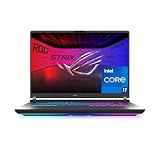
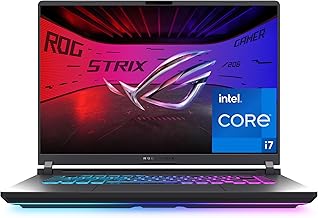
ASUS ROG Strix G16 (2025)
This is the strongest all-round performer on the list, pairing an RTX 5060 with a Core i7-14650HX and 16GB of DDR5 on a 165Hz 16:10 panel. The extra vertical screen space and 1TB Gen 4 SSD make it as capable for work as it is for gaming, and the ROG cooling system holds sustained clocks better than most machines at this price.
Acer Nitro V 16
The 16-inch Nitro V pairs an RTX 5050 with a Core 7 240H, 16GB of DDR5, and a 1TB Gen 4 SSD on a bright 180Hz WUXGA display. It’s arguably the best pure value proposition here, delivering the fast panel and generous storage that competitors often cut to hit the same price.
Acer Nitro V 15.6″
The smaller Nitro V trades the Core 7 for an i5-13420H and drops to a 512GB SSD, but keeps the RTX 5050 with 8GB of GDDR7 and 16GB of RAM. For players who want a more portable 15.6-inch chassis and don’t mind adding a second drive later, it’s the cheapest credible route to current-generation GPU performance.
Alienware 16 Aurora
Alienware’s entry-level Aurora brings an RTX 5050 and Core 7 240H into a chassis with build quality and thermal engineering that outclasses most sub-$1000 competition. Buy this one if you value a premium keyboard, sturdier construction, and quieter sustained operation over raw specs per dollar.
ASUS TUF Gaming A16
The TUF A16 pairs a Ryzen 7 7445HS with an RTX 4050 and 16GB of DDR5 behind a 145Hz Full HD+ display, all in a military-spec-tested chassis. The previous-generation GPU keeps the price low, and it remains a dependable 1080p performer with excellent battery life for the category.
Frequently Asked Questions
Can a sub-$1000 laptop run modern AAA games?
Yes, comfortably at 1080p. An RTX 5050 or 5060 will handle current AAA titles at high settings with upscaling enabled, typically landing between 60 and 100fps depending on the game. Ray tracing is possible but usually requires dropping to medium presets.
Is 8GB of RAM ever acceptable?
Only if you plan to upgrade immediately. Machines like the renewed HP Victus 15 are priced attractively precisely because they ship with 8GB, and adding a second stick is a cheap, straightforward fix. If you won’t open the chassis, buy 16GB from the start.
Should I buy a renewed gaming laptop?
Renewed units from reputable sellers offer real savings and typically come with a limited warranty, but you’re accepting an unknown history of thermal cycling. It’s a reasonable gamble on a lower-tier GPU where the price gap is meaningful, less so if you’re near the top of your budget anyway.
How long will one of these last?
Expect three to four years of solid 1080p gaming from an RTX 5050 or 5060 machine, longer if you’re happy to lower settings over time. Adequate RAM and storage headroom extend that window considerably, which is why we weight both heavily.
Final Thoughts
If you want the most performance available near $1000, the ASUS ROG Strix G16 is the clear choice thanks to its RTX 5060, fast Core i7, and 1TB of storage. For the best balance of price and specification, the 16-inch Acer Nitro V is hard to beat with its 180Hz panel and DDR5 memory, while the ASUS TUF Gaming A16 remains the smart pick for buyers who prioritise durability and battery life over the newest GPU generation.