Our Top Picks
 JUNHETEK Retro Handheld Game Console 4.0-inch IPS 64GB4.0 Inches5.5 x 3.2 x 1 inches0.55 poundsCheck on Amazon
The Retroid Pocket 6 suits most buyers who want an Android handheld that covers everything up to PS2, GameCube and Wii-era emulation without a flagship budget, the AYN Odin 3 suits players who want the most headroom and the biggest battery, and a vertical Anbernic such as the RG406V suits people who mainly want Game Boy-style ergonomics for 8-bit to 128-bit libraries. Below is how the current options compare on maker-listed and reviewer-reported details, what limits each one, and how to match a device to the games you actually play.
At a glance
| Device | Best for | Key stated specs | Limits |
|---|---|---|---|
| Retroid Pocket 6 | All-round value, PS2/GameCube/Wii | Snapdragon 8 Gen 2, 5.5-inch 1920×1080 AMOLED at 120Hz, Android 13, 6,000mAh battery per most spec listings, microSD slot, Wi-Fi 7 | Heavier Switch and newer PS2 titles can still need per-game tuning; spec sheets on retailer sites disagree on small details |
| AYN Odin 3 | Maximum headroom, long sessions | Snapdragon 8 Elite (Dragonwing Q8 variant per reports), 6-inch 1920×1080 AMOLED at 120Hz, up to 24GB LPDDR5X, 8,000mAh battery, Android 15, about 390g | Larger and heavier; newer chip support can take time to mature in emulators; higher memory tiers sit in a higher budget class |
| AYN Odin 2 Portal | Big-screen play | Reviewers describe a 7-inch 1080p OLED | Previous-generation chip compared with the Odin 3; bulkier for pockets |
| Anbernic RG406V | Vertical form factor, 4:3 screen | Reviewers describe a 4-inch 4:3 high-resolution screen and power for the 128-bit era | Not the pick for heavy 3D systems; one guide covering it is older |
| Anbernic RG556 | Budget tier value | Reviewers call it the best score per budget dollar among current picks | Check which systems you need before committing |
| AYN Thor | DS and 3DS focus | Reviewers describe a dual-screen emphasis released in summer 2026 | Narrower focus; limited independent coverage so far |
What PC gamers should know before buying
Emulation handhelds are not plug-and-play consoles in the way a retail console is. Most current models run Android, so you install emulators such as those for PlayStation 2, GameCube, Dreamcast, PSP and Nintendo systems yourself, then point them at game files you legally own. Performance depends on the chip, the emulator build and per-game settings. Reviewers repeatedly stress that two devices with similar spec sheets can feel different because of thermals, driver maturity and the front-end software.

R36MAX 2 Retro Handheld Console, 4.5" IPS HD Portable Gaming Emulator, Detachable Grip, 20000+ Classic Arcade Games, Open Source Linux & 4000mAh Battery (Black-128G)
Chosen because it specifies 4.5" IPS HD Portable Gaming Emulator and Detachable Grip.
View on AmazonJUNHETEK Retro Handheld Game Console 4.0-inch IPS 64GB Black | 30+ Emulators, 4000mAh Battery, Open Source, Dual Analog Sticks, Portable Gaming
Chosen because it specifies 30+ Emulators and 4000mAh Battery.
View on Amazon
RS36 Retro Handheld Game Console,20,000+ Classic Games, 64GB,4.0“ | 12 Emulators,4000mAh Battery Portable Pocket Video Games,Transparent Black
Chosen because it specifies 000+ Classic Games and 64GB.
View on Amazon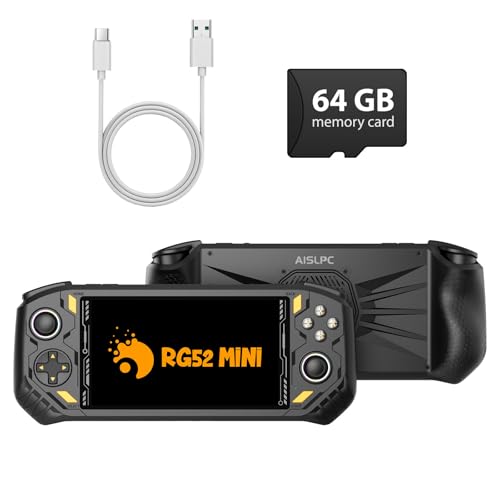
RG52MINI Retro Handheld Game Console, 5.5 Inch IPS Screen, Portable Dual System, 64GB Support 30+ Emulator&22000+ Classic Games, WiFi Networked Fighting, HDMI TV Output, 5000mAh Battery(Black 64GB)
Chosen because it specifies 5.5 Inch IPS Screen and Portable Dual System.
View on AmazonIf you already play on a PC, a handheld complements it well. Many owners use Android handhelds for retro libraries and keep a gaming PC for modern titles. Some models also support game streaming from a PC on the same network, although that depends on the apps you install and your Wi-Fi quality, so treat it as a bonus rather than the reason to buy.
Retroid Pocket 6: the common all-round pick
Held Games and several other roundups name the Retroid Pocket 6 the best all-around Android emulation handheld for 2026. The maker-aligned spec listings describe a Snapdragon 8 Gen 2 with an Adreno 740 GPU, up to 12GB of LPDDR5X memory and 256GB of UFS 3.1 storage in the top configuration, a 5.5-inch 1080p AMOLED at 120Hz, a microSD slot, a USB-C port with video output, Wi-Fi 7 and Bluetooth 5.3. Fast charging at 27W is listed. Most sources cite a 6,000mAh battery, though one outlet lists a slightly different figure, so confirm the battery on the product page of your chosen seller.
The Snapdragon 8 Gen 2 is a mature chip with wide emulator support, which is a practical advantage: developers have had time to optimize for it. Reviewers describe it as comfortable for PS2, GameCube and Wii, and workable for a share of Switch titles with tuning. Retro Dodo’s review calls the device excellent but a little unexciting, which in handheld terms is praise for consistency.
Trade-offs: the 5.5-inch screen is a good size for pockets but smaller than the Odin 2 Portal. Weight is reported as roughly 300 to 320 grams depending on the source. Memory and storage tiers change the budget class, so decide how much storage you need before comparing.
AYN Odin 3: the headroom pick
AYN lists the Odin 3 with a Snapdragon 8 Elite (reported as a Dragonwing Q8 handheld variant), a 6-inch 1080p AMOLED at 120Hz, memory options from 8GB up to 24GB of LPDDR5X, storage from 128GB UFS 3.1 up to 1TB UFS 4.0, an 8,000mAh battery with 60W fast charging and bypass charging, Android 15, and dimensions around 224.8 x 87.5 x 16.6 mm. Weight is listed at about 390 grams. Android Authority and Android Central both covered the launch, and independent comparison articles place it above the Pocket 6 for raw performance, especially for Switch and PS2 workloads.
Trade-offs: newer silicon takes time to reach full emulator support, so some titles may need updates before they run as well as the spec sheet suggests. The larger body is less pocketable and heavier in the hands during long sessions. There is also a meaningful budget gap between the cheapest Pocket 6 and the top Odin 3 tier according to comparison sites, so the Odin 3 only makes sense if you will actually use the headroom.
Vertical and value alternatives
Anbernic RG406V
Guides describe the RG406V as a vertical, Game Boy-style handheld with a 4-inch 4:3 screen that suits older consoles whose native aspect ratio is 4:3. If your library is mostly 8-bit, 16-bit, PlayStation 1 and some Dreamcast or PSP, a screen shaped for those games can look better than a wide screen with black bars.
Anbernic RG556
Reviewers highlight the RG556 as the strongest value in the budget tier. It is a sensible entry point if you are unsure how much you will use emulation, though you should confirm that the systems you care about are supported at the performance you expect.
AYN Odin 2 Portal
Described by reviewers as the premium large-screen option with a 7-inch 1080p OLED. It is previous generation compared with the Odin 3, but the screen size is its selling point for players who prefer a bigger view of 3D games.
AYN Thor
RetroDodo calls the Thor a standout summer 2026 release aimed at Nintendo DS and 3DS emulation. Because independent coverage is still limited, treat it as a niche pick for players who want dual-screen play.
Compatibility and fit notes
- Android emulators: performance for a given system depends on the emulator, not only the chip. Dedicated emulator apps are updated regularly, so results change over time.
- Screen aspect ratio: 16:9 screens suit PSP, PS2 widescreen patches and modern content, while 4:3 screens suit older systems.
- Storage: the base storage fills quickly with PS2, GameCube and Switch libraries. A microSD slot (listed on the Pocket 6) helps, but internal UFS is faster.
- Battery: larger batteries run longer, but heavy 3D emulation drains any device faster than 2D games.
- Cooling: performance-focused devices throttle if they run hot. Reviewers mention fan or thermal behavior in their coverage, so read the review for the specific model.
- Controls: analog sticks, triggers and a gyro matter for GameCube, PS2 and Switch games. Check that the layout matches how you hold a controller.
Choose by budget tier
| Tier | Typical choice | What you get | What you give up |
|---|---|---|---|
| Budget | Anbernic RG556 or a vertical RG-series | Strong 8-bit to PSP and PS1 coverage, compact bodies | Less headroom for GameCube, Wii and Switch |
| Mid-range | Retroid Pocket 6 | Broad compatibility through the Wii era, OLED screen, mature chip | Not the fastest for demanding Switch games |
| Premium | AYN Odin 3, Odin 2 Portal | More performance and battery, or a larger screen | Size, weight and a higher budget |
Pick X if…
| If you want… | Pick |
|---|---|
| One device for most retro libraries up to the Wii era | Retroid Pocket 6 |
| The most performance and the longest battery listed | AYN Odin 3 |
| A large screen for 3D games | AYN Odin 2 Portal |
| Game Boy-style ergonomics and a 4:3 screen | Anbernic RG406V |
| A low-risk entry into emulation | Anbernic RG556 |
| Dual-screen DS and 3DS play | AYN Thor |
Where sources disagree
Retailer pages and buying guides do not always match on weight, battery capacity or memory type. One spec listing for the Pocket 6 gives different memory and storage types than most others, and weight is quoted between about 300 and 320 grams. Treat maker pages and reputable review outlets as the final word, and expect small differences between regional variants.
Frequently Asked Questions
Which handheld is best for PS2 and GameCube?
Reviewers consistently point to the Retroid Pocket 6 as a comfortable all-rounder for those systems, with the AYN Odin 3 offering more headroom for harder cases. Both depend on emulator settings, so some games need individual tuning.
Can these devices play Nintendo Switch games?
Higher-end Snapdragon devices such as the Pocket 6 and Odin 3 can run a portion of the Switch library through emulation, with the Odin 3 reported to do better. Results vary by game, and emulator development changes quickly.
Do I need a handheld with a 4:3 screen?
Not necessarily. A 4:3 screen displays older console games without black bars, which some players prefer. A 16:9 AMOLED screen is better for PSP, widescreen patches and general use.
Is Android or a Linux-based handheld better for emulation?
Android handhelds in this class offer the widest emulator selection and the strongest performance for 3D systems. Linux-based budget devices can be simpler and cheaper, but they are generally aimed at lighter systems.
How much storage should I get?
Older systems take little space, while PS2, GameCube and Switch libraries grow quickly. Choose the higher internal storage tier if you plan to carry large libraries, or pick a model with a microSD slot such as the Pocket 6.
Where do game files come from?
Emulators do not include games. Use backups of games you own and follow the laws in your region regarding copies and system firmware.
FAQ
Which handheld is best for PS2 and GameCube?
Can these devices play Nintendo Switch games?
Do I need a handheld with a 4:3 screen?
Is Android or a Linux-based handheld better for emulation?
How much storage should I get?
Where do game files come from?
More from Amazon
Programs that pair well with the guide above. Offers and eligibility are set by Amazon and may change.
Free shipping on eligible items, Prime Video and more. Eligible new members can start with a free trial.
Start a Prime free trialAd-free music streaming. Eligible new subscribers can start with a free trial.
Try Music Unlimited freeA Prime membership for ages 18-24 with a trial period. Eligibility is set by Amazon.
See Prime for Young AdultsAudiobooks and podcasts to listen to on the go. Eligible new members can start with a free trial.
Try Audible freeAs an Amazon Associate we earn from qualifying purchases.