Key takeaways
- Cooling ceiling: A 360mm AIO moves more heat than even the best air tower under sustained load.
- Reliability: Air coolers have no pump to fail and last a decade-plus; AIOs have a finite pump life.
- Price: Premium air runs a third to half the cost of a comparable 360mm liquid unit.
- Noise: Both can be quiet, but a large radiator lets fans spin slower at the same temperature.
- Clearance: Tall air towers can block RAM or side panels; AIOs free up space around the socket.
- Aesthetics: AIOs offer a cleaner look and ARGB flair; air is bulkier but simpler.
The air versus water cooling debate splits PC builders like few others, and 2026’s hot-running CPUs and GPUs make the choice matter more than ever. A good air tower is cheap, reliable, and nearly maintenance-free, while an all-in-one liquid cooler moves more heat and looks cleaner. Neither is universally right; it depends on your CPU, your case, and your priorities.
This comparison covers real thermal performance, noise, price, installation, and long-term reliability so you can decide with clear eyes. We reference practical parts, from a Thermalright Peerless Assassin air cooler to an ARCTIC Liquid Freezer III Pro 360 AIO, to keep the trade-offs grounded.
Our top picks
 ARCTIC Liquid Freezer III Pro 360 A-RGB
- Product Group: Personal Computer
- Binding: Tools & Home Improvement



As an Amazon Associate we earn from qualifying purchases at no extra cost to you. Ratings are shown as listed on Amazon.
⚡ Save on Your Next PC — Amazon Prime
Prime members get fast free shipping on the systems above, plus early access to Prime Day & Black Friday PC deals. New members get a 30-day free trial.
Watch: Air vs Water Cooling for Gaming PCs — Video Review
Quick Verdict
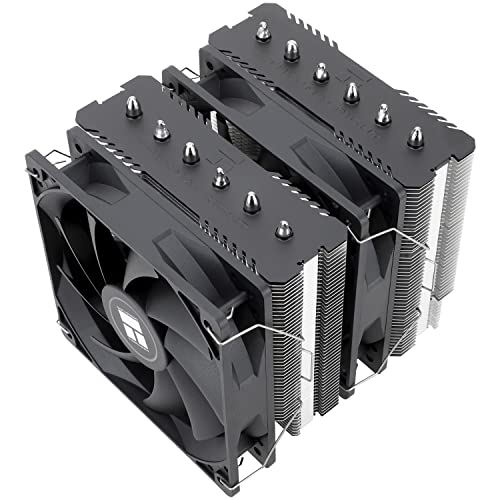
For most builders a high-end dual-tower air cooler like the Thermalright Peerless Assassin 120 SE is the smartest buy: it tames all but the hottest CPUs, costs a fraction of liquid, and never leaks or fails a pump. Choose a 360mm AIO such as the ARCTIC Liquid Freezer III Pro when you run a top-tier CPU, want lower peak temps, or care about the clean look inside a glass case.
Key Differences
- Cooling ceiling: A 360mm AIO moves more heat than even the best air tower under sustained load.
- Reliability: Air coolers have no pump to fail and last a decade-plus; AIOs have a finite pump life.
- Price: Premium air runs a third to half the cost of a comparable 360mm liquid unit.
- Noise: Both can be quiet, but a large radiator lets fans spin slower at the same temperature.
- Clearance: Tall air towers can block RAM or side panels; AIOs free up space around the socket.
- Aesthetics: AIOs offer a cleaner look and ARGB flair; air is bulkier but simpler.
The Case for Air Cooling
Air cooling wins on value and peace of mind. A six-heatpipe dual-fan tower keeps a Ryzen 7 or mid-tier Intel chip well within safe temperatures for well under the cost of liquid, and there is nothing to leak, no pump to wear out, and no coolant to worry about. For the vast majority of gaming builds, a Peerless Assassin-class cooler is all you will ever need.
The main drawbacks are size and looks. Big towers can crowd tall RAM and make a compact case feel cramped, and they lack the sleek appearance many builders want behind a tempered-glass panel.
The Case for Water Cooling
Liquid cooling shines when heat output is high. A 360mm AIO like the ARCTIC Liquid Freezer III Pro or a Thermalright Aqua Elite 240 V3 pulls heat away from a power-hungry CPU faster, holding lower peak temperatures during long gaming or rendering sessions. The radiator lives at the top or front of the case, freeing space around the socket and delivering that tidy, modern look with ARGB accents.
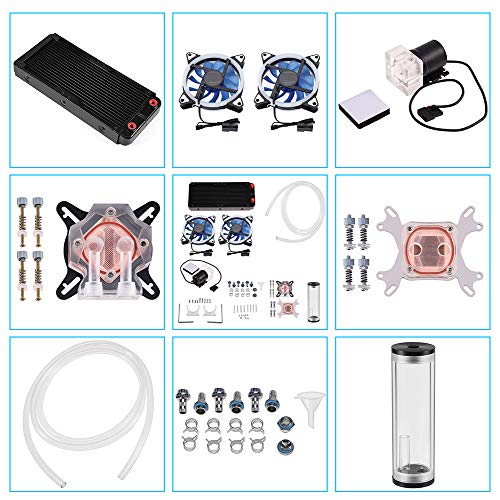
Custom loops with kits and fittings go further still for enthusiasts, but they add cost, complexity, and real maintenance. For nearly everyone, a sealed AIO is the sensible liquid choice.
Which Should You Buy?
- Mid-range gaming CPU on a budget: a premium air tower is the best value.
- Top-tier CPU or heavy rendering: a 360mm AIO holds lower peak temps.
- Compact or airflow-focused case: an AIO frees space around the socket.
- Maximum reliability with zero maintenance: air cooling wins.
- Show build behind glass: an AIO gives the cleaner, ARGB-friendly look.
Frequently Asked Questions
Does water cooling actually cool better than air?
A large 360mm AIO beats even top air towers under sustained heavy load, but for mid-range CPUs a good air cooler keeps temperatures perfectly safe with no measurable gaming disadvantage.
Can an AIO leak and destroy my PC?
Modern sealed AIOs rarely leak, but the risk is not zero and the pump has a finite lifespan. Air coolers eliminate both concerns entirely.
Is air cooling too loud for a quiet build?
No. A quality dual-fan tower runs quietly at gaming loads. A big radiator can be quieter still because its fans spin slower to shed the same heat.
Do I need liquid cooling for a Ryzen 7 9800X3D?
Not necessarily. X3D chips run cool, so a strong air cooler handles them fine. Liquid only helps if you want the lowest possible temps or a cleaner look.
Final Verdict
Buy a premium air cooler for the best mix of value, silence, and reliability on any mid-range gaming build. Step up to a 360mm AIO when you run a flagship CPU, need lower peak temperatures, or want a sleek, glass-friendly interior. Both keep 2026 hardware safe; the deciding factor is your CPU’s heat and your love of clean aesthetics.