Key takeaways
- Competitive FPS: light linear or speed switches for the fastest repeated inputs.
- Mixed gaming and work: tactile switches give feedback without slowing you down.
- Typing-heavy days: tactile or clicky switches reduce typos by confirming each press.
- Shared spaces: silent linear switches keep the noise down for everyone nearby.
What's inside
- Watch: Mechanical Keyboard Switches Explained — Video Review
- The Three Switch Families
- Reading the Spec Sheet: Force and Travel
- Hot-Swappable Boards Change the Game
- Keycaps, Sound, and Feel
- Matching a Switch to How You Play
- Tips
- Related Guides
- Frequently Asked Questions
- Conclusion
- Related Articles
- Related Guides
The switch under each keycap is the single component that decides how your keyboard feels, sounds, and responds during a match. Two boards can share the same case and RGB lighting yet play completely differently because one uses light linear switches and the other uses tactile bumps. If you have ever wondered why some keyboards feel mushy while others snap back instantly, the answer almost always comes down to switches.
- Watch: Mechanical Keyboard Switches Explained — Video Review
- The Three Switch Families
- Reading the Spec Sheet: Force and Travel
- Hot-Swappable Boards Change the Game
- Keycaps, Sound, and Feel
- Matching a Switch to How You Play
- Tips
- Related Guides
- Frequently Asked Questions
- Conclusion
- Related Articles
- Related Guides
In this guide you will learn the three main switch families, what the numbers on a spec sheet actually mean, and how to match a switch type to the way you play and type. By the end you will be able to read a product listing and know exactly what the typing experience will be like before you ever press a key.
As an Amazon Associate we earn from qualifying purchases at no extra cost to you.





⚡ Save on Your Next PC — Amazon Prime
Prime members get fast free shipping on the systems above, plus early access to Prime Day & Black Friday PC deals. New members get a 30-day free trial.
Watch: Mechanical Keyboard Switches Explained — Video Review
The Three Switch Families
Almost every mechanical switch falls into one of three groups. Linear switches move straight down with no bump and no click, which makes them smooth and quiet; they are the go-to for fast-twitch shooters where rapid double-taps matter. Tactile switches add a small bump partway through the press so you can feel the moment the key registers, which many people prefer for a mix of gaming and typing. Clicky switches add that same bump plus an audible click, satisfying to some and distracting to others (and to your teammates on voice chat).
Reading the Spec Sheet: Force and Travel
Two numbers describe how a switch behaves. Actuation force, measured in grams, is how hard you push before the key registers; lighter switches around 45g feel effortless, heavier ones near 60g resist accidental presses. Travel distance is how far the key moves, split into actuation point (where it registers) and bottom-out (where it stops). Speed switches shorten the actuation point to register sooner, which shaves milliseconds off every keypress in competitive play.
Hot-Swappable Boards Change the Game
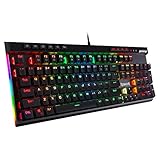
A hot-swappable keyboard lets you pull switches out and drop new ones in without soldering, so a single board can evolve as your taste changes. Boards like the Redragon Mechanical Gaming Keyboard with hot-swappable red switches or the AULA F75 Pro with pre-lubed Reaper switches are built for exactly this kind of experimentation. If you are unsure which feel you prefer, a hot-swap board is the cheapest way to try several without buying several keyboards.
Keycaps, Sound, and Feel
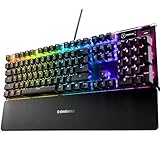
Switches set the foundation, but keycap material shapes the final experience. Double-shot PBT keycaps resist the greasy shine that cheaper ABS develops and produce a deeper, less hollow sound. Pre-lubed switches and factory sound-dampening foam, found on boards such as the Razer BlackWidow V4 X, further smooth out the typing acoustics. If a quiet office or shared room matters, look for linear or “silent” switches paired with PBT caps.
Matching a Switch to How You Play
- Competitive FPS: light linear or speed switches for the fastest repeated inputs.
- Mixed gaming and work: tactile switches give feedback without slowing you down.
- Typing-heavy days: tactile or clicky switches reduce typos by confirming each press.
- Shared spaces: silent linear switches keep the noise down for everyone nearby.
Tips
- Buy a cheap switch tester or a hot-swap board before committing to a full set you cannot change.
- Pair heavier switches with a wrist rest to reduce fatigue during long sessions.
- Prefer PBT keycaps over ABS if you want the legends and finish to last for years.
- Ignore RGB when choosing a switch, lighting has zero effect on how the keyboard feels.
Frequently Asked Questions
Are red switches always the best for gaming?
Reds are popular because they are light and linear, which suits fast inputs, but “best” depends on you. Plenty of pros game on tactile browns or speed silvers. If you also type a lot, a tactile switch may serve you better overall.
Do clicky switches actually make you type faster?
Not directly. The click is feedback, not speed. Some people type more accurately because the sound confirms each keypress, but raw speed comes from muscle memory and a comfortable layout, not the click itself.
What does hot-swappable mean and do I need it?
It means you can replace switches by hand, no soldering. You do not strictly need it, but it is invaluable if you are still figuring out your preference or like to tinker over time.
Will heavier switches reduce accidental key presses?
Yes, to a degree. A higher actuation force means you have to push more deliberately, which helps if you rest heavy fingers on the keys, though it can cause fatigue over very long sessions.
Conclusion
Choosing a mechanical switch is less about finding the “best” option and more about matching feel, weight, and sound to how you actually play and type. Start with the family that fits your main use, pay attention to actuation force and travel, and lean toward a hot-swappable board if you want room to experiment. Get the switch right and every other upgrade feels better on top of it.