Key takeaways
- Integrated versus dedicated GPU: APU-based mini PCs handle esports and older titles, but only models with a discrete RTX card manage modern AAA games smoothly.
- Cooling design: Small chassis trap heat, so prioritize systems with proven thermal solutions and quiet fan profiles to avoid throttling.
- Memory type and capacity: Look for 16GB or more, and note whether RAM is soldered LPDDR5 or upgradeable SO-DIMM if you plan to expand later.
- Connectivity and display output: Triple 4K output, WiFi 6, and 2.5G LAN make these boxes flexible for both gaming and productivity.
- Warranty and support: Compact prebuilt systems benefit from longer warranties; a three-year term signals confidence in the cooling and components.
What's inside
The idea of a gaming PC that fits in your palm used to be a fantasy, but mini and micro gaming machines have matured into something genuinely capable. Whether you want a tidy living-room setup, a compact desk build, or a travel-friendly rig, today’s small-form-factor systems range from efficient APU-based mini PCs to surprisingly potent boxes with dedicated RTX graphics.
The trade-offs are real, though, and a tiny chassis constrains cooling and upgrade paths in ways a full tower does not. This roundup highlights the standout micro gaming PCs of 2026 and explains how to match one to your games without being surprised by thermal or GPU limits.
As an Amazon Associate we earn from qualifying purchases at no extra cost to you. Product prices and availability are accurate as of the date shown and are subject to change.


🎮 Get More From Your Setup — Free
Prime Gaming gives you free PC games every month, in-game loot, and a free Twitch channel sub — plus fast free shipping on all the gear above. New members get a 30-day free trial.
Watch: Best Micro Gaming PC — Video Review
How to Choose a Micro Gaming PC
- Integrated versus dedicated GPU: APU-based mini PCs handle esports and older titles, but only models with a discrete RTX card manage modern AAA games smoothly.
- Cooling design: Small chassis trap heat, so prioritize systems with proven thermal solutions and quiet fan profiles to avoid throttling.
- Memory type and capacity: Look for 16GB or more, and note whether RAM is soldered LPDDR5 or upgradeable SO-DIMM if you plan to expand later.
- Connectivity and display output: Triple 4K output, WiFi 6, and 2.5G LAN make these boxes flexible for both gaming and productivity.
- Warranty and support: Compact prebuilt systems benefit from longer warranties; a three-year term signals confidence in the cooling and components.
The Best Micro Gaming PCs Reviewed
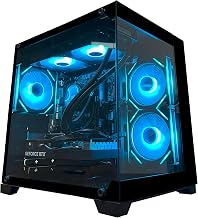
Continuum Micro RTX 5060 Ti 16GB / Ryzen 7 5700X
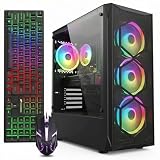
This is the performance leader, packing an 8-core Ryzen 7 and a full RTX 5060 Ti 16GB into a compact case with 32GB of RAM. Its three-year warranty and real desktop GPU make it the pick for serious 1080p and 1440p gaming.
Continuum Micro RTX 5060 Ti 8GB / Ryzen 7 5700X
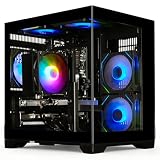
A slightly more affordable sibling, this build keeps the same capable Ryzen 7 and 32GB memory while stepping down to the 8GB RTX 5060 Ti. It still delivers strong frame rates in modern titles.
KAMRUI Hyper H2 (Core i9-14900HX)
For those who want raw CPU power in a tiny footprint, the 24-core i9-14900HX Hyper H2 is remarkable. It leans on integrated graphics, so it shines in esports, emulation, and productivity more than AAA gaming.
KAMRUI E3B (Ryzen 7 7730U)
A tidy, efficient mini PC with 16GB RAM and triple 4K output, the E3B is best for lighter gaming, streaming, and a clean home-office setup where size and silence matter most.
ACEMAGIC K1 (Ryzen 7 7730U)
Similar in spirit to the KAMRUI models, the K1 focuses on quiet cooling and multitasking with six USB ports and WiFi 6. It is a great choice for home office use with light gaming on the side.
Frequently Asked Questions
Can a micro PC really play modern AAA games?
Yes, but only models with a dedicated RTX GPU like the Continuum builds. APU-based mini PCs are best suited to esports, indie, and older titles.
Do these systems run hot?
Small chassis concentrate heat, so cooling quality varies widely. Systems with well-engineered thermal designs stay quiet, while cheaper boxes may throttle under sustained load.
Are micro gaming PCs upgradeable?
It depends. Many allow RAM and SSD upgrades, but soldered LPDDR5 memory and non-standard GPUs limit how far you can take them compared to a tower.
Is a mini PC good for a living-room setup?
Absolutely. Their small size, quiet operation, and multiple display outputs make them ideal for connecting to a TV for couch gaming and media.
Final Thoughts
The Continuum Micro with the RTX 5060 Ti 16GB is the clear winner for genuine gaming performance in a compact body, while the KAMRUI Hyper H2 is unbeatable for CPU-heavy tasks. For a quiet, efficient home-office box with light gaming, the ACEMAGIC K1 is a smart, affordable pick.