Key takeaways
- Graphics card board power: approximately 220–250W, depending on model
- Ryzen 7 3700X during a demanding workload: approximately 90W
- Motherboard, memory, SSDs, fans, and USB devices: approximately 70W
- Transient and aging reserve: approximately 100W
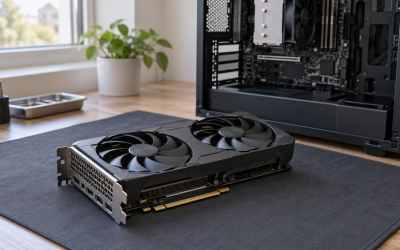
The best graphics cards GPUs for 3700X owners are the Radeon RX 9060 XT or GeForce RTX 5060 Ti for sensible 1080p, the GeForce RTX 5070 or Radeon RX 9070 for balanced 1440p, and the RTX 5070 Ti or RX 9070 XT when image quality matters more than avoiding every CPU limit.
AMD’s Ryzen 7 3700X remains an eight-core, 16-thread PCIe 4.0 processor, but it is no longer an ideal match for the fastest modern GPUs at high-refresh 1080p. At 1440p, however, the graphics card does more of the work, making a stronger GPU worthwhile. The right choice depends on resolution, refresh rate, ray tracing, power supply capacity, and whether a future CPU upgrade is planned.
Quick GPU decision matrix for the Ryzen 7 3700X
| Gaming situation | Best-fit GPU class | Recommended examples | Why it fits |
|---|---|---|---|
| 1080p, 60–144Hz, value-focused | 8–16GB mainstream | Radeon RX 9060 XT 16GB, GeForce RTX 5060 Ti 16GB | Strong performance without paying for frames the 3700X may not deliver |
| 1080p, 165–240Hz esports | Upper-mainstream | GeForce RTX 5070, Radeon RX 9070 | High frame rates, although competitive games may become CPU-limited |
| 1440p, 60–165Hz | Upper-mainstream to performance | GeForce RTX 5070, RTX 5070 Ti, Radeon RX 9070 | Good balance between GPU workload and the 3700X’s remaining capability |
| 1440p ultra, ray tracing, or long-term use | Performance class with 16GB | Radeon RX 9070 XT, GeForce RTX 5070 Ti | More shader performance and memory headroom; some games will still be CPU-limited |
| 4K, heavy ray tracing, or a future CPU upgrade | High-end | GeForce RTX 5080 or Radeon RX 9070 XT and above | Reasonable only if upgrading the platform or accepting lower CPU-limited frame rates |
Best balanced choices for most 3700X systems
GeForce RTX 5070: the practical 1440p ceiling for many builds
The RTX 5070 is a strong match for 1440p gaming with the 3700X. It has enough performance for high settings and supports modern upscaling and frame-generation features, while its power requirements are generally easier to accommodate than those of higher-tier cards.
At 1080p, the 3700X can limit average frame rates in simulation games, large multiplayer matches, and esports titles. At 1440p, the additional GPU workload shifts the balance toward the graphics card. Use a frame-rate cap around 120 or 144fps if your monitor supports it; this reduces CPU spikes and makes frame pacing more consistent.
Choose the RTX 5070 if ray tracing, DLSS support, streaming features, or lower power consumption matter. A 12GB model is adequate for current 1440p settings, but it leaves less long-term texture headroom than 16GB alternatives.
Radeon RX 9070: the high-value 16GB 1440p option
The RX 9070 is a compelling alternative for rasterized 1440p gaming. Its 16GB memory capacity is useful for high-resolution textures, large open-world games, and future titles that exceed the comfortable limits of 12GB cards.
The 3700X will not always allow the RX 9070 to reach its full potential at 1080p, but this is less damaging at 1440p. If the games you play are primarily rasterized and your power supply is suitable, the RX 9070 is one of the most sensible performance upgrades for an existing AM4 system.
Its main trade-off is ray tracing performance and feature preference. Check the individual games you play rather than assuming that a faster raster card will also be faster with every ray-traced setting enabled.
Best value picks: RX 9060 XT and RTX 5060 Ti
For a 3700X paired with a 1080p monitor, the RX 9060 XT 16GB and RTX 5060 Ti 16GB are often more rational than an expensive high-end GPU. They can deliver high settings at 1080p and competent 1440p performance without creating an extreme CPU-GPU mismatch.
Prefer the 16GB version where the price difference is reasonable. VRAM does not directly increase frame rate, but insufficient VRAM can cause texture streaming problems, stutter, or forced reductions in texture quality. The 8GB versions can still work for competitive games and lighter titles, but they offer less flexibility for new AAA releases.
These cards also suit older 550W–650W power supplies, provided the unit is a reputable model with the necessary connectors. Confirm the exact board-partner card’s power recommendation before buying.
When an RTX 5070 Ti or RX 9070 XT makes sense
The RTX 5070 Ti and RX 9070 XT are appropriate if you use a 1440p high-refresh monitor, want ultra settings, or intend to replace the 3700X later with a faster AM4 processor such as the Ryzen 7 5700X3D, where the motherboard BIOS supports it.
With the 3700X still installed, expect diminishing returns at 1080p. The GPU may be capable of producing 200fps, while the CPU supplies only 130–170fps in a busy game. At 1440p ultra, the same card may become the limiting component and provide a more worthwhile improvement.
These GPUs generally call for a quality 650W–750W power supply, depending on the specific model and the rest of the system. Avoid pairing a high-power graphics card with an old, unidentified, or low-quality unit simply because its label shows enough watts.
PCIe compatibility: what the 3700X platform can and cannot do
The Ryzen 7 3700X supports PCIe 4.0 when installed on a compatible motherboard, such as many B550 and X570 boards. Some older B450 and X470 boards can support PCIe 4.0 only in limited configurations or may run the slot at PCIe 3.0, depending on the board firmware and manufacturer policy.
Modern graphics cards are backward-compatible, so a PCIe 4.0 or PCIe 5.0 GPU will work in a PCIe 3.0 x16 slot. The important exception is a card using a reduced x8 or x4 interface. On PCIe 3.0, those cards have less bandwidth available and may show a larger performance loss in some games, especially when VRAM is nearly full.
| Interface link | Theoretical one-way bandwidth | Practical implication |
|---|---|---|
| PCIe 3.0 x16 | About 15.8GB/s | Usually fine for x16 GPUs; less ideal for reduced-lane cards |
| PCIe 4.0 x16 | About 31.5GB/s | Normal target for a 3700X on B550/X570 |
| PCIe 4.0 x8 | About 15.8GB/s | Equivalent link bandwidth to PCIe 3.0 x16 |
Before purchasing, install the latest stable motherboard BIOS, place the GPU in the top full-length slot, and check the link width with a hardware information utility. Enable Resizable BAR, called Smart Access Memory on compatible AMD systems, if the BIOS exposes the option. It will not remove a CPU bottleneck, but it can improve GPU access to memory in supported games.
Power supply calculations for a 3700X upgrade
A realistic power estimate should include the whole system, not only the GPU. For example, consider a 3700X system with an RX 9070:
- Graphics card board power: approximately 220–250W, depending on model
- Ryzen 7 3700X during a demanding workload: approximately 90W
- Motherboard, memory, SSDs, fans, and USB devices: approximately 70W
- Transient and aging reserve: approximately 100W
That produces an estimated requirement of 480–510W under a heavy mixed load. A quality 650W supply therefore gives reasonable margin, while a 550W unit may work only if it is a strong, modern model and the GPU’s manufacturer recommendation allows it. For an RTX 5070 Ti or RX 9070 XT, a quality 750W supply is a safer general target. Use separate power cables where the GPU requires multiple connectors, rather than relying on one heavily loaded daisy-chain cable.
How to minimize a 3700X bottleneck
At 1080p
- Use a frame cap slightly below the monitor’s refresh rate, such as 141fps for a 144Hz display.
- Lower CPU-heavy settings first: view distance, crowd density, simulation quality, and shadows.
- Keep GPU-heavy settings such as texture quality high if VRAM allows; lowering them will not fix a CPU limit.
- Use a faster AM4 CPU if your motherboard supports it. The Ryzen 7 5700X3D is a particularly relevant upgrade for high-refresh gaming.
At 1440p
- Start with high settings rather than ultra, then raise textures if the card has 16GB of VRAM.
- Use DLSS or FSR quality mode when a demanding game cannot hold the desired frame rate.
- Enable ray tracing selectively; reflections and global illumination often cost more than they improve image quality.
- Monitor GPU utilization. If it stays near 95–99%, the GPU is the limit and a faster card can help. If it repeatedly falls below about 90% while one or more CPU cores are busy, the processor is limiting performance.
Final buying recommendation
For most existing 3700X PCs, buy the RX 9060 XT 16GB or RTX 5060 Ti 16GB for 1080p, the RTX 5070 or RX 9070 for balanced 1440p, and the RX 9070 XT or RTX 5070 Ti for demanding 1440p use. Avoid paying for an RTX 5080-class card unless you are also planning a CPU and platform upgrade, or you primarily play at 4K where the graphics card becomes the dominant limit.
The best graphics cards GPUs for 3700x systems are not determined by maximum benchmark speed alone. Match the GPU to your display, verify PCIe lane behavior, reserve enough PSU capacity, and choose 16GB when keeping the system for several years matters more than the lowest initial price.