Key takeaways
- Switch type: Linear switches suit twitchy shooters, tactile switches reward deliberate typists, and Hall-effect magnetic switches let competitive players tune actuation depth per key.
- Hot-swap sockets: A hot-swappable PCB lets you change switch feel later without soldering, turning a cheap board into a platform you can grow into.
- Layout and size: Full-size boards keep the numpad, while 75%, 65%, and 60% layouts free up desk space for wide, low-sensitivity mouse swings.
- Connectivity: Wired guarantees the lowest latency, but modern budget wireless with a 2.4GHz dongle is now fast enough for all but the most elite play.
- Build and stabilizers: An aluminum plate and pre-lubed stabilizers do more for daily feel than flashy lighting, so prioritize a solid chassis over gimmicks.
What's inside
You do not need to spend a fortune to get a keyboard that keeps up with fast-paced ranked matches in 2026. The budget mechanical scene has matured to the point where hot-swappable switches, per-key RGB, and genuine tournament-grade polling are showing up on boards that cost less than a decent set of keycaps did a few years ago. That means the real question is no longer “can I afford a good gaming keyboard,” but “which affordable board fits the way I actually play.”
To make that call easier, we spent time with the most popular value picks of the year, weighing switch feel, build rigidity, layout, and the extras that matter when the pressure is on. Below you will find our hands-on shortlist, followed by a buying framework and answers to the questions budget shoppers ask most often.
As an Amazon Associate we earn from qualifying purchases at no extra cost to you. Product prices and availability are accurate as of the date shown and are subject to change.


⚡ Save on Your Next PC — Amazon Prime
Prime members get fast free shipping on the systems above, plus early access to Prime Day & Black Friday PC deals. New members get a 30-day free trial.
Watch: Best Budget Gaming Keyboards 2026 — Video Review
How to Choose a Budget Gaming Keyboard
- Switch type: Linear switches suit twitchy shooters, tactile switches reward deliberate typists, and Hall-effect magnetic switches let competitive players tune actuation depth per key.
- Hot-swap sockets: A hot-swappable PCB lets you change switch feel later without soldering, turning a cheap board into a platform you can grow into.
- Layout and size: Full-size boards keep the numpad, while 75%, 65%, and 60% layouts free up desk space for wide, low-sensitivity mouse swings.
- Connectivity: Wired guarantees the lowest latency, but modern budget wireless with a 2.4GHz dongle is now fast enough for all but the most elite play.
- Build and stabilizers: An aluminum plate and pre-lubed stabilizers do more for daily feel than flashy lighting, so prioritize a solid chassis over gimmicks.
The Best Budget Gaming Keyboards Reviewed
AULA F75 Pro
The AULA F75 Pro is the standout value play of the group, pairing a 75% hot-swappable layout with wireless flexibility and a gasket-mounted feel that punches well above its price. Custom-keyboard enthusiasts love it because you can drop in new switches on a whim, while newcomers appreciate that it sounds and types great straight out of the box.
Redragon K668
Redragon’s K668 is built for players who want dedicated media and macro control without stepping up in price. Its hot-swap sockets, four extra hotkeys, and bright RGB make it a versatile pick for anyone splitting time between competitive lobbies and everyday productivity.
Redragon K556
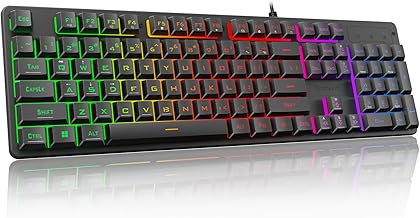
If you prefer the reassuring heft of a full-size board, the aluminum-topped Redragon K556 delivers 104 keys of durable, RGB-lit clatter. The metal plate resists flex during frantic input, and the roomy layout keeps the numpad handy for strategy and sim players.
Logitech G213 Prodigy
The Logitech G213 Prodigy is the safe, spill-resistant membrane option for players who value a quiet, cushioned keypress and rock-solid brand support. Its Mech-Dome keys mimic mechanical feedback, and the integrated palm rest makes long sessions comfortable.
AULA WIN68 HE
For competitors chasing every millisecond, the AULA WIN68 HE brings Hall-effect magnetic switches to a 60% chassis at a shockingly low price. Adjustable actuation and rapid-trigger response let you fine-tune each key for the fastest possible resets, a feature that used to be reserved for premium boards.
Frequently Asked Questions
Are budget mechanical keyboards durable enough for daily gaming?
Yes. Most mechanical switches on these boards are rated for tens of millions of keystrokes, and models with aluminum plates hold up to years of aggressive play without developing wobble or dead keys.
Is wireless too slow for competitive gaming?
Modern 2.4GHz wireless on boards like the AULA F75 Pro delivers latency low enough that the vast majority of players cannot feel a difference versus wired. For absolute elite tournament use, wired remains the conservative choice.
What does hot-swappable actually mean for me?
A hot-swappable board lets you pull out a switch and press in a different one with no soldering. It means you can change the entire feel of your keyboard later for the price of a switch set instead of a whole new board.
Do I need Hall-effect switches?
Not everyone does, but if you play reaction-heavy shooters, the adjustable actuation and rapid trigger on a Hall-effect board like the WIN68 HE offer a real competitive edge that traditional switches cannot match.
Final Thoughts
Budget no longer means compromise in 2026. Whether you gravitate toward the tinker-friendly AULA F75 Pro, the feature-packed Redragon K668, or the speed-tuned AULA WIN68 HE, every board on this list earns its place. Match the switch type and layout to your genre of choice, prioritize a rigid build, and you will walk away with a keyboard that feels far more expensive than it is.