Key takeaways
- Raw performance: The 5080 ships with roughly 20% more CUDA cores and higher memory throughput, translating to about a 15–20% frame rate lead at 4K and a smaller gap at 1440p where CPUs increasingly intervene.
- Memory: Both carry 16GB of GDDR7 on a 256-bit bus, so VRAM capacity is a wash — the 5080 simply feeds it faster thanks to higher-clocked modules.
- Power and PSU: The 5080 draws around 360W versus roughly 300W for the 5070 Ti, which often decides whether you can keep your existing power supply.
- Cooling and size: 5080 partner cards trend larger — the ASUS ROG Astral RTX 5080 is a 3.8-slot, four-fan design — while 5070 Ti models are more likely to clear compact cases.
- Feature parity: DLSS 4 with Multi Frame Generation, PCIe 5.0, DisplayPort 2.1 and full Blackwell encode/decode are identical on both, so no feature is gated behind the higher tier.
- Value curve: The 5070 Ti consistently wins on frames per dollar; the 5080 wins on absolute ceiling and longevity at 4K.
What's inside
The GeForce RTX 5080 and RTX 5070 Ti are the two cards most enthusiasts actually shortlist in 2026. They share the same GB203 silicon, the same 16GB of GDDR7 on a 256-bit bus, and the same DLSS 4 feature set — yet they occupy noticeably different price brackets and target noticeably different displays. That overlap is exactly what makes the decision tricky: on paper they look like siblings, but in practice one is a 4K card with headroom and the other is a high-refresh 1440p card that can stretch to 4K with upscaling.
Now that Blackwell has been on shelves for a full generation cycle, supply has normalized, partner designs have matured, and driver-level performance is well understood. That means the choice is no longer about availability — it’s about how much you’re willing to pay for roughly 15–20% more raster performance, higher sustained clocks, and beefier cooling. Below we break down where each card wins, which board partner models are worth your money, and how to match the right GPU to your monitor and CPU.
As an Amazon Associate we earn from qualifying purchases at no extra cost to you. Product prices and availability are accurate as of the date shown and are subject to change.




⚡ Save on Your Next PC — Amazon Prime
Prime members get fast free shipping on the systems above, plus early access to Prime Day & Black Friday PC deals. New members get a 30-day free trial.
Watch: RTX 5080 vs 5070 Ti: Worth It in 2026? — Video Review
Quick Verdict
Buy the RTX 5080 if you game at 4K, run a 240Hz+ panel, or do GPU-accelerated creative work where render time is money — it’s the faster card with more thermal and power headroom, and premium models like the ASUS ROG Astral RTX 5080 or TUF Gaming RTX 5080 OC keep it quiet under sustained load. Buy the RTX 5070 Ti if you’re primarily a 1440p high-refresh gamer, or a 4K player comfortable leaning on DLSS 4 — it delivers the large majority of the 5080’s real-world experience for meaningfully less money, and it’s easier to fit into a mid-range PSU and case.
Key Differences
- Raw performance: The 5080 ships with roughly 20% more CUDA cores and higher memory throughput, translating to about a 15–20% frame rate lead at 4K and a smaller gap at 1440p where CPUs increasingly intervene.
- Memory: Both carry 16GB of GDDR7 on a 256-bit bus, so VRAM capacity is a wash — the 5080 simply feeds it faster thanks to higher-clocked modules.
- Power and PSU: The 5080 draws around 360W versus roughly 300W for the 5070 Ti, which often decides whether you can keep your existing power supply.
- Cooling and size: 5080 partner cards trend larger — the ASUS ROG Astral RTX 5080 is a 3.8-slot, four-fan design — while 5070 Ti models are more likely to clear compact cases.
- Feature parity: DLSS 4 with Multi Frame Generation, PCIe 5.0, DisplayPort 2.1 and full Blackwell encode/decode are identical on both, so no feature is gated behind the higher tier.
- Value curve: The 5070 Ti consistently wins on frames per dollar; the 5080 wins on absolute ceiling and longevity at 4K.
GeForce RTX 5080: The 4K Choice
The 5080 is the card to buy when you don’t want to think about settings. At 4K it holds comfortable averages in current AAA titles with ray tracing enabled and DLSS 4 in Quality mode, and its extra bandwidth keeps 1% lows tighter in heavy open-world scenes. It’s also the more sensible pick for creators — Blender, DaVinci Resolve and Stable Diffusion workloads all scale with the additional cores.
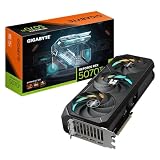
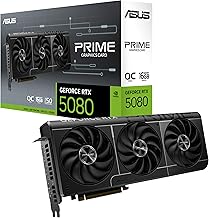
Model choice matters more here than on the tier below, because the 5080 generates real heat. The ASUS ROG Astral RTX 5080 OC and ASUS TUF Gaming RTX 5080 OC sit at the top for acoustics and sustained boost clocks, while the GIGABYTE RTX 5080 Gaming OC 16G with WINDFORCE cooling and the MSI RTX 5080 Ventus 3X OC White are excellent mid-tier options — the latter being an easy pick for white-themed builds. If space is tight, the SFF-Ready ASUS Prime RTX 5080 OC squeezes into 2.5 slots with a vapor chamber and dual BIOS, and the PNY RTX 5080 Epic-X RGB OC Triple-Fan is a solid value entry if RGB is on your list.
GeForce RTX 5070 Ti: The Value Champion
The 5070 Ti is arguably the smarter buy for most people. At 1440p it saturates 165Hz and 240Hz panels in nearly everything, and with DLSS 4 Multi Frame Generation it remains genuinely capable at 4K — you’ll trade a preset tier or two in the most demanding titles, not playability. Its 16GB frame buffer means texture quality never has to be the compromise.
It’s also the friendlier card to build around. Lower board power means a quality 750W PSU is typically sufficient, partner designs are usually two to three slots, and thermals are easier to manage in airflow-restricted cases. If your monitor is 1440p, that saved budget is better spent on a faster CPU, more NVMe storage, or the display upgrade itself.
Which Should You Buy?
- For 4K 120Hz+ gaming: pick the RTX 5080 — the headroom is worth it, and ray-traced titles benefit most.
- For 1440p high-refresh: pick the RTX 5070 Ti; you’ll be CPU-limited before the 5080 pulls meaningfully ahead.
- For small form factor builds: pick the ASUS Prime RTX 5080 OC if you want 5080 performance in 2.5 slots, otherwise a compact 5070 Ti.
- For content creation and AI workloads: pick the RTX 5080 — render and iteration times scale directly with core count.
- For best value per frame: pick the RTX 5070 Ti and redirect the savings elsewhere in your build.
Frequently Asked Questions
Is 16GB of VRAM enough in 2026?
For 4K gaming with ray tracing and high-res texture packs, 16GB remains sufficient in the vast majority of titles. A handful of poorly optimized releases will push close to the limit, but neither card is disadvantaged since both offer identical capacity.
What power supply do I need?
Plan on a quality 850W unit for the RTX 5080 and 750W for the RTX 5070 Ti with a modern mainstream CPU. Both use the 12V-2×6 connector; use the included adapter or a native ATX 3.1 cable and seat it fully.
Will a 5070 Ti bottleneck a high-end CPU?
No — if anything the reverse is true at 1440p, where CPU limits appear first. Pair either card with a current-generation eight-core chip and you’ll be GPU-bound in demanding titles.
Does the 5070 Ti support DLSS 4 Multi Frame Generation?
Yes. All Blackwell cards support the full DLSS 4 stack, including Multi Frame Generation and the transformer-based upscaling and ray reconstruction models. There is no feature gap between the two.
Final Verdict
The RTX 5080 is the better card, and the RTX 5070 Ti is the better deal — which one is right for you comes down to your monitor. If you’re gaming at 4K or working professionally on the GPU, the 5080 earns its premium, and models like the ASUS ROG Astral, TUF Gaming OC or GIGABYTE Gaming OC give you the cooling to sustain it. If you’re at 1440p, the 5070 Ti delivers a near-identical experience for a lot less, and that’s the pick we’d make for most builds in 2026.