Key takeaways
- Seamless whole-home coverage with one unified network name.
- Scalable packs in 2 and 3-unit options to fit different home sizes.
- Wi-Fi 7 future-proofing on the Deco 7 models for fast plans.
- Easy app setup and features like parental controls and HomeShield.
What's inside
A Wi-Fi mesh router system solves the oldest problem in home networking: dead zones. Instead of relying on a single router struggling to reach the far corners of your home, a mesh system uses multiple coordinated nodes that blanket every room in strong, seamless signal. You keep one network name as you move around, devices hand off automatically between nodes, and the whole thing is managed from a simple phone app.
In this review we focus on TP-Link’s popular Deco lineup, which spans everything from the affordable AC1900 Deco S4 to the Wi-Fi 6 Deco X55 and the newer Wi-Fi 7 Deco 7 BE23 and BE25 systems. Whether you have a modest apartment or a large multi-story home, and whether you want budget coverage or future-proof speed, there is a Deco configuration here to match your space and internet plan.
As an Amazon Associate we earn from qualifying purchases at no extra cost to you. Product prices and availability are accurate as of the date shown and are subject to change.




🎮 Get More From Your Setup — Free
Prime Gaming gives you free PC games every month, in-game loot, and a free Twitch channel sub — plus fast free shipping on all the gear above. New members get a 30-day free trial.
Watch: Wifi Mesh Router System: Review & Buyer’s Guide — Video Review
Design & Build
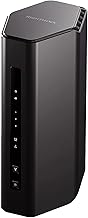
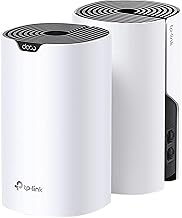
TP-Link’s Deco units share a clean, upright cylindrical design that looks tidy on a shelf and disappears into a room far better than antenna-covered routers of old. Each node in the X55 and Deco 7 lines carries multiple wired ports, with the Wi-Fi 7 models adding faster 2.5G ports for high-speed backhaul, while the value-oriented Deco S4 sticks to Gigabit connections. Packs come in two-unit and three-unit configurations, letting you scale coverage to your home size. Setup across all of them is app-driven and beginner-friendly.
Performance
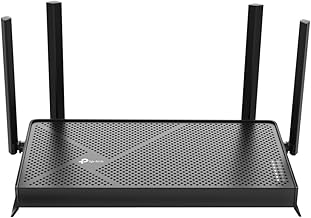
Coverage and speed scale with the model and pack size. The Deco X55 (AX3000, Wi-Fi 6) covers up to 6,500 sq. ft. in its 3-pack and is an excellent match for gigabit-or-slower plans, while its 2-pack suits smaller homes around 4,500 sq. ft. The Deco S4 (AC1900) is the budget performer, covering up to 5,500 sq. ft. in a 3-pack for basic browsing and streaming needs. Stepping to Wi-Fi 7, the Deco 7 BE25 (BE5000) and BE23 (BE3600) add MLO, wider channels, and 2.5G wired backhaul, pushing coverage past 6,500 sq. ft. and readying your network for multi-gig internet. For gaming, the Ethernet backhaul support across these systems keeps latency low and stable.
Pros & Cons
- Seamless whole-home coverage with one unified network name.
- Scalable packs in 2 and 3-unit options to fit different home sizes.
- Wi-Fi 7 future-proofing on the Deco 7 models for fast plans.
- Easy app setup and features like parental controls and HomeShield.
- Dual-band designs lack a dedicated backhaul band found on pricier tri-band kits.
- Budget S4 speed limits, since AC1900 trails modern Wi-Fi 6 and 7.
- App-first control may frustrate users who want deep manual settings.
Alternatives to Consider
If you have a very large or device-dense home, a tri-band mesh system dedicates a band to backhaul and holds speeds better under heavy load, at a higher cost. For small apartments, a single strong Wi-Fi 6 router might be all you need instead of a full mesh kit. And if you want the absolute latest speed, the Wi-Fi 7 Deco 7 BE25 is the forward-looking pick over the older but still capable Wi-Fi 6 Deco X55.
Frequently Asked Questions
How many nodes do I need?
Most homes are well served by a 3-pack, while apartments and smaller spaces can start with a 2-pack. You can add more Deco units later, since the system expands easily.
Is Wi-Fi 6 or Wi-Fi 7 the right choice?
Wi-Fi 6 systems like the Deco X55 are excellent for gigabit-or-slower internet. Choose Wi-Fi 7 Deco 7 models if you have multi-gig service or want to keep your network current for years.
Will a mesh system improve my gaming?
It improves coverage and stability, and using Ethernet backhaul between nodes keeps latency low. Mesh will not increase your internet plan’s speed, but it delivers a more consistent connection everywhere.
Is the budget Deco S4 worth it?
For basic browsing, streaming, and smaller homes on modest plans, the S4 offers solid whole-home coverage at a low price. Heavier users and faster plans benefit from stepping up to the X55 or Deco 7.
Verdict
For the best all-around value, the TP-Link Deco X55 remains our top recommendation, delivering strong Wi-Fi 6 coverage that suits the vast majority of homes and internet plans. Budget-conscious buyers with smaller spaces can rely on the Deco S4, while anyone with multi-gig internet or a desire to future-proof should choose the Wi-Fi 7 Deco 7 BE25. Match the standard and pack size to your home and plan, use wired backhaul where possible, and your dead zones will be a thing of the past.