Key takeaways
- Table of Contents 4 sections 10 min read 1 Quick Verdict 2 How to Choose 2.1 The inverse square law is why webcam mics sound thin 2.2 What noise cancellation can and cannot remove 2.3 Dual mics buy you stereo…
What's inside
Every webcam sold today advertises a microphone, and most of them advertise two. Dual omnidirectional mics, noise cancellation, AI noise reduction, beamforming — the feature lists have grown considerably more impressive than the hardware behind them. The uncomfortable truth is that webcam microphones are constrained by physics in a way that no amount of processing escapes, and the constraint is distance.
This does not make them useless. A webcam mic is the most convenient audio input that exists: no extra cable, no extra desk space, no extra thing to switch on. For plenty of people it is the right choice. But knowing which webcam mics are genuinely better than the rest, and knowing the point at which a $30 dedicated microphone makes your audio unrecognisably better, is worth ten minutes of reading. Here is how the current field actually compares.

1080P HD Webcam with Microphone, Noise Cancellation, Privacy Cover, Wide-Angle Lens, Auto Light Correction, Plug & Play USB Webcam for Laptop, Desktop, PC, Mac, Zoom, Skype, Streaming (Black)
Selected for "best webcam microphone quality compared": this listing is a lighting product (1080P HD Webcam with Microphone, Noise Cancellation, Privacy Cover, Wide-Angle L), matching the product category this article compares.
View on Amazon
NexiGo N60 1080P Webcam with Microphone, Software Control & Privacy Cover, USB HD Computer Web Camera, Plug and Play, for Zoom/Skype/Teams, Conferencing and Video Calling
Selected for "best webcam microphone quality compared": this listing is a cameras product (NexiGo N60 1080P Webcam with Microphone, Software Control & Privacy Cover, USB H), matching the product category this article compares.
View on Amazon
EMEET C960 1080P Webcam with Microphone, 2 Mics, 90° FOV, Computer Camera
Selected for "best webcam microphone quality compared": this listing is a cameras product (EMEET C960 1080P Webcam with Microphone, 2 Mics, 90° FOV, Computer Camera), matching the product category this article compares.
View on Amazon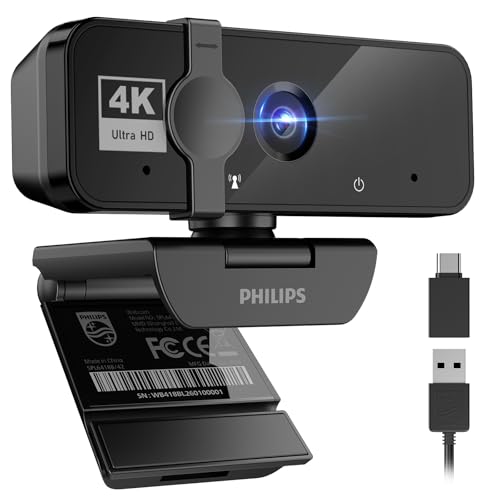
PHILIPS 4K Webcam for PC with Microphone, Computer Camera for Meetings
Selected for "best webcam microphone quality compared": this listing is a cameras product (PHILIPS 4K Webcam for PC with Microphone, Computer Camera for Meetings), matching the product category this article compares.
View on AmazonQuick Verdict
Webcam mics cluster into three tiers: single-mic budget units that are adequate for one person in a quiet room, dual-mic units that handle stereo and modest room noise, and dual-mic units with real noise-cancellation processing aimed at open-plan offices. Nothing in the category competes with a dedicated mic placed close to your mouth. The comparison below is within the category.
| Model | Price | Mic configuration | Noise handling | Best for |
|---|---|---|---|---|
| EMEET C960 1080P | $27.07 | 2 mics | Basic | Best dual-mic value |
| Acer A610 1080p | $26.99 | Multiple mics | Basic | Meetings on a budget |
| Acer A640 4K | $39.98 | AI noise-cancelling mic | Processed | Noisy rooms, cheap |
| AOC 4K Webcam | $39.99 | Noise-cancelling mic | Processed | Shared workspaces |
| EMEET NOVA 4K | $44.99 | Dual omni mics | Moderate | Wider pickup, two people |
| Dell WB3023 | $53.00 | Noise reduction mic | Processed | Conservative business tuning |
| Logitech C920S HD Pro | $59.99 | Stereo | Basic | Reliable, well-supported |
| NexiGo N680E Pro | $79.99 | Dual noise-cancelling mics | Strong | Best webcam mic setup here |
How to Choose
The inverse square law is why webcam mics sound thin
Sound intensity falls off with the square of distance. Double the distance from a sound source to a microphone and the level arriving at the capsule drops to roughly a quarter. A headset mic sits two inches from your mouth. A webcam on top of your monitor sits somewhere between twenty and thirty inches away, which is ten to fifteen times further.
The consequence is not just that you are quieter. It is that your voice and the room arrive at closer to equal levels. Keyboard clatter, the fan in your PC, the air conditioning, the reflections of your own voice off bare walls — all of it gets picked up at a level much closer to your voice than it would with a close mic. This is why webcam audio sounds hollow and roomy even when it is loud enough. The camera is not doing anything wrong; it is just far away.
What noise cancellation can and cannot remove
Modern noise suppression, including the AI-branded kind, is genuinely good at steady, predictable sounds: fan hum, air conditioning, distant traffic, refrigerator drone. It models the constant background and subtracts it. That is a real improvement and worth paying for if you work near an HVAC vent.
It is much weaker against two things. The first is transient noise — a door slam, a dog bark, keyboard clicks — which is unpredictable and often gets through, or worse, causes the suppressor to briefly duck your voice as well. The second is room reverb, because reverb is your own voice arriving slightly later off the walls, and it is spectrally identical to the thing the processor is trying to keep. No consumer webcam removes room reverb. Soft furnishings do. A rug and curtains will improve your audio more than upgrading from a one-mic to a two-mic webcam.
Dual mics buy you stereo or beamforming, and they are not the same
Two microphones can be used two ways. The simple approach is stereo capture: left and right channels, a wider sense of space. The sophisticated approach is beamforming, where the tiny time difference between the two capsules is used to work out which direction a sound came from and to attenuate everything outside a target zone in front of the camera.
Most budget “dual omni mic” webcams, including the EMEET NOVA 4K at $44.99, are doing the first, possibly with some light directional processing. Products that explicitly claim noise-cancelling dual mics, like the NexiGo N680E Pro at $79.99, are more likely doing the second. The practical difference shows up when someone else is talking in the room or a TV is on to one side. If you work alone in a quiet room, dual mics change very little.
Pickup pattern matters more than mic count
Omnidirectional means the mic picks up equally from all directions, which is what most webcams use and is exactly why they capture so much room. It is also why they work reasonably for two people sitting side by side at the same desk, which is a genuine use case. A directional pattern would sound cleaner for one person and cut off the second. Manufacturers pick omni because it fails gracefully. Know which behaviour you want before you buy.
Sample rate and bit depth are not the problem
Webcam mic specs sometimes advertise sample rates as a quality signal. Ignore them. Voice over a conferencing platform is compressed to a narrow bitrate anyway, and the codec, not the capture format, sets the ceiling. What determines whether you sound good is mic distance, room acoustics and background noise, in that order. No spec on the box tells you about any of those.
Know the threshold where a separate mic wins
This is the honest breakpoint. If your audio is for internal meetings, casual calls, or gaming with friends, a decent webcam mic in a quiet room is fine and the convenience is worth something real. If your audio is published — streams, podcasts, recorded videos, client-facing sales calls — then a basic USB microphone placed eight inches from your mouth will outperform every webcam on this list by a margin that is not subtle. It is not a close contest, and it is not a matter of price tiers: the distance advantage is decisive on its own.
The Picks in Detail
NexiGo N680E Pro — $79.99
This is the strongest audio package among the webcams here, listing dual noise-cancelling microphones alongside 4K capture, PDAF autofocus, a 1080p 60fps mode and a built-in ring light. Two mics plus explicit noise cancellation is the configuration most likely to be doing real directional processing rather than just recording in stereo. If you want one device that handles video and audio acceptably in a room that is not silent, this is the pick.
EMEET NOVA 4K — $44.99
Dual omnidirectional mics at $44.99, paired with 4K capture and PDAF autofocus. The omni pattern means wide pickup: good if two of you share the desk, less good if the room is noisy. For a quiet home office it is more than sufficient, and the price-to-feature ratio is among the best in the category.
Acer A640 4K — $39.98
Sold specifically on its AI noise-cancelling mic, at $39.98 with 4K capture. If your main audio complaint is a constant background drone — a desktop PC’s fans, a window air conditioner, office ventilation — this is the cheapest targeted answer. Expect it to be less effective against sudden noises.
AOC 4K Webcam — $39.99
Effectively the same proposition at the same price: 4K capture with a noise-cancelling microphone, aimed at shared workspaces. Between this and the Acer A640, buy whichever is cheaper on the day; the audio specifications as published are functionally equivalent.
Dell WB3023 — $53.00
A 2K QHD camera with a Sony sensor and a noise-reduction microphone. Dell’s tuning on business peripherals tends to be conservative — less aggressive processing, fewer artefacts, a more natural if less dramatic result. For client calls where sounding normal matters more than sounding loud, that restraint is a feature.
EMEET C960 1080P — $27.07
Two mics and a 90° field of view at $27.07 makes this the value entry for dual-mic capture. The wide FOV and omni mics together suit a desk shared by two people. At this price the processing is basic, so a quiet room does most of the work, but the fundamentals are sound.
Acer A610 1080p — $26.99
Straightforward 1080p meeting camera with built-in microphones at $26.99. No claims beyond the basics, which is refreshing. It will sound like a webcam — slightly distant, slightly roomy — and for internal meetings that is entirely acceptable.
Logitech C920S HD Pro — $59.99
Listed at 1080p/30fps with clear stereo audio. Its mics are unremarkable by 2026 standards and it lacks the modern noise-suppression marketing, but the whole package is well supported, well documented and predictable. If you value not troubleshooting over having the best specification, this remains a reasonable default.
Related guides: 1080p vs 4k webcam which is worth it, best webcam for low light rooms, best webcam mount and tripod options, best webcam under 50 on a budget, best webcam with autofocus under 100
FAQ
Is a webcam microphone good enough for streaming?
For a casual stream among friends, yes. For anything you want people to watch repeatedly, no. The distance from a monitor-mounted camera to your mouth means your voice arrives at a similar level to your room, and viewers notice roomy, hollow audio much faster than they notice mediocre video. Audio is the spec that keeps an audience.
Do two microphones actually sound better than one?
Only if the camera is using them for directional processing rather than just stereo. Stereo on a voice call is largely pointless, since most platforms collapse to mono anyway. Two mics used for beamforming can meaningfully reject off-axis noise. Look for the phrase “noise-cancelling” attached to the dual-mic claim rather than “dual omni” on its own.
Will noise cancellation remove my mechanical keyboard?
Partially at best. Keystrokes are sharp transients, and suppression algorithms handle steady noise far better than sudden noise. Some clicks will get through and some may cause brief dips in your voice as the processor reacts. Moving the keyboard further from the camera, or using a quieter switch, helps more than any camera feature.
Why does my voice sound echoey even though the webcam is loud?
That is room reverb, not a microphone fault. Because the camera is far from you, it captures both your direct voice and the reflections off hard walls, floors and desks at similar levels. No webcam removes reverb. Adding soft surfaces to the room — a rug, curtains, a bookshelf, even a throw over a bare wall — reduces it immediately and costs nothing.
If I buy a separate microphone, does the webcam mic still matter?
No, and you should disable it. Having two active inputs risks the wrong one being selected by a platform after an update, and you will discover it mid-call. Pick your microphone explicitly in the audio settings of each application, and consider disabling the webcam’s microphone in your operating system’s sound settings so it cannot be chosen by accident.
Prices reflect US retail at the time of writing and change frequently; verify on the listing before you buy.