Key takeaways
- Table of Contents 4 sections 10 min read 1 Quick Verdict 2 How to Choose 2.1 What you actually lose below $50 2.2 Ignore the resolution race under $35 2.3 Fixed focus is not the compromise it sounds like 2.4…
What's inside
Under fifty dollars is the most crowded and most confusing price band in the webcam market. It contains genuinely good cameras from established brands, it contains 4K models that cost less than a decade-old 1080p model, and it contains a long tail of near-identical units from names you have never heard of selling for under twenty dollars. The specs on the listings are frequently more optimistic than the hardware.
The good news is that the floor has risen. A $25 webcam in 2026 is a substantially better device than a $25 webcam five years ago, and for a lit room and a video call, most of them are entirely adequate. The purpose of this guide is to tell you which ones are worth the money, what you are actually giving up compared to the $60–$100 tier, and which specs on a budget listing you should simply ignore.

SVPRO 1080P USB Webcam with Telephoto 5-50mm Lens, Full HD Computer Camera 100fps/60fps/30fps for Windows/Mac/Linux/Android
Selected for "best webcam under 50 on a budget": this listing is a cameras product (SVPRO 1080P USB Webcam with Telephoto 5-50mm Lens, Full HD Computer Camera 100fp), matching the product category this article compares.
View on AmazonQuick Verdict
The sweet spot is $25–$45. Below about $20 you are buying a camera with no published sensor information and unpredictable software support. Above $45 you start getting real sensor specs. Here is the field.
| Model | Price | Capture | Mic | Best for |
|---|---|---|---|---|
| Diccik 1080P Webcam | $9.98 | 1080p | Single | Absolute minimum spend |
| NIVEOLI 1080P | $12.99 | 1080p | Single | Spare or second machine |
| EMEET C950 1080P | $17.99 | 1080p | Single | Known brand, privacy cover |
| UGREEN 2K Webcam | $21.84 | 2K | Yes | Cheapest step above 1080p |
| Logitech Brio 101 | $24.99 | Full HD 1080p | Yes | Best name-brand safety pick |
| NexiGo N60 | $24.99 | 1080p | Yes | Software control, privacy cover |
| EMEET C960 1080P | $27.07 | 1080p | 2 mics | Two people at one desk, 90° FOV |
| PHILIPS 4K Webcam | $31.99 | 4K | Yes | Cheapest 4K capture |
| Acer A640 4K | $39.98 | 4K | AI noise-cancelling | Noisy rooms |
| EMEET NOVA 4K | $44.99 | 4K | Dual omni | Best overall under $50 |
How to Choose
What you actually lose below $50
Being specific about this is more useful than a general warning. Compared to the $60–$100 tier, budget webcams typically give up four things.
First, sensor area. Cameras above $50 increasingly publish their sensor size — a Sony 1/2″ on the $56.37 Acer metal-body model, a Sony 1/2.55″ on the $59.49 EMEET S600 — and cameras below $50 almost never do. Second, low-light behaviour, which follows directly from the first. Third, software: the more expensive brands ship configuration utilities that let you lock exposure, adjust field of view and save profiles. Fourth, long-term driver and firmware support, which matters more than people expect when an operating system update changes how cameras are enumerated.
What you do not lose is basic image quality in good light. In a well-lit room, a $27 camera and a $60 camera are much closer than the price difference suggests.
Ignore the resolution race under $35
You can buy a 4K webcam at $31.99 and a 1080p webcam at $24.99 from a name brand. The 4K number is real in the sense that the camera outputs a 4K stream, but the sensor behind it is small and unspecified, and the pixels on it are correspondingly tiny. Small pixels collect less light each, which means more noise in anything other than bright conditions.
Meanwhile most video calling platforms will downscale whatever you send them anyway, so the 4K figure often never reaches your audience. Under $35, treat resolution as close to irrelevant and buy on brand reliability, field of view and microphone instead. Above $40, resolution starts correlating with a camera that had money spent on it.
Fixed focus is not the compromise it sounds like
Many budget webcams use fixed focus, meaning the lens is set to a fixed distance with a depth of field wide enough to cover typical desk use. Autofocus models actively adjust. It is tempting to read autofocus as strictly better, but for a static desk setup the opposite is often true: fixed focus never hunts, never softens mid-sentence when you move your hands, and never breathes in and out looking for something to lock onto. Because you sit at roughly the same distance every day, the fixed setting is simply correct most of the time.
Autofocus earns its place when the subject distance actually changes — holding an object up to the camera, moving between sitting and standing, or shooting something other than your face. If you never do those things, fixed focus is a feature.
Field of view changes the shot more than any other budget spec
A 90° lens, like the one on the EMEET C960 1080P, takes in a wide slice of your room. That is useful if two people share a desk and a liability if your background is untidy. Narrower lenses crop closer to your head and shoulders and look more deliberate. Most budget listings publish FOV, and it affects the finished shot more than the difference between 1080p and 2K does. Read it.
Look for a privacy shutter and a real cable
Two small practical things. A physical privacy cover is standard at this price and genuinely worth having — it is the only camera security measure that cannot be defeated by software. And cable length matters more than you expect: a short cable forces the camera to live near the USB port rather than where the shot is good. Check the length before you buy a mount that puts the camera three feet away.
Plug and play, and the driver question
Nearly every camera in this band advertises plug-and-play operation, which means it conforms to the USB Video Class standard and works without vendor drivers on Windows, macOS and Linux. That is genuinely reassuring and it is why cheap webcams mostly work. The catch is that UVC gives you the camera but not the extra controls — the field-of-view presets, exposure locks and image tuning that live in vendor software. Brands like NexiGo and Logitech ship that software; anonymous brands typically do not.
The Picks in Detail
EMEET NOVA 4K — $44.99
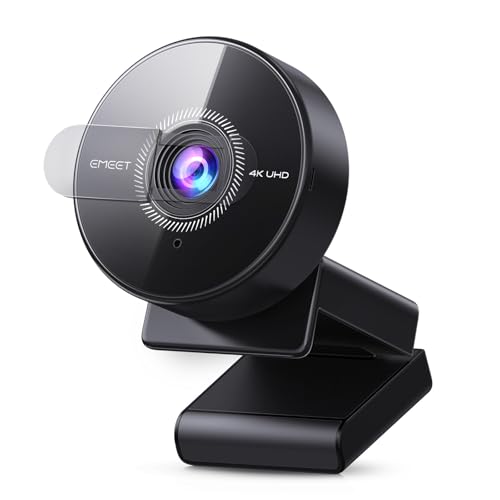
The best overall camera under fifty dollars. It combines 4K capture with PDAF — phase-detect autofocus, which locks faster and hunts less than the contrast-detection systems typical at this price — and dual omnidirectional microphones. PDAF at under $45 is the standout feature here; it is the kind of thing that normally appears further up the range. If you want one recommendation from this list, this is it.
Logitech Brio 101 — $24.99
The safety pick. At $24.99 this is the cheapest way to get a full HD camera from the brand with the deepest support, the widest mount compatibility and the most troubleshooting documentation in existence. It will not beat the EMEET on features. It will still be working, and still be supported, in five years, which is not something you can assume about a $13 camera from an unfamiliar brand.
Acer A640 4K — $39.98
Sold on its AI noise-cancelling microphone alongside 4K capture, and aimed squarely at people taking meetings in rooms with constant background noise. Noise suppression is at its best against steady sounds — fans, air conditioning, distant traffic — and considerably weaker against sudden ones like door slams and keystrokes. If a drone is your main audio complaint, this is a targeted $40 fix.
PHILIPS 4K Webcam — $31.99
Notable mostly for price: 4K capture from a recognisable consumer brand at $31.99. Treat the resolution as headroom for local recording and cropping rather than as a guarantee of a better call image, since the sensor is not specified. For a lit room it is a lot of camera for the money.
EMEET C960 1080P — $27.07
Two microphones and a 90° field of view at $27.07. The wide lens plus omnidirectional mics make this the natural pick for a desk shared by two people, or for anyone who wants more of the room in shot. The same wide lens is the reason to skip it if you want a tight, tidy head-and-shoulders frame.
NexiGo N60 — $24.99
1080p with a microphone, a privacy cover, and — the differentiator — NexiGo’s software control utility. Being able to adjust and lock image settings is unusual at $25 and it directly addresses the biggest frustration with cheap cameras, which is automatic exposure that keeps changing its mind mid-call.
UGREEN 2K Webcam — $21.84
A 2K camera with a microphone at $21.84 from a brand better known for cables and chargers but with a real support presence. 2K is a sensible middle ground: more capture headroom than 1080p without the USB bandwidth and CPU cost of 4K.
EMEET C950 1080P — $17.99
A basic 1080p camera with a microphone and a physical privacy cover from a brand that also makes the better cameras higher on this list. At $17.99 it is a sensible choice for a second machine, a family PC or a spare.
NIVEOLI at $12.99 and Diccik at $9.98
These represent the floor. Both are 1080p with a microphone and both will produce a working picture in a bright room. There is no published sensor information, the software support is minimal, and expectations should be set accordingly. Buy one as a backup or for a machine that takes two calls a month; do not buy one as your daily camera if how you look on calls matters at all.
Related guides: 1080p vs 4k webcam which is worth it, best webcam for low light rooms, best webcam microphone quality compared, best webcam mount and tripod options, best webcam with autofocus under 100
FAQ
Is a $25 webcam actually good enough for work calls?
In a well-lit room, yes. Conferencing platforms compress and downscale your video heavily, which flattens the difference between a $25 camera and a $60 one. The gap opens up in dim light, where the cheaper sensor produces visible noise and the camera drops frame rate to compensate. Fix the lighting and the cheap camera holds up remarkably well.
Should I buy a $32 4K webcam or a $25 1080p one?
If you record locally or crop your footage, take the 4K for the headroom. If your video only ever goes into a call, take the better-supported 1080p camera, because the platform will downscale you anyway and brand support is worth more day to day than an unused resolution mode.
Why do so many cheap webcams look identical?
Because many are built on the same reference designs from the same handful of manufacturers, rebadged under different names. That is not automatically bad — the underlying modules are competent — but it does mean the brand name carries little information about quality or longevity, and that software support and warranty handling vary enormously between sellers of physically similar products.
Do I need autofocus at this price?
Usually not. For a person sitting at a fixed distance from a desk, fixed focus is stable and predictable while autofocus can hunt and soften when you gesture. Autofocus matters if you hold objects up to the camera or change your distance frequently. Budget autofocus systems are usually contrast-based, which hunt more than the phase-detect systems on pricier models.
What is the single best upgrade after a budget webcam?
Lighting, then a mount. A lamp placed in front of you at roughly eye height improves your image more than any camera upgrade in this price band, because light reaching the sensor is the real constraint. A mount that puts the camera at eye level rather than clipped to a monitor bezel is the second-cheapest meaningful improvement.
Prices reflect US retail at the time of writing and change frequently; check the listing before buying.