Key takeaways
- Table of Contents 4 sections 11 min read 1 Quick Verdict 2 How to Choose 2.1 The 1/4″-20 thread is the standard and nearly everything uses it 2.2 Eye-line geometry is the whole point 2.3 Gooseneck versus articulated arm 2.4…
What's inside
Nobody plans to buy a webcam mount. You buy a camera, clip it to the top of your monitor, and discover that the resulting shot looks down your nose, catches the ceiling light, and shakes every time you type. Then you find out that the monitor clip does not grip an ultrawide’s curved bezel, or that your laptop lid is too thin, or that you want the camera below your face for a hands-on demo and there is simply no way to get it there.
A mount is the cheapest meaningful upgrade to how you look on camera, and the gap between a $12 gooseneck and a $30 articulated arm is small compared to the difference either makes over a monitor clip. This guide covers the mounting hardware itself: the thread standard you need to know, the geometry of a flattering angle, and which style of stand suits which desk. Prices below are current US retail.

30 Inch Webcam Stand Camera Mount, Upgraded Thick Base Flexible Gooseneck Camera Stand Desk Webcam Mount Clamp for Logitech Webcams C930e C930 C920 C922x C922 Brio 4K C925e C615, Gopro Hero 8 7 6 5 4
Selected for "best webcam mount and tripod options": this listing is a lighting product (30 Inch Webcam Stand Camera Mount, Upgraded Thick Base Flexible Gooseneck Camera), matching the product category this article compares.
View on Amazon
InnoGear Webcam Stand Arm for Desk Camera Mount Holder for Logitech Webcam
Selected for "best webcam mount and tripod options": this listing is a cameras product (InnoGear Webcam Stand Arm for Desk Camera Mount Holder for Logitech Webcam), matching the product category this article compares.
View on Amazon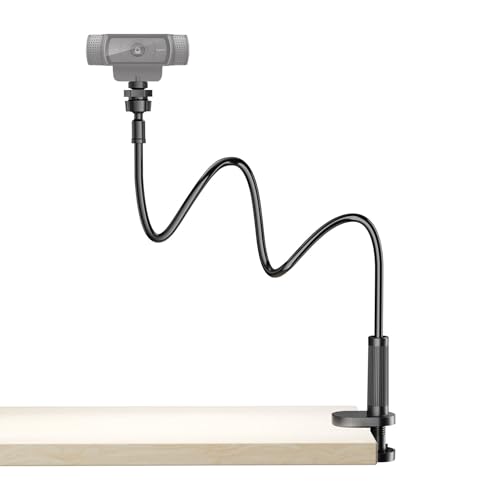
Flexible Webcam Stand Mount for Desk, Gooseneck Webcam Tripod with Clamp, Desktop Phone Holder & Table Top Tripod Compatible with Action Camera Gopro C922 C930e C920S C920 C615 C960 C920x Brio
Selected for "best webcam mount and tripod options": this listing is a lighting product (Flexible Webcam Stand Mount for Desk, Gooseneck Webcam Tripod with Clamp, Deskto), matching the product category this article compares.
View on Amazon
Ponlrie Webcam Stand for Desk, 28" Telescopic Tripod with Phone Holder, Desktop Webcam Mount Compatible with Logitech Webcam C922 C930e C920S C920 C615 C960 C920x BRIO 4K NexiGo N60, 1/4'' Thread
Selected for "best webcam mount and tripod options": this listing is a cameras product (Ponlrie Webcam Stand for Desk, 28" Telescopic Tripod with Phone Holder, Desktop ), matching the product category this article compares.
View on AmazonQuick Verdict
Almost every webcam and almost every stand share the same 1/4″-20 tripod thread, so compatibility is rarely the issue — reach, stability and clamp type are. Pick a gooseneck for flexibility on a cheap desk, an articulated boom arm for stability and repeatability, a floor tripod when the desk is out of the question, and a mini tripod when portability matters.
| Mount | Price | Type | Reach | Best for |
|---|---|---|---|---|
| UURIG TP05 Mini Tripod | $6.98 | Desktop mini tripod | Short | Travel and laptop bags |
| Urciwos Webcam Stand | $11.99 | Gooseneck, clamp | 12.6 in | Cheapest usable upgrade |
| Flexible Gooseneck with Clamp | $15.99 | Gooseneck, clamp | Medium | Phone and webcam sharing one mount |
| NEEWER TP34 Phone Tripod | $17.99 | Flexible mini tripod | Short | Phone-as-webcam setups |
| 30 in Gooseneck Stand | $19.49 | Gooseneck, weighted base | 30 in | Desks with no clampable edge |
| InnoGear Boom Arm | $19.99 | Articulated arm, clamp | Medium | Webcam plus mic on one desk |
| InnoGear Webcam Stand Arm | $21.99 | Articulated arm, clamp | Medium | Repeatable, stable framing |
| SMALLRIG 22″ Magic Arm | $25.76 | Magic arm, C-clamp | 22 in | Overhead and heavier cameras |
| 80 in Floor Tripod | $26.99 | Floor tripod | 80 in | Standing shots, no desk space |
| NEEWER UA057 Magic Arm | $30.59 | Magic arm, desk C-clamp | 22 in | The most rigid option here |
How to Choose
The 1/4″-20 thread is the standard and nearly everything uses it
The threaded socket on the bottom of a webcam is almost always 1/4″-20 — a quarter-inch diameter, twenty threads per inch — which is the same standard used by camera tripods worldwide. This is why an $80 floor tripod listed as compatible with the Logitech C920x, C922x, C930e and MX Brio works with those cameras: they all share the thread. It is also why a webcam will happily screw onto a photography tripod you already own.
Two things to watch. First, some clip-style webcams have the thread hidden inside the folding foot, so you need to unfold the clip fully before the socket is accessible. Second, a few stands use a 5/8″ screw, the microphone-stand standard, rather than 1/4″-20 — the 22-inch desk mount listed at $26.95 explicitly calls out a 5/8″ screw because it is designed to carry mic hardware too. Adapters between the two cost very little, but check before you order.
Eye-line geometry is the whole point
The reason to mount a camera deliberately rather than clipping it to a monitor is angle. A camera positioned slightly above eye level, looking very slightly down, is the most universally flattering position: it shortens the appearance of the neck and produces a natural gaze when you look at the screen. A camera below eye level looking up is the least flattering angle in existence, which is why laptop webcams have a reputation they will never shake.
The second consideration is gaze alignment. The further the camera is from the part of the screen where the other person’s face appears, the more it looks like you are staring off to the side. Mounting a camera on a second monitor you never look at is a common and easily avoided mistake. Get the camera close to the top-centre of your primary display, at or just above eye height.
Gooseneck versus articulated arm
Goosenecks are flexible metal tubes: cheap, infinitely adjustable, and good at getting a camera into awkward positions. Their weakness is stability. A gooseneck stores energy, so a knock to the desk sets it wobbling for a second or two, and a longer gooseneck holding a heavier camera will slowly droop. They are also hard to return to exactly the same position after you move them.
Articulated arms use rigid segments with tightening joints. They cost slightly more, they hold position indefinitely, and they return to the same framing every time because the joints lock. The InnoGear arm at $21.99 and the magic arms from SMALLRIG at $25.76 and NEEWER at $30.59 all work this way. If your framing matters and you set it once, an arm is the better instrument.
Clamp compatibility is where purchases go wrong
Most desk mounts use a C-clamp that grips the edge of the desk. Check three things before buying. The clamp’s jaw depth must exceed your desktop thickness — thick butcher-block and some standing desks defeat cheap clamps. The desk must have a clampable overhanging edge, which rules out desks with a full apron or a wall-mounted rear edge if you wanted to mount at the back. And the clamp must not sit where your chair arms or keyboard tray will collide with it.
If any of those fail, a weighted-base stand solves the problem outright. The 30-inch gooseneck at $19.49 uses a thick weighted base rather than a clamp, which means it can sit anywhere on the surface at the cost of using up desk area.
Reach determines the shots you can get
Short mounts hold the camera near the desk edge. Long mounts let you place the camera over the desk, off to one side, or above a work surface for overhead shots. A 22-inch magic arm can reach out over a keyboard for top-down demonstrations. An 80-inch floor tripod, like the $26.99 model built for Logitech’s range, lets you shoot standing or from across the room, which is what you want for presenting on your feet or for a full-body fitness or instrument stream.
Longer reach also means more leverage, so the further out the camera sits, the more the mount’s rigidity matters. This is the main argument for spending $30 on a magic arm rather than $16 on a long gooseneck if you intend to fully extend it.
Cable management is not an afterthought
A USB cable hanging off a boom arm will slowly pull the camera out of alignment, and it will transmit every desk knock up into the frame. Most decent arms include cable clips; use them, and leave a small service loop of slack at the camera end so the weight of the cable hangs from the arm rather than from the camera’s mounting joint. This single habit prevents most of the mysterious slow drift people blame on cheap mounts.
The Picks in Detail
NEEWER 22″ Magic Arm with Desk C-Clamp (UA057) — $30.59
The most rigid option here. Magic arms are built for camera work, which means they hold heavier loads at full extension without creeping, and the desk C-clamp gives a solid anchor. Twenty-two inches of reach is enough to position a camera overhead for a top-down shot of your hands, your desk or a keyboard. If you shoot anything other than a static head-and-shoulders frame, this is the versatile choice.
SMALLRIG 22″ Magic Arm Clamp — $25.76
The same concept, slightly cheaper, from a brand that primarily serves camera rigs. Same 22-inch reach, same overhead capability. Between this and the NEEWER, buy on price and on which clamp geometry suits your desk edge.
InnoGear Webcam Stand Arm — $21.99
Purpose-built for webcams, with tightening joints that hold position. This is the sweet spot for someone who wants a stable, repeatable head-and-shoulders framing and nothing more exotic. Set it once, forget it, and it will be in the same place next month.
InnoGear Boom Arm for Webcam and Microphone — $19.99
Listed as compatible with both webcams and microphones including the Blue Yeti, which matters because a mic is far heavier than a webcam and an arm rated for one will comfortably hold the other. At $19.99 it is a good buy for anyone building a combined streaming and calling setup on a single desk.
30-inch Gooseneck Stand with Weighted Base — $19.49
The answer when clamping is not possible. A thick weighted base sits on the desk surface and a 30-inch gooseneck gets the camera wherever you need it. It uses more desk area than a clamp mount and it is less rigid than an arm, but it works on desks where nothing else will, including glass tops and desks with a full apron.
80-inch Floor Tripod — $26.99
Explicitly listed for Logitech’s C920x, C922x, C930e, MX Brio and Brio 501, which is simply confirmation that it uses the standard 1/4″-20 thread. Eighty inches of height means you can shoot standing, at a distance, or down at a table from above. Essential if you present on your feet; unnecessary if you never leave your chair.
Urciwos 12.6-inch Webcam Stand — $11.99
The budget entry. A short gooseneck with a clamp for under $12 that gets your camera off the monitor bezel and lets you set a proper angle. It is not rigid and it is not long, but it is a genuine improvement over a monitor clip for the price of a sandwich.
UURIG TP05 Mini Tripod — $6.98
An extendable desktop tripod that also works as a handle, at $6.98. It will not raise a camera to eye height from a desk, so pair it with a monitor riser or a stack of books, but it packs flat and it is the right thing to throw in a laptop bag for travel.
NEEWER TP34 Flexible Phone Tripod — $17.99
A small flexible tripod that handles phones as well as cameras. Worth noting if you are using a phone as your webcam, since phone mounting is the single biggest practical headache of that approach and a purpose-built flexible tripod solves it cleanly.
Related guides: 1080p vs 4k webcam which is worth it, best webcam for low light rooms, best webcam microphone quality compared, best webcam under 50 on a budget, best webcam with autofocus under 100
FAQ
Will any tripod work with my webcam?
Almost certainly, because webcams and tripods both standardise on the 1/4″-20 thread. The exceptions are webcams with no threaded socket at all — rare but they exist — and stands that use the 5/8″ microphone thread instead. Check that your camera has a visible threaded hole, sometimes hidden under the folding clip foot, and check the stand’s screw size in the listing.
Where should the camera actually sit?
At or slightly above eye level, centred on the display you look at most, and angled to look very slightly down at you. Avoid mounting it below your face, and avoid putting it on a secondary monitor you rarely look at, because your gaze will appear to wander off to the side for the whole call.
Is a gooseneck or an arm better?
An arm, if you can afford the extra ten dollars. Goosenecks are more flexible for awkward one-off positions but they wobble after a knock, they droop under weight over time, and they are hard to return to the same spot. Articulated arms lock and stay locked. For a fixed daily setup an arm is better; for occasional repositioning a gooseneck is fine.
Will a clamp mount work on my standing desk?
Check the desktop thickness against the clamp’s maximum jaw opening, which good listings publish. Thick tops and full-apron desks defeat many cheap clamps. If in doubt, a weighted-base stand like the $19.49 30-inch gooseneck sidesteps the question entirely at the cost of desk space.
Do I need a mount if my webcam already clips to my monitor?
Not strictly, but the clip forces one position: the top bezel, aimed however the hinge allows. A mount lets you set the height, distance and angle independently, which is what actually makes the shot look considered rather than incidental. It also keeps the camera stable when you type, since monitor bezels transmit desk vibration directly.
Prices reflect US retail at the time of writing and change frequently; check the current listing before ordering.