Key takeaways
- Pixel density: At 27 inches, 4K delivers roughly 163 pixels per inch versus about 109 for 1440p. Text, foliage, distant geometry, and fine textures are visibly crisper, and anti-aliasing artefacts largely disappear.
- GPU load: 4K renders 8.3 million pixels per frame against 3.7 million at 1440p. Expect a 40–50% frame rate drop in native rendering, partially recovered through upscaling and frame generation.
- Refresh rate: 1440p panels routinely hit 165–180Hz at budget prices. 4K options like the VG270K V4, XG27UCSR, and ASUS TUF VG27UQ1A now reach 160Hz+, but the entry-level Dell S2725QS caps at 120Hz.
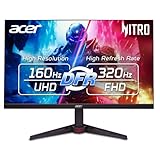
- Dual-mode flexibility: Several 4K screens can drop to 1080p at 320Hz+ for esports — the Acer Nitro hits 320Hz and the ROG XG27UCSR reaches 324Hz. No 1440p monitor offers a comparable trick.
- Screen size scaling: 1440p starts to look soft above 27 inches, which is why the 32-inch Odyssey G55C leans on its 1000R curve for immersion. 4K stays sharp from 27 up to 32 inches and beyond.
- Console fit: Current consoles target 4K output over HDMI 2.1. A 4K panel receives that signal natively; a 1440p monitor will accept it but discard detail.
What's inside
Choosing between 1440p and 4K is the single biggest decision you’ll make when buying a gaming monitor in 2026, and it’s no longer the simple “sharpness versus frame rate” trade-off it was five years ago. QHD panels now push 180Hz and beyond at prices that used to buy you a basic 60Hz screen, while 4K displays have quietly absorbed the features that once justified paying a premium for 1440p: high refresh rates, sub-1ms response times, HDMI 2.1, and dual-mode panels that switch to a low-resolution, ultra-high-refresh mode on demand.
What has actually changed is the graphics card requirement. Upscaling and frame generation have made 4K viable on mid-range hardware, but they haven’t made it free — you’re still rendering 2.25 times as many pixels as 1440p, and in competitive titles where you want raw, low-latency frames, that gap still matters. The right answer depends on your GPU, the games you play, how far you sit from the screen, and whether the monitor doubles as a work display. Below we break down where each resolution wins.
As an Amazon Associate we earn from qualifying purchases at no extra cost to you. Product prices and availability are accurate as of the date shown and are subject to change.


⚡ Save on Your Next PC — Amazon Prime
Prime members get fast free shipping on the systems above, plus early access to Prime Day & Black Friday PC deals. New members get a 30-day free trial.
Watch: 1440p vs 4K Gaming Monitor: 2026 Guide — Video Review
Quick Verdict
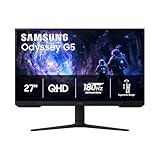
Pick 1440p if you play competitive shooters, own a mid-range GPU, or want the highest sustained frame rates for the money — the Samsung Odyssey G5 (G51F) at 27 inches and 180Hz is the reference point here, with the 32-inch curved Odyssey G55C for anyone who wants a bigger, more immersive panel. Pick 4K if you play visually rich single-player games, sit close to a 27-inch screen, game on a PS5 or Xbox Series X, or use the monitor for photo, video, or text-heavy work. The ASUS ROG XG27UCSR and Acer Nitro VG270K V4 are the flexible dual-mode picks, while the Dell S2725QS is the value-focused hybrid work-and-play option.
Key Differences
- Pixel density: At 27 inches, 4K delivers roughly 163 pixels per inch versus about 109 for 1440p. Text, foliage, distant geometry, and fine textures are visibly crisper, and anti-aliasing artefacts largely disappear.
- GPU load: 4K renders 8.3 million pixels per frame against 3.7 million at 1440p. Expect a 40–50% frame rate drop in native rendering, partially recovered through upscaling and frame generation.
- Refresh rate: 1440p panels routinely hit 165–180Hz at budget prices. 4K options like the VG270K V4, XG27UCSR, and ASUS TUF VG27UQ1A now reach 160Hz+, but the entry-level Dell S2725QS caps at 120Hz.
- Dual-mode flexibility: Several 4K screens can drop to 1080p at 320Hz+ for esports — the Acer Nitro hits 320Hz and the ROG XG27UCSR reaches 324Hz. No 1440p monitor offers a comparable trick.
- Screen size scaling: 1440p starts to look soft above 27 inches, which is why the 32-inch Odyssey G55C leans on its 1000R curve for immersion. 4K stays sharp from 27 up to 32 inches and beyond.
- Console fit: Current consoles target 4K output over HDMI 2.1. A 4K panel receives that signal natively; a 1440p monitor will accept it but discard detail.
1440p Gaming Monitors
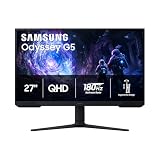
QHD remains the frame-rate enthusiast’s resolution. A 27-inch panel like the Odyssey G5 (G51F) pairs 180Hz and a 1ms response with practical competitive extras — Black Equalizer for lifting shadow detail and a Virtual Aim Point overlay — while asking far less of your graphics card than any 4K screen. On a card in the RTX 5060 Ti or RX 9060 XT class, you can realistically saturate a 180Hz panel in Valorant, CS2, Apex, or Overwatch without touching upscaling, and still run demanding single-player titles at high settings.
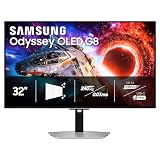
The other 1440p advantage is size for money. The 32-inch Odyssey G55C gives you a substantially larger, 1000R curved canvas at 165Hz for less than most 27-inch 4K displays cost. Pixel density drops to roughly 93 PPI at that size, so text is noticeably coarser and you’ll want to sit a little further back, but for racing, RPGs, and simulation games the wraparound effect is a genuine trade worth making.
4K Gaming Monitors
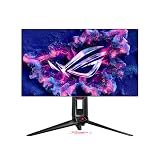
4K is now the better long-term buy for most people who aren’t chasing 240Hz-plus. The ASUS ROG XG27UCSR is the most complete option here: 162Hz, 0.03ms response, G-SYNC compatibility, 95% DCI-P3 coverage, USB-C, and a Dual Mode that flips to 1080p at 324Hz when you load a competitive title. The Acer Nitro VG270K V4 covers similar ground with 160Hz, FreeSync Premium, dual HDMI 2.1 ports, and a 320Hz mode, while the ASUS TUF VG27UQ1A offers 160Hz with ELMB Sync at a friendlier price.
If frame rate is secondary, the Dell S2725QS makes a strong case as an all-rounder: 4K IPS at 120Hz, USB-C, 99% sRGB, and full height, swivel, and pivot adjustment. It’s the natural choice for someone splitting time between console gaming, creative work, and a spreadsheet-heavy job, where 163 PPI text clarity pays dividends every single day.
Which Should You Buy?
- For competitive FPS: Pick the Samsung Odyssey G5 (G51F) — 180Hz at 1440p is easier to sustain than any 4K equivalent.
- For single-player visuals: Pick the ASUS ROG XG27UCSR or Acer Nitro VG270K V4 for maximum detail with high-refresh headroom.
- For consoles: Pick a 4K HDMI 2.1 panel like the Acer Nitro VG270K V4 or ASUS TUF VG27UQ1A.
- For work and play: Pick the Dell S2725QS — USB-C, ergonomics, and sharp text outweigh the 120Hz ceiling.
- For immersion on a budget: Pick the 32-inch Samsung Odyssey G55C and its 1000R curve.
Frequently Asked Questions
Can you see the difference between 1440p and 4K at 27 inches?
Yes, clearly, at a typical desk distance of 60–75cm. The improvement is most obvious in text, distant detail, and fine textures such as hair, grass, and chain-link fencing. The difference narrows considerably if you sit further back or use a smaller panel.
What GPU do I need for 4K gaming in 2026?
For 60fps or better with upscaling enabled, an RTX 5070 or RX 9070-class card is a sensible floor. To push a 160Hz 4K panel in demanding titles you’ll want an RTX 5080-tier GPU or above, or you’ll be relying heavily on frame generation.
Are dual-mode 4K monitors worth it?
If you split time between competitive and cinematic games, yes. The 320Hz+ 1080p modes on the Acer Nitro and ROG XG27UCSR are genuinely usable for esports, effectively giving you two monitors in one chassis rather than a marketing gimmick.
Is 1440p still worth buying in 2026?
Absolutely. It remains the best balance of sharpness, frame rate, and price, and it lets a mid-range GPU stay relevant for years longer. Only move to 4K if your hardware