Key takeaways
- Refresh rate versus resolution: Under $200 you generally pick one to prioritise. Competitive players in shooters and fighting games should chase 144Hz at 1080p; anyone playing story-driven or strategy games will get more out of a sharper 1440p panel at a lower refresh rate.
- Match screen size to resolution: Pixel density matters more than raw inches. 1080p looks crisp at 22–24 inches, acceptable at 25–27 inches from a normal viewing distance, and noticeably grainy beyond that. If you want a 27-inch screen and sharpness, budget for 1440p.
- Panel type sets the mood: IPS gives the most accurate colour and the widest viewing angles, VA delivers deeper blacks and stronger contrast for dark, atmospheric games, and TN trades colour quality for speed. Most buyers are happiest with IPS unless they mostly game at night.
- Adaptive sync is non-negotiable: FreeSync (and G-Sync Compatible certification) eliminates screen tearing without the input lag penalty of V-Sync. It costs manufacturers almost nothing to include, so treat its absence as a red flag at this price.
- Check the ports and the stand: Confirm there is a DisplayPort input if you want the full refresh rate from a desktop GPU, and check the VESA mounting pattern. Budget stands are usually tilt-only, so an arm or wall mount is often the smartest $30 you will spend.
What's inside
Shopping for a gaming monitor under $200 is genuinely difficult in 2026, because this is the price bracket where marketing language does the most work. Spec sheets throw around terms like “1ms response time,” “HDR support,” and “gaming-grade refresh rates” that mean very different things depending on the panel underneath. A 144Hz panel with sluggish pixel transitions can feel worse in a fast shooter than a well-tuned 100Hz screen, and an aggressively priced 27-inch 1080p display can look noticeably soft next to a smaller, sharper alternative. The result is a lot of buyers spending real money and ending up disappointed.
This guide cuts through that. Every monitor below sits comfortably within a $200 budget at typical street pricing, and each one is here for a specific reason — not because it has the longest spec list. We cover what actually matters at this price (panel type, real-world refresh rate, resolution versus screen size, and connectivity), then break down the standout picks for competitive play, immersive single-player gaming, and everyday mixed-use setups. If you want the short version: there is no single “best” budget monitor, only the best one for how you play.
As an Amazon Associate we earn from qualifying purchases.







⚡ Save on Your Next PC — Amazon Prime
Prime members get fast free shipping on the systems above, plus early access to Prime Day & Black Friday PC deals. New members get a 30-day free trial.
Watch: Best Gaming Monitor Under $200 — Video Review
How to Choose Gaming Monitor Under $200
- Refresh rate versus resolution: Under $200 you generally pick one to prioritise. Competitive players in shooters and fighting games should chase 144Hz at 1080p; anyone playing story-driven or strategy games will get more out of a sharper 1440p panel at a lower refresh rate.
- Match screen size to resolution: Pixel density matters more than raw inches. 1080p looks crisp at 22–24 inches, acceptable at 25–27 inches from a normal viewing distance, and noticeably grainy beyond that. If you want a 27-inch screen and sharpness, budget for 1440p.
- Panel type sets the mood: IPS gives the most accurate colour and the widest viewing angles, VA delivers deeper blacks and stronger contrast for dark, atmospheric games, and TN trades colour quality for speed. Most buyers are happiest with IPS unless they mostly game at night.
- Adaptive sync is non-negotiable: FreeSync (and G-Sync Compatible certification) eliminates screen tearing without the input lag penalty of V-Sync. It costs manufacturers almost nothing to include, so treat its absence as a red flag at this price.
- Check the ports and the stand: Confirm there is a DisplayPort input if you want the full refresh rate from a desktop GPU, and check the VESA mounting pattern. Budget stands are usually tilt-only, so an arm or wall mount is often the smartest $30 you will spend.
The Best Picks Reviewed
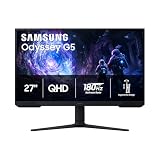
Samsung 27″ Odyssey G5 (G51F) QHD
This is the pick for anyone who wants a genuine step up in image quality rather than just a bigger screen, pairing 1440p sharpness with a 27-inch panel that finally gives that size the pixel density it deserves. It is the most demanding option here in terms of GPU requirements, so it makes the most sense if you are running something in the RTX 4060 or RX 7600 class and above.
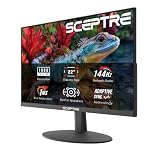
Sceptre 22-Inch 144Hz (E225W-FW144)
A focused competitive display that puts its entire budget into refresh rate and response, and the compact 22-inch size is a genuine advantage in shooters because your eyes travel less across the screen. Built-in speakers and both HDMI and DisplayPort inputs make it an easy secondary monitor later on, once you upgrade your primary.
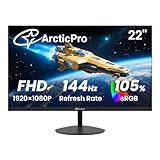
ArcticPro 22-Inch 144Hz
The 105% sRGB coverage is the differentiator here, giving this monitor noticeably richer colour than most sub-$150 panels while still hitting 144Hz for fast-paced play. It is a smart choice if you edit photos or video between gaming sessions and do not want a screen that only performs well in one discipline.
Sceptre 27-Inch Prime (E275W-FW100T)
Full 100% sRGB coverage and dual HDMI inputs make this the best all-rounder for a shared desk or console setup, and the frameless design looks far more expensive than it is. The 100Hz refresh rate is the compromise, but for single-player and cinematic games the extra screen real estate is the better trade.
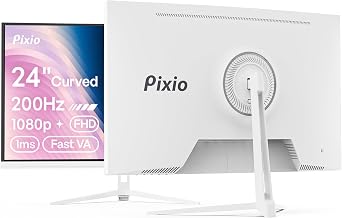
Sceptre Curved 24-Inch (C248W-1920RN)
The aggressive 1500R curve wraps the image around your peripheral vision in a way flat panels at this size simply cannot match, which pays off in racing sims, flight sims and open-world titles. With dual HDMI plus VGA it is also unusually good at accommodating older hardware and consoles alongside a modern PC.
Frequently Asked Questions
Is 144Hz worth it if my PC can only hit 80fps?
Yes, though the benefit is smaller. A higher refresh rate still reduces input latency and lets FreeSync operate across a wider range, so gameplay feels more responsive even when your frame rate falls short of the panel’s maximum. If you plan to upgrade your GPU within a year or two, buying the higher refresh rate now saves you replacing the monitor later.
Should I choose 1440p or a higher refresh rate at this budget?
It depends entirely on what you play. Competitive shooters, fighting games and fast arena titles reward refresh rate, while RPGs, strategy games and anything visually detailed benefit far more from the extra pixels. If you genuinely split your time, a 27-inch 1440p panel at a moderate refresh rate is the safer compromise.
Do I need HDR on a budget monitor?
Not really. HDR badges at this price almost always indicate a panel that can accept an HDR signal rather than one with the brightness and local dimming needed to display it convincingly. Treat it as a bonus feature, never as a reason to choose one monitor over another.
Are built-in speakers good enough for gaming?
They are adequate for menu sounds, video calls and casual play, but they lack the bass and positional accuracy that competitive gaming depends on. Consider them a convenient backup rather than a replacement for headphones or desktop speakers.
Final Thoughts
If you want the biggest genuine upgrade in image quality, the Samsung Odyssey G5 is the clear choice — 1440p at 27 inches transforms how modern games look, and nothing else here comes close on sharpness. Competitive players are better served by the Sceptre 22-Inch 144Hz, which spends every dollar where it counts for reaction-based play, while the Sceptre 27-Inch Prime remains the smartest all-rounder for anyone splitting time between gaming, work and streaming. Buy for how you actually play, not for the longest spec sheet, and any of these will outlast the budget you spent on it.