Key takeaways
- Memory: 16GB GDDR6 on a 256-bit bus for the 9070 XT versus 12GB GDDR7 on a 192-bit bus for the 5070 — AMD wins on capacity, NVIDIA on per-chip bandwidth.
- Raster performance: The 9070 XT is typically the faster card at 1440p and 4K, often by a comfortable double-digit margin depending on the engine.
- Ray tracing: RDNA 4 closed most of the historic gap, so the two trade wins in RT titles rather than NVIDIA sweeping them outright.
- Upscaling and frame generation: FSR 4 is a genuine leap in image quality, but DLSS 4 still has broader game support and Multi Frame Generation.
- Power and thermals: The 5070 draws noticeably less board power, making it the easier drop-in for smaller cases and modest power supplies.
- Software ecosystem: NVENC, CUDA and broad third-party app support favour NVIDIA; AMD counters with more VRAM headroom for local workloads.
What's inside
The 1440p sweet spot has never been more competitive than it is in 2026. AMD’s Radeon RX 9070 XT and NVIDIA’s GeForce RTX 5070 launched within days of each other and have spent the months since trading blows in review charts, driver updates and street-price swings. Both are built for the same buyer: someone running a high-refresh 1440p monitor, occasionally dabbling in 4K, who wants modern ray tracing and upscaling without paying flagship money.
On paper the two cards look closer than they play. The RX 9070 XT is an RDNA 4 part with 16GB of GDDR6 on a 256-bit bus, while the RTX 5070 is a Blackwell design with 12GB of faster GDDR7 on a narrower 192-bit bus. That 4GB gap, and the raw shader throughput behind it, is the single biggest reason the two cards diverge as games get heavier — and it matters more every year as texture budgets and ray-traced effects climb.
As an Amazon Associate we earn from qualifying purchases at no extra cost to you. Product prices and availability are accurate as of the date shown and are subject to change.




⚡ Save on Your Next PC — Amazon Prime
Prime members get fast free shipping on the systems above, plus early access to Prime Day & Black Friday PC deals. New members get a 30-day free trial.
Watch: RX 9070 XT vs RTX 5070: 2026 Comparison — Video Review
Quick Verdict
The Radeon RX 9070 XT is the better raw-performance buy for most 1440p and entry-level 4K gamers, delivering meaningfully higher frame rates and a larger frame buffer for a similar outlay. The GeForce RTX 5070 is the smarter pick if you lean on DLSS 4 Multi Frame Generation, do heavy video encoding, or run CUDA-dependent creative and AI workloads alongside gaming. Pure gamers should lean AMD; hybrid gamer-creators should lean NVIDIA.
Key Differences
- Memory: 16GB GDDR6 on a 256-bit bus for the 9070 XT versus 12GB GDDR7 on a 192-bit bus for the 5070 — AMD wins on capacity, NVIDIA on per-chip bandwidth.
- Raster performance: The 9070 XT is typically the faster card at 1440p and 4K, often by a comfortable double-digit margin depending on the engine.
- Ray tracing: RDNA 4 closed most of the historic gap, so the two trade wins in RT titles rather than NVIDIA sweeping them outright.
- Upscaling and frame generation: FSR 4 is a genuine leap in image quality, but DLSS 4 still has broader game support and Multi Frame Generation.
- Power and thermals: The 5070 draws noticeably less board power, making it the easier drop-in for smaller cases and modest power supplies.
- Software ecosystem: NVENC, CUDA and broad third-party app support favour NVIDIA; AMD counters with more VRAM headroom for local workloads.
Radeon RX 9070 XT
AMD’s card is the one to beat on frames per dollar. Across a broad 1440p test suite it generally sits ahead of the RTX 5070 and closer to NVIDIA’s next tier up, and the 16GB buffer means texture-heavy titles and aggressive mod packs don’t force compromises. FSR 4’s machine-learning upscaler is a night-and-day improvement over FSR 3, and AMD’s driver-level override lets you push it into many games that only shipped with older FSR support.
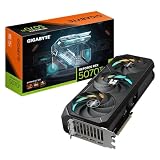
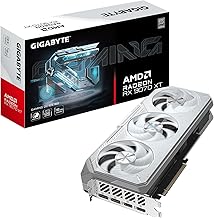
Board partner choice matters here more than usual, because cooler quality separates a quiet card from a noisy one. The ASRock Challenger 16GB OC and PowerColor Reaper are the compact, value-focused options that fit tighter builds. The GIGABYTE Gaming OC 16G and its white Gaming OC ICE sibling use a chunkier 2.7-slot cooler with server-grade thermal gel for lower sustained temperatures. The ASUS Prime OC Edition adds dual BIOS and ball-bearing Axial-tech fans in a slimmer 2.5-slot body, while the XFX Swift triple-fan model splits the difference with three DisplayPort outputs and solid acoustics.
GeForce RTX 5070
The RTX 5070’s appeal is efficiency and software. It runs cooler and quieter at stock than most 9070 XT designs, fits comfortably in small-form-factor builds, and pairs happily with a 650W power supply. DLSS 4’s transformer-based upscaler remains the image-quality benchmark, and Multi Frame Generation can transform a 60fps baseline into something that feels genuinely fluid on a 240Hz panel — provided you accept the added latency and are already above a reasonable native frame rate.
The compromise is the 12GB frame buffer. At 1440p it’s adequate today, but path-traced titles with high-resolution texture packs already brush against it, and 4K with ray tracing enabled can force settings reductions the 16GB Radeon simply doesn’t need. If your workload extends beyond gaming — Premiere Pro, Blender, Stable Diffusion, local LLM inference — NVIDIA’s ecosystem advantage often outweighs that limitation.
Which Should You Buy?
- For 1440p high-refresh gaming: pick the RX 9070 XT for the higher baseline frame rate.
- For entry-level 4K: pick the RX 9070 XT — the 16GB buffer is the deciding factor.
- For streaming and video editing: pick the RTX 5070 for NVENC and CUDA acceleration.
- For small-form-factor or 550–650W builds: pick the RTX 5070, or a compact Reaper/Challenger if you want Radeon.
- For maximum frame smoothness on a 240Hz display: pick the RTX 5070 for DLSS 4 Multi Frame Generation.
Frequently Asked Questions
Is 12GB of VRAM still enough in 2026?
For 1440p at high settings, generally yes. For 4K, path tracing, or heavy texture mods, 12GB is increasingly the bottleneck — which is where the 9070 XT’s 16GB pulls ahead.
How close is FSR 4 to DLSS 4?
Very close on image quality in supported titles. DLSS 4 retains an edge in game coverage and in multi-frame generation, but FSR 4 is no longer a reason to avoid Radeon.
What power supply do I need?
Plan on 750W for the RX 9070 XT and 650W for the RTX 5070, from a quality unit. Overclocked partner cards benefit from extra headroom.
Which board partner RX 9070 XT should I choose?
Prioritise cooler size and case clearance over factory clock speeds. The GIGABYTE Gaming OC models run coolest, the ASUS Prime and XFX Swift balance size and acoustics, and the ASRock Challenger and PowerColor Reaper suit tighter builds.
Final Verdict
If you are building a gaming PC and nothing else, the Radeon RX 9070 XT is the stronger buy in 2026 — faster in most titles, better equipped with VRAM, and available in several excellent partner designs. Choose the GeForce RTX 5070 if efficiency, NVENC, CUDA or DLSS 4 Multi Frame Generation are central to how you actually use your machine.