Key takeaways
- Contrast and black levels: OLED pixels switch off completely for effectively infinite contrast, while even the best IPS panels show some backlight glow and grey-black shadows unless paired with dense mini-LED dimming zones.
- Motion clarity: OLED’s 0.03ms grey-to-grey response virtually eliminates smearing and dark-scene ghosting; quality Fast IPS lands around 1ms, which is excellent but still shows mild trailing on high-contrast transitions.
- Brightness: IPS sustains high full-screen brightness indefinitely, whereas OLED throttles full-field luminance and relies on small-window peaks for HDR highlights.
- Burn-in and longevity: OLED carries a small but real risk of permanent image retention, mitigated by pixel-shifting and panel-refresh routines; IPS has no burn-in mechanism whatsoever.
- Text clarity: IPS uses a standard RGB stripe for crisp text at any size, while OLED subpixel layouts can produce slight colour fringing on thin fonts, particularly at 1440p on 27-inch panels.
- Value: Dollar for dollar, IPS delivers more resolution and refresh rate; OLED commands a premium you’re paying specifically for contrast and response time.
What's inside
Choosing between an OLED and an IPS gaming monitor used to be a straightforward trade-off: eye-searing contrast on one side, everyday practicality on the other. In 2026, that line has blurred considerably. QD-OLED and WOLED panels are now several generations mature, refresh rates have pushed past 480Hz, glare-free coatings have solved much of the reflection problem, and multi-year burn-in coverage ships as standard. IPS hasn’t stood still either — Fast IPS and mini-LED-backlit IPS panels deliver higher sustained brightness, cleaner text rendering, and 4K high-refresh gaming at prices OLED still can’t match.
This decision matters more than almost any other line item on your build list. Panel technology dictates how your games look in a dimly lit room, how sharp motion stays during a flick shot, how legible your spreadsheets are at three in the afternoon, and how long the display will realistically last under daily mixed use. Below we break down exactly where each technology wins in 2026, and which panels genuinely deserve your money.
As an Amazon Associate we earn from qualifying purchases at no extra cost to you. Product prices and availability are accurate as of the date shown and are subject to change.


⚡ Save on Your Next PC — Amazon Prime
Prime members get fast free shipping on the systems above, plus early access to Prime Day & Black Friday PC deals. New members get a 30-day free trial.
Watch: OLED vs IPS Gaming Monitor: 2026 Comparison — Video Review
Quick Verdict
OLED is the right pick if image quality and motion clarity are your top priorities — it delivers true black levels, near-instant 0.03ms pixel response, and the most convincing HDR you can get on a desktop, making it ideal for dark-room single-player gaming, high-level competitive play, and cinematic ultrawide immersion. IPS remains the smarter buy if you game in a bright room, keep static UI elements on screen for eight hours a day, need pin-sharp text for productivity, or simply want the most refresh rate and resolution per dollar without worrying about long-term wear.
Key Differences
- Contrast and black levels: OLED pixels switch off completely for effectively infinite contrast, while even the best IPS panels show some backlight glow and grey-black shadows unless paired with dense mini-LED dimming zones.
- Motion clarity: OLED’s 0.03ms grey-to-grey response virtually eliminates smearing and dark-scene ghosting; quality Fast IPS lands around 1ms, which is excellent but still shows mild trailing on high-contrast transitions.
- Brightness: IPS sustains high full-screen brightness indefinitely, whereas OLED throttles full-field luminance and relies on small-window peaks for HDR highlights.
- Burn-in and longevity: OLED carries a small but real risk of permanent image retention, mitigated by pixel-shifting and panel-refresh routines; IPS has no burn-in mechanism whatsoever.
- Text clarity: IPS uses a standard RGB stripe for crisp text at any size, while OLED subpixel layouts can produce slight colour fringing on thin fonts, particularly at 1440p on 27-inch panels.
- Value: Dollar for dollar, IPS delivers more resolution and refresh rate; OLED commands a premium you’re paying specifically for contrast and response time.
OLED Gaming Monitors: Perfect Blacks and Instant Pixels
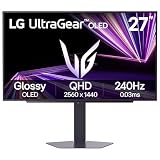
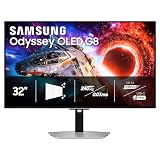
The headline advantage is self-emissive pixels. Nothing else on the market renders a starfield, a night-time street or a dark corridor with the same authority. For competitive players, the LG UltraGear 27GX790A-B pushes QHD to 480Hz with DisplayPort 2.1, delivering motion clarity that Fast IPS physically cannot replicate. If 240Hz is sufficient, the LG UltraGear 27GS93QE and the Samsung Odyssey OLED G6 (G61SH) cover the same 1440p sweet spot, with the Samsung’s glare-free coating being a genuine advantage in rooms with windows or overhead lighting.
Larger formats are where OLED really justifies the premium. The LG UltraGear 34GX900A-B pairs a 3440×1440 curved panel with 240Hz, HDMI 2.1 and 65W USB-C power delivery, making it a legitimate single-cable workstation as well as a gaming display. The LG UltraGear 32GX850A-B adds dual-mode flexibility, switching between 4K at 165Hz and 1080p at 330Hz depending on whether you’re playing a cinematic RPG or a shooter. For maximum immersion, the Samsung 49″ Odyssey G93SC covers your entire field of view in DQHD — unmatched for sim racing and flight sims, though it demands serious desk depth and GPU headroom.
IPS Gaming Monitors: Brightness, Durability and Value
IPS earns its place through consistency. Sustained full-screen brightness stays high, so bright HDR scenes and daylight gaming don’t dim the way they can on OLED. Colour accuracy off-axis is excellent, viewing angles are wide, and the RGB stripe subpixel structure means text is razor-sharp for coding, writing and browsing. Crucially, there’s zero risk of taskbars, HUD elements or streaming overlays etching themselves into the panel over years of use.
The compromises are real but manageable. Blacks appear grey in dark rooms, contrast typically sits between 1000:1 and 1500:1 without local dimming, and HDR is more a checkbox than an experience unless you’re buying a mini-LED model with hundreds of dimming zones. Response times are strong on modern Fast IPS panels but not instantaneous. In exchange, you generally get more pixels and more hertz for your budget — and a monitor you can leave running all day without a second thought.
Which Should You Buy?
- For competitive FPS: pick OLED — the LG 27GX790A-B at 480Hz offers the fastest, cleanest motion available at 1440p.
- For single-player and HDR gaming: pick OLED — the LG 32GX850A-B or 34GX900A-B deliver TrueBlack 400 contrast that IPS can’t approach.
- For sim racing and immersion: pick OLED — the Samsung 49″ Odyssey G93SC wraps DQHD around your entire viewport.
- For bright rooms and all-day productivity: pick IPS — sustained brightness, sharp text and no burn-in anxiety.