Key takeaways
- Immersion: Curved panels bend the edges toward your eyes so the whole image sits at a similar viewing distance. Flat panels feel more like a window than a wraparound cockpit.
- Panel type: Most affordable curved gaming monitors use VA panels with deep 3000:1–4000:1 contrast. Flat models more often use IPS, trading black depth for wider viewing angles and color consistency.
- Geometry accuracy: Flat screens render perfectly straight lines, which matters for photo editing, CAD, spreadsheets, and pixel-precise UI work. Curves introduce mild distortion at the edges.
- Ideal size: Curvature pays off from 27 inches upward, and is close to essential on 32-inch and ultrawide panels. Below 24 inches, the benefit is marginal.
- Seating distance: A 1500R curve is designed for roughly 1.5m viewing or closer; 1800R is gentler and more forgiving. Flat panels work at any distance.
- Multi-monitor setups: Flat displays sit flush side by side. Curved panels can be arrayed, but bezels and angles rarely line up cleanly.
What's inside
Curved and flat gaming monitors have never been closer in price or performance than they are in 2026. A few years ago, choosing a curve meant paying a premium for a panel with mediocre response times; today you can find 240Hz VA panels with 1ms MPRT ratings at mainstream prices, while flat IPS panels have pushed color accuracy and viewing angles further than ever. The result is a genuine decision rather than a default.
The right answer depends less on which technology is “better” and more on how you sit, what you play, and how much desk space you have. Curved panels wrap the image toward your eyes for immersion; flat panels keep geometry perfectly straight for precision and predictability. Below we break down the practical differences, then match specific monitors to specific players.
As an Amazon Associate we earn from qualifying purchases at no extra cost to you. Product prices and availability are accurate as of the date shown and are subject to change.


⚡ Save on Your Next PC — Amazon Prime
Prime members get fast free shipping on the systems above, plus early access to Prime Day & Black Friday PC deals. New members get a 30-day free trial.
Watch: Curved vs Flat Gaming Monitor: 2026 Guide — Video Review
Quick Verdict
Buy a curved monitor if you sit close to a large screen, play single-player, racing, or simulation titles, and want maximum immersion for the money — the SANSUI 32-Inch Curved 240Hz and Sceptre 34-Inch Curved Ultrawide are strong examples. Buy a flat monitor if you play competitive shooters at 24–27 inches, do design or CAD work where straight lines must stay straight, or plan to run a multi-monitor array.
Key Differences
- Immersion: Curved panels bend the edges toward your eyes so the whole image sits at a similar viewing distance. Flat panels feel more like a window than a wraparound cockpit.
- Panel type: Most affordable curved gaming monitors use VA panels with deep 3000:1–4000:1 contrast. Flat models more often use IPS, trading black depth for wider viewing angles and color consistency.
- Geometry accuracy: Flat screens render perfectly straight lines, which matters for photo editing, CAD, spreadsheets, and pixel-precise UI work. Curves introduce mild distortion at the edges.
- Ideal size: Curvature pays off from 27 inches upward, and is close to essential on 32-inch and ultrawide panels. Below 24 inches, the benefit is marginal.
- Seating distance: A 1500R curve is designed for roughly 1.5m viewing or closer; 1800R is gentler and more forgiving. Flat panels work at any distance.
- Multi-monitor setups: Flat displays sit flush side by side. Curved panels can be arrayed, but bezels and angles rarely line up cleanly.
The Case for a Curved Gaming Monitor
Curvature earns its keep on big screens. On a 32-inch 1080p panel like the SANSUI 32-Inch Curved 240Hz, the 1500R curve pulls the far edges into your peripheral vision instead of leaving them off to the side — you notice movement sooner and your eyes refocus less. Combine that with the deep contrast VA panels deliver, and dark scenes in horror, RPG, and space sims look substantially better than on a comparable budget IPS display. The 32-Inch 240Hz Curved VA model with its gentler 1800R curvature is a smart middle ground if you sit farther back or want less edge distortion.
Ultrawides are where the argument becomes almost one-sided. The Sceptre 34-Inch Curved Ultrawide at 3440 × 1440 and up to 180Hz would be genuinely uncomfortable as a flat panel; the R1500 curve keeps the extremities within a natural field of view. Smaller curved options exist too — the Pixio PXC248 Wave White at 24 inches and 200Hz, and the SANSUI 27 Inch Curved 240Hz with 4000:1 contrast and FreeSync — though at these sizes the curve is more a matter of taste than necessity.
The Case for a Flat Gaming Monitor
Flat panels remain the default for competitive play, and for good reason. At 24 to 27 inches, a well-tuned flat display already fits inside your field of view, so a curve adds little. What you gain instead is total geometric consistency: crosshair placement, recoil patterns, and minimap edges behave exactly as your muscle memory expects, and nothing shifts if you lean out of the sweet spot mid-match.
Flat is also the pragmatic choice if your monitor works for a living. Video timelines, architectural drawings, spreadsheets, and photo work all benefit from lines that are actually straight, and IPS flat panels typically hold color better across the full width of the screen. If you intend to run two or three displays, flat is effectively mandatory — curved panels create awkward gaps and inconsistent viewing angles when butted together.
Which Should You Buy?
- For competitive FPS at 24–27in: pick flat, or a subtle option like the Pixio PXC248 Wave if you want 200Hz in a compact frame.
- For immersive single-player and racing: pick curved — the Sceptre 34-Inch Curved Ultrawide is the strongest immersion-per-dollar choice here.
- For a big-screen console or couch-ish setup: pick curved with a gentler radius, such as the 32-Inch 1800R Curved VA panel.
- For creative or office work alongside gaming: pick flat for accurate geometry and consistent color.
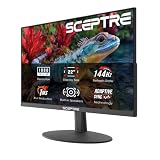
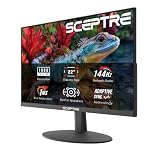
- For a high-refresh budget build: pick either — the SANSUI 27 Inch Curved 240Hz and Sceptre 27-inch Prime at 180Hz both deliver serious speed affordably.
Frequently Asked Questions
Do curved monitors hurt competitive performance?
No. Curvature does not affect input lag, refresh rate, or response time. Any disadvantage is purely about familiarity — if your aim was trained on flat panels, expect a short adjustment period rather than a permanent handicap.
What does 1500R or 1800R actually mean?
It is the radius of the circle the curve is based on, in millimetres. A 1500R panel is designed for viewing at 1.5m or closer and curves more aggressively; 1800R is flatter and better suited to greater seating distances.
Is a curved monitor worth it at 24 inches?
Only mildly. At 24 inches the entire screen already sits within your field of view, so models like the Pixio PXC248 Wave should be chosen for their 200Hz refresh rate and 1ms response, with the curve as a bonus rather than the reason to buy.
Can I wall-mount or use a curved monitor with an arm?
Yes. Most curved gaming monitors, including the SANSUI 32-inch and Sceptre ultrawide models, are VESA compatible and work with standard arms and wall mounts.
Final Verdict
Choose curved when the screen is large, the games are immersive, and the monitor is primarily for play — the payoff grows with every inch beyond 27. Choose flat when precision, color accuracy, or multi-monitor flexibility matter more than atmosphere. In 2026 both categories offer 180Hz–240Hz panels with 1ms response times at reasonable prices, so buy for the shape that fits your desk and your genre, not for the spec sheet alone.