Key takeaways
- Footprint: A full-size board typically runs 44–46 cm wide; a TKL trims that to roughly 35–37 cm, freeing about 8–10 cm of mousing room without changing key spacing.
- Number pad: Full-size keeps the dedicated numeric cluster for spreadsheets, accounting, CAD entry, and sim rigs. TKL removes it entirely, usually retaining the arrow keys and nav cluster.
- Mouse ergonomics: Removing the numpad lets you centre your keyboard on your torso and keep your mousing arm closer to your body, which reduces shoulder abduction over long sessions.
- Extra controls: Full-size layouts more often include dedicated macro columns and volume rollers, though premium TKLs like the Huntsman V3 Pro TKL still fit media keys and a control dial.
- Portability: TKL boards fit most 15-inch laptop bags. The Logitech G PRO TKL leans into this with a detachable cable designed for transport.
- Price per feature: At equal build quality, full-size boards usually cost slightly more; but at the enthusiast tier, TKLs command a premium because that is where the newest switch tech appears.
What's inside
On paper, the only difference between a full-size keyboard and a tenkeyless (TKL) one is a block of 17 keys. In practice, that number pad decides how much desk you have left for your mouse, how your shoulder sits during a six-hour session, and whether your keyboard travels well. It is the single most consequential spec on a gaming keyboard that has nothing to do with switches, polling rate, or RGB — and it is the one most buyers pick by habit rather than by need.
The choice matters more in 2026 than it did five years ago. Competitive shooters have pushed players toward lower mouse sensitivities and wider sweeps, which makes horizontal desk space a genuine performance variable. At the same time, manufacturers now debut their headline technologies — analog optical switches, adjustable actuation, rapid trigger, SOCD handling — on TKL chassis first, because that is what esports players buy. Meanwhile full-size boards have quietly become the value pick, often bundling more keys and more media controls for less money. Neither layout is objectively better; they simply optimise for different desks and different workloads.
As an Amazon Associate we earn from qualifying purchases at no extra cost to you. Product prices and availability are accurate as of the date shown and are subject to change.


⚡ Save on Your Next PC — Amazon Prime
Prime members get fast free shipping on the systems above, plus early access to Prime Day & Black Friday PC deals. New members get a 30-day free trial.
Watch: Full-Size vs TKL Keyboard: 2026 Comparison — Video Review
Quick Verdict
Choose a full-size keyboard if you regularly enter numbers, play sims, MMOs, or strategy titles that reward extra bindable keys, and you have at least 60 cm of usable desk width to spare. Choose a TKL if you play shooters at low or mid sensitivity, share a desk with other gear, travel to LANs, or simply want the most current switch technology — which in 2026 lands on tenkeyless boards like the Razer Huntsman V3 Pro TKL and Corsair K70 CORE TKL before anything else.
Key Differences
- Footprint: A full-size board typically runs 44–46 cm wide; a TKL trims that to roughly 35–37 cm, freeing about 8–10 cm of mousing room without changing key spacing.
- Number pad: Full-size keeps the dedicated numeric cluster for spreadsheets, accounting, CAD entry, and sim rigs. TKL removes it entirely, usually retaining the arrow keys and nav cluster.
- Mouse ergonomics: Removing the numpad lets you centre your keyboard on your torso and keep your mousing arm closer to your body, which reduces shoulder abduction over long sessions.
- Extra controls: Full-size layouts more often include dedicated macro columns and volume rollers, though premium TKLs like the Huntsman V3 Pro TKL still fit media keys and a control dial.
- Portability: TKL boards fit most 15-inch laptop bags. The Logitech G PRO TKL leans into this with a detachable cable designed for transport.
- Price per feature: At equal build quality, full-size boards usually cost slightly more; but at the enthusiast tier, TKLs command a premium because that is where the newest switch tech appears.
Full-Size Keyboards: The Complete Layout
A full-size board is the default for a reason. Everything is where muscle memory expects it: function row, nav cluster, arrows, and numpad. If your PC does double duty as a work machine, that numpad is not a luxury — entering figures on the top-row numbers is measurably slower and more error-prone than using a dedicated ten-key. Flight and space sims, city builders, and MMOs also benefit, because the numpad supplies 17 easy-to-reach binds for camera presets, thruster controls, or ability bars without resorting to layered shortcuts.
The trade-off is width. On a 100 cm desk with a monitor stand and a headset, a full-size board can push your mouse toward the edge and force a bent, outward-angled wrist. Players who use 800 DPI and low in-game sensitivity will hit the keyboard mid-flick. If your desk is deep enough that you can angle the board and still sweep freely, none of that applies — and you keep the extra keys for free. Note that most popular TKLs have full-size siblings, so you rarely have to trade brand or switch feel for layout.
TKL Keyboards: Compact and Competition-Ready
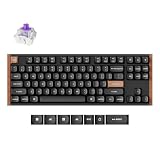
Tenkeyless has become the default competitive form factor. The Razer Huntsman V3 Pro TKL is the clearest example of why: analog optical switches, adjustable actuation, rapid trigger, Snap Tap, doubleshot PBT keycaps, and a wrist rest, all in a chassis that leaves room for full arm sweeps. The Corsair K70 CORE TKL takes a more traditional route with pre-lubed MLX Red v2 linear switches, SOCD handling, and internal sound dampening for a deeper, quieter typing profile. Both deliver flagship features without flagship width.
TKL also scales down gracefully. The Logitech G413 TKL SE offers tactile mechanical switches, anti-ghosting, and cross-platform Windows and macOS support in a no-nonsense package. The SteelSeries Apex 3 TKL adds IP32 water and dust resistance with whisper-quiet switches, while the Corsair K55 CORE TKL pairs quiet spill-resistant membrane keys with 8-zone RGB, media keys, and a 1000 Hz polling rate. For LAN players, the Logitech G PRO TKL remains the benchmark: clicky switches, Lightsync lighting, and a detachable cable built for repeated packing.
Which Should You Buy?
- For competitive FPS: Pick a TKL. The Razer Huntsman V3 Pro TKL is the strongest option if adjustable actuation and rapid trigger matter to you.
- For work and gaming on one PC: Pick full-size, unless you are willing to keep a separate numpad on hand.
- For a tight budget or shared living space: Pick the Corsair K55 CORE TKL or SteelSeries Apex 3 TKL — both are quiet and forgiving of spills.
- For LAN events and travel: Pick the Logitech G PRO TKL for its detachable cable and compact case-friendly shape.
- For the best typing feel per dollar: Pick the Corsair K70 CORE TKL, or the Logitech G413 TKL SE if you prefer tactile switches.
Frequently Asked Questions
Do professional players use TKL or full-size?
The overwhelming majority of professional shooter players use TKL or smaller. It is not superstition: low sensitivities require wide sweeps, and tournament setups have limited table space. Outside FPS, full-size remains common.
Can I get the number pad back on a TKL?
Yes. A standalone USB or wireless numpad costs very little and can sit on either side of your keyboard, which some users actually prefer for ergonomics. It is the standard workaround for spreadsheet-heavy workflows.
Will a TKL actually improve my aim?
Indirectly. The layout does not make you more accurate, but the extra mousing room lets you use a lower sensitivity comfortably, and lower sensitivity generally improves micro-adjustment consistency once you adapt.
Is a TKL uncomfortable for typing?
No. TKL boards use full-size key spacing and retain the function row, arrows, and navigation cluster, so touch typists notice almost nothing missing. Only heavy numeric entry feels genuinely slower.
Final Verdict
If your PC is a hybrid work-and-play machine and desk space is not tight, a full-size layout costs you nothing and gives you 17 extra keys. For everyone else — and especially for shooter players in 2026 — TKL is the better default: it frees the space that actually affects your aim, and it is where manufacturers are putting their best switches. Start with the Razer Huntsman V3 Pro TKL if you want the ceiling, the Corsair K70 CORE TKL for the best balance of feel and value, and the SteelSeries Apex 3 TKL or Corsair K55 CORE TKL if quiet operation and budget come first.