Key takeaways
- Use the monitor’s maximum refresh rate in Windows and in the game.
- Enable adaptive sync when frame rates do not stay consistently above the refresh rate.
- Use a frame-rate limit around 2–3 frames per second below the maximum refresh rate for smoother adaptive-sync behavior.
- Keep sharpening, motion interpolation, dynamic contrast, and artificial black equalizer settings modest.
- For OLED, use a calibrated SDR mode for desktop work and enable HDR only when the game supports it properly.
What's inside
For FPS gaming in 2026, OLED is the better choice for motion clarity, response time, HDR impact, and black levels, while IPS remains the safer value for long competitive sessions, bright rooms, and buyers concerned about burn-in. A modern 240Hz OLED can deliver roughly 0.03–0.1 ms pixel response and near-instant transitions, compared with about 1–4 ms for a fast IPS gaming monitor. However, IPS can cost less, reach higher sustained brightness in some models, and avoid OLED image-retention concerns. The right choice depends on whether you prioritize clean dark-scene visibility and premium motion performance or maximum practicality and value.
OLED vs IPS response time and motion clarity
OLED’s biggest gaming advantage is pixel response. Each pixel emits its own light and can switch states extremely quickly, so an OLED monitor usually produces far less ghosting than an IPS panel at the same refresh rate. This is especially noticeable when tracking enemies, turning quickly, or aiming across a detailed background.
Fast IPS monitors have improved substantially. A good 240Hz IPS display can provide excellent motion clarity, particularly when its overdrive is correctly tuned. Nevertheless, IPS response times vary more between transitions. A setting that reduces dark-to-light smearing can introduce inverse ghosting on other transitions, while OLED generally maintains a more consistent response across the refresh range.
Refresh rate still matters
Response time does not replace refresh rate. A 240Hz display refreshes every 4.17 milliseconds, while a 360Hz display refreshes every 2.78 milliseconds. OLED makes the individual frames cleaner, but your graphics card and game must produce high frame rates to benefit fully. For competitive Counter-Strike 2, Valorant, Overwatch 2, or Rainbow Six Siege, a 240Hz or 360Hz monitor is more meaningful than buying OLED without enough GPU performance.
| Monitor class | Typical resolution and refresh | Pixel response target | HDR capability | Typical 2026 price range |
|---|---|---|---|---|
| Fast IPS esports | 27-inch, 1440p, 240Hz | About 1–4 ms practical | Usually DisplayHDR 400 or limited HDR | $300–$500 |
| Fast IPS high refresh | 24.5-inch, 1080p, 360Hz | About 1–3 ms practical | Usually basic HDR or SDR-focused | $250–$450 |
| QD-OLED esports | 27-inch, 1440p, 240Hz | About 0.03–0.1 ms | Strong HDR contrast, often DisplayHDR True Black 400 | $600–$900 |
| WOLED ultrawide | 34-inch, 3440×1440, 240Hz | About 0.03–0.1 ms | Strong HDR, usually True Black class | $700–$1,100 |
| 4K OLED gaming | 32-inch, 3840×2160, 240Hz | About 0.03–0.1 ms | High-impact HDR with per-pixel dimming | $900–$1,400 |
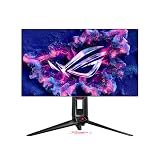
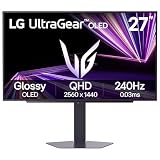
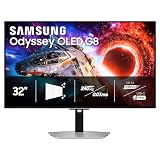
Examples include the 27-inch 1440p 240Hz MSI MPG 271QRX QD-OLED and Alienware AW2725DF, as well as 32-inch 4K 240Hz OLED models such as the LG 32GS95UE and ASUS ROG Swift OLED PG32UCDM. Fast IPS alternatives include 1440p 240Hz models and 1080p 360Hz esports monitors. Always check measured performance rather than relying only on a manufacturer’s “0.03 ms” or “1 ms” headline.
HDR and black levels in FPS games
OLED wins decisively on black levels. Because an OLED pixel can switch off completely, a black corner in a dark map can approach true black instead of appearing gray. There is no traditional backlight bleeding, and contrast remains strong even when a bright muzzle flash appears beside a dark wall.
IPS panels use a backlight, so their native contrast is commonly around 1,000:1 to 1,500:1. Black areas can look charcoal gray, especially in a dark room. IPS monitors with full-array local dimming can improve HDR substantially, but they are less common, more expensive, and may show blooming around bright objects. Basic HDR400 IPS displays often provide limited improvement over a well-calibrated SDR mode.
Does HDR help competitive FPS gaming?
HDR is most valuable in single-player games and visually rich shooters, where explosions, sunlight, neon lighting, and night scenes benefit from greater contrast. In competitive games, HDR can make the image more immersive, but it does not automatically improve aim. Incorrect HDR settings can crush shadow detail or make highlights distractingly bright.
OLED HDR also has a limitation: large bright scenes may trigger automatic brightness limiting, commonly called ABL. A small highlight can look extremely bright, but a full white screen will usually be dimmer than a powerful IPS backlight. For a dark competitive map, OLED’s contrast is still more noticeable than peak brightness alone.
Input latency, adaptive sync, and competitive value
Input latency includes signal processing, refresh timing, pixel response, and the time between a frame being rendered and displayed. OLED does not inherently guarantee lower total latency, but premium OLED gaming monitors typically combine fast processing with high refresh rates and very quick pixels. A well-designed 240Hz OLED can feel exceptionally immediate.
Fast IPS can be just as competitive when configured correctly. Disable unnecessary image processing, use the monitor’s low-latency or game mode, and select the moderate overdrive setting rather than automatically choosing the strongest option. Adaptive sync, including AMD FreeSync or NVIDIA G-SYNC compatibility, helps prevent tearing when frame rates fluctuate.
Recommended settings for FPS
- Use the monitor’s maximum refresh rate in Windows and in the game.
- Enable adaptive sync when frame rates do not stay consistently above the refresh rate.
- Use a frame-rate limit around 2–3 frames per second below the maximum refresh rate for smoother adaptive-sync behavior.
- Keep sharpening, motion interpolation, dynamic contrast, and artificial black equalizer settings modest.
- For OLED, use a calibrated SDR mode for desktop work and enable HDR only when the game supports it properly.
At 240Hz, a frame cap near 237 frames per second is a common starting point. At 360Hz, try approximately 357 frames per second. These are practical settings, not universal rules; your game engine, GPU, and adaptive-sync implementation may require adjustment.
Burn-in risk, brightness, and everyday use
OLED’s main disadvantage is potential permanent image retention. Static elements such as a game HUD, health bar, minimap, taskbar, or browser toolbar can wear pixels unevenly over long periods. Modern OLED monitors reduce the risk with pixel shifting, logo detection, screen savers, panel refresh cycles, and multi-year panel warranties on some products, but no prevention system makes the risk zero.
For mixed gaming and normal desktop use, practical habits help. Set the screen to turn off after a few minutes, hide the taskbar, vary content, avoid leaving a paused game open for hours, and allow the monitor to complete its automatic pixel-refresh routine. OLED is a reasonable choice for many users, but someone who displays the same productivity software for eight hours every day may prefer IPS.
IPS is usually brighter for large white windows and has no OLED burn-in concern. It is therefore better suited to bright offices, static dashboards, spreadsheets, and users who want to keep one display for many years with minimal maintenance. IPS can still suffer temporary image retention in unusual cases, but permanent burn-in is not the central ownership concern it is with OLED.
Which panel should FPS players buy?
Choose OLED when
Choose OLED if you play in a dim or controlled room, value extremely clean motion, want genuine dark blacks, and also enjoy cinematic games. A 27-inch 1440p 240Hz QD-OLED is a strong balance for competitive FPS gaming, while a 32-inch 4K 240Hz OLED is better for high-end visual quality if your graphics card can drive it. Expect to pay more and accept sensible burn-in precautions.
Choose IPS when
Choose IPS if you play in a bright room, need sustained desktop brightness, want the lowest purchase cost, or leave static content on-screen for long periods. A 24.5-inch 1080p 360Hz IPS monitor can be a highly effective esports tool, and a 27-inch 1440p 240Hz IPS model offers sharper image quality without OLED’s ownership trade-offs.
FAQ
Is OLED faster than IPS for FPS gaming?
Yes, usually. OLED pixels switch much faster and show less ghosting, so a 240Hz OLED normally looks cleaner during rapid movement than a similarly specified IPS monitor. Total input latency can still be comparable between well-designed models, so refresh rate, processing quality, and your frame rate remain important.
Can OLED black levels improve competitive visibility?
OLED produces much deeper blacks and stronger contrast, which makes dark scenes more convincing and can reveal detail without gray backlight glow. However, visibility depends on the game’s gamma, HDR implementation, and color settings. Do not assume maximum black equalizer or excessive brightness will improve enemy detection; test moderate settings and avoid crushing shadow detail.
Bottom line
OLED is the superior premium FPS monitor technology in 2026 when motion clarity, HDR, and black levels are the priority. Its near-instant response and per-pixel lighting make fast movement and dark scenes look cleaner than on most IPS displays. IPS remains the better practical purchase for bright rooms, static desktop workloads, lower budgets, and players who want zero burn-in anxiety. For most serious competitive players, a 1440p 240Hz OLED is the sweet spot; for pure esports value, a fast 240Hz or 360Hz IPS monitor still delivers excellent performance for considerably less money.