Key takeaways
- Frame timing: 144Hz delivers a new frame every 6.9ms; 240Hz every 4.2ms. The 2.7ms gap is real but far smaller than the 9.8ms jump from 60Hz to 144Hz — this is the diminishing-returns zone.
- Motion clarity: On sample-and-hold LCDs, higher refresh directly reduces perceived blur. Text and enemy outlines stay legible during fast horizontal pans at 240Hz in a way they don’t at 144Hz.
- GPU demand: Saturating 240Hz at 1080p requires 240fps sustained. That’s achievable in CS2, Valorant or Rocket League on modest hardware, but unrealistic in modern AAA titles without heavy setting cuts or upscaling.
- Panel compromises: At the same price, a 144Hz monitor typically buys you higher resolution or a larger panel; a 240Hz monitor at that price is almost always 1080p. Both categories now use IPS or fast VA rather than the TN panels of the past.
- Connectivity: 240Hz at 1080p needs DisplayPort 1.4 or HDMI 2.0. Older HDMI 1.4 cables and ports cap out well below that — a common cause of monitors quietly running at 60Hz out of the box.
- Adaptive sync range: Both tiers support FreeSync Premium, but a wider refresh window on 240Hz panels means smoother behaviour when framerates dip mid-match.
What's inside
For the better part of a decade, 144Hz was the line that separated a “gaming monitor” from an ordinary display. In 2026 that line has moved. Panel supply has matured to the point where 240Hz 1080p screens now sell for what 144Hz models cost two years ago, and the entry-level shelf is crowded with fast IPS panels from Dell, GIGABYTE, Sceptre, SANSUI and newcomers like ArcticPro. The question is no longer whether 240Hz is affordable — it is whether the extra refresh rate does anything useful for the way you actually play.
The honest answer depends on three things: the games you spend the most hours in, the graphics card driving them, and what you would otherwise spend that money on. A 240Hz panel you can only feed 90fps is a worse buy than a 144Hz panel running at its ceiling. Below we break down where each refresh rate genuinely earns its keep, and which current models are worth shortlisting.
As an Amazon Associate we earn from qualifying purchases at no extra cost to you. Product prices and availability are accurate as of the date shown and are subject to change.




⚡ Save on Your Next PC — Amazon Prime
Prime members get fast free shipping on the systems above, plus early access to Prime Day & Black Friday PC deals. New members get a 30-day free trial.
Watch: 144Hz vs 240Hz Monitor: Worth It in 2026? — Video Review
Quick Verdict
Choose 144Hz if you play a broad mix of single-player and multiplayer titles, run a mid-range GPU, or would rather put the savings toward resolution, panel size or a better GPU — it captures roughly 80% of the benefit of high-refresh gaming for a fraction of the system cost. Choose 240Hz if competitive shooters, fighting games or arena titles dominate your playtime, you already have a GPU that pushes well past 150fps at 1080p, and you want the sharpest possible motion clarity during fast flicks and tracking.
Key Differences
- Frame timing: 144Hz delivers a new frame every 6.9ms; 240Hz every 4.2ms. The 2.7ms gap is real but far smaller than the 9.8ms jump from 60Hz to 144Hz — this is the diminishing-returns zone.
- Motion clarity: On sample-and-hold LCDs, higher refresh directly reduces perceived blur. Text and enemy outlines stay legible during fast horizontal pans at 240Hz in a way they don’t at 144Hz.
- GPU demand: Saturating 240Hz at 1080p requires 240fps sustained. That’s achievable in CS2, Valorant or Rocket League on modest hardware, but unrealistic in modern AAA titles without heavy setting cuts or upscaling.
- Panel compromises: At the same price, a 144Hz monitor typically buys you higher resolution or a larger panel; a 240Hz monitor at that price is almost always 1080p. Both categories now use IPS or fast VA rather than the TN panels of the past.
- Connectivity: 240Hz at 1080p needs DisplayPort 1.4 or HDMI 2.0. Older HDMI 1.4 cables and ports cap out well below that — a common cause of monitors quietly running at 60Hz out of the box.
- Adaptive sync range: Both tiers support FreeSync Premium, but a wider refresh window on 240Hz panels means smoother behaviour when framerates dip mid-match.
144Hz Monitors: The Balanced Default
144Hz remains the most sensible target for the majority of players. It eliminates virtually all of the stutter and blur that makes 60Hz feel sluggish, and it is comfortably reachable in most games without gutting visual settings. If you split your time between competitive matches and story-driven games, a 144Hz screen lets you run higher resolutions — 1440p in particular — where the image quality gain is immediately visible on every frame, not just during fast motion.
There’s also a system-cost argument. Feeding 144fps at 1440p is roughly comparable to feeding 240fps at 1080p, but the former looks substantially better in slower games. For anyone building around a mid-tier GPU, 144Hz is where the money stops fighting itself. The main caveat: in 2026, aggressive 240Hz pricing means the savings gap has narrowed considerably at 1080p, so 144Hz makes the most sense when you’re stepping up in resolution or size rather than staying at Full HD.
240Hz Monitors: The Competitive Edge
If your main titles are esports staples, 240Hz is now easy to justify. The GIGABYTE GS25F2A is the enthusiast pick of this group — a 24.5-inch SuperSpeed IPS panel with 1ms GtG response and FreeSync Premium, sized to the 24–25-inch sweet spot most competitive players prefer because the entire playfield sits inside your focal cone. Dell’s SE2426HG covers similar ground at 23.8 inches with dual HDMI plus DisplayPort 1.4 and TÜV 3-Star eye comfort certification, while the SE2726HG offers the same specification stretched to 27 inches for players who sit further back.
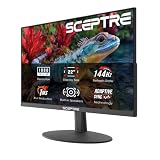
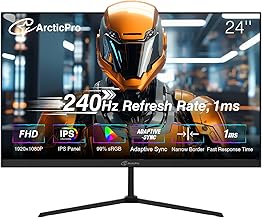
For immersion over pure precision, the curved options are worth a look. The Sceptre C255B-FWT240 pairs a 24.5-inch R1500 curve with 1ms response, two DisplayPort and two HDMI inputs and built-in speakers, and the SANSUI 27-inch curved 240Hz adds 130% sRGB coverage, 4000:1 contrast and HDR support on a metal stand. The ArcticPro 24-inch rounds out the budget end with an IPS panel, three-sided frameless design, 120% sRGB and adaptive sync. All six are 1080p, which is the right resolution at this refresh rate — it keeps GPU demand realistic.
Which Should You Buy?
- For competitive FPS players: pick 240Hz, and prioritise a 24–25-inch panel like the GIGABYTE GS25F2A or Dell SE2426HG over a larger screen.
- For mixed gaming libraries: pick 144Hz at 1440p — the resolution upgrade pays off in every game, not just fast ones.
- For mid-range GPUs: pick 144Hz unless you play exclusively lightweight esports titles that already exceed 200fps.
- For immersion on a budget: pick a curved 240Hz panel such as the Sceptre C255B-FWT240 or SANSUI 27-inch, which deliver both speed and presence at 1080p.
- For a first upgrade from 60Hz: either works — the jump is dramatic. Buy 240Hz if the price gap is small, since it leaves headroom for a future GPU.
Frequently Asked Questions
Can you actually see the difference between 144Hz and 240Hz?
Yes, but it’s subtler than most upgrade paths. Side by side, 240Hz shows visibly cleaner motion during fast camera movement. In blind testing, trained competitive players consistently identify it; casual players often can’t. It’s a refinement, not a revelation.
What GPU do I need to make use of 240Hz?
For CS2, Valorant, Overwatch or Rocket League at 1080p, most current mid-range cards will clear 240fps at competitive settings. For AAA titles, expect 100–160fps even on high-end hardware — you’ll still benefit from adaptive sync, but you won’t saturate the panel.
Is 240Hz worth it on a 27-inch 1080p monitor?
It depends on viewing distance. At 27 inches, 1080p works out to about 82 PPI, so pixel structure is noticeable up close. Models like the Dell SE2726HG or SANSUI 27-inch are a good fit if you sit at arm’s length or further; otherwise a 24–25-inch panel will look sharper.
Does a higher refresh rate reduce input lag?
Indirectly, yes. A shorter frame interval means less time between your input and the next displayed frame — roughly 2.7ms saved on average going from 144Hz to 240Hz. That’s genuine but modest; response time and total system latency usually matter more.
Final Verdict
In 2026 the 144Hz-versus-240Hz decision comes down to resolution strategy rather than refresh rate al